STO for startups: complete launch process and timeline
Startups looking to raise capital through a security token offering face a complex project management challenge that extends far beyond writing code. An STO for startups requires orchestrating legal compliance, financial structuring, smart contract development, and investor marketing into a cohesive timeline. Many founders mistakenly treat a security token offering as a purely technical exercise, focusing on blockchain selection while underestimating the rigorous securities laws that govern the transaction. This guide breaks down the complete STO launch process into six sequential phases, detailing the critical dependencies and timelines required to bring tokenized equity to market. By treating the launch as a structured fundraising event rather than a software deployment, founders can avoid the regulatory delays and platform bottlenecks that frequently derail poorly planned offerings. We will examine the exact steps from initial entity structuring through post-launch cap table management, providing a realistic framework for executing a compliant digital asset raise. Reading our complete guide to tokenizing your startup will provide additional foundational context before diving into these specific operational phases.
Pre-launch preparation and infrastructure selection
Preparing an STO requires three to six months of legal and technical groundwork before any tokens are minted. Founders must select a regulatory exemption, engage experienced securities counsel, prepare financial projections, and choose a tokenization platform that supports the required compliance standards and blockchain infrastructure.
The pre-launch preparation phase establishes the legal and financial foundation for the entire capital raise. Founders must first evaluate their existing corporate entity structure to determine if it can support tokenized securities or if a specialized special purpose vehicle is required. Engaging securities counsel with specific experience in digital assets is the immediate next step, as legal advice will dictate which regulatory exemption fits the company’s fundraising goals and target investor base. You cannot begin drafting offering documents until you finalize the exemption, and you cannot select a tokenization platform until you know exactly what compliance parameters that platform must enforce. During this three to six-month window, the management team must also prepare a comprehensive business plan and detailed financial projections to meet the tokenization legal requirements for US startups. For founders pursuing a Regulation A+ offering, this phase requires securing audited financial statements, which often adds two to three months to the timeline depending on the complexity of the company’s operating history.
Selecting the platform and technical infrastructure runs parallel to the legal preparation but requires its own rigorous evaluation period of one to two months. The tokenization platform you choose will largely dictate your blockchain options, as most institutional-grade providers support specific networks like Ethereum, Polygon, or Avalanche. Founders must evaluate platforms based on their ability to enforce compliance rules on-chain using established token standards. The ERC-3643 standard has emerged as the primary framework for institutional-grade compliance because it utilizes verifiable credentials to ensure only authorized investors can hold or transfer the security tokens. Alternatively, the ERC-1400 standard provides another robust framework for managing security tokens with built-in transfer restrictions. This phase also requires selecting integrated providers for KYC/AML verification and engaging an SEC-registered transfer agent to maintain the authoritative record of token ownership. Most founders severely underestimate the time required for platform evaluation, failing to realize that comparing technical vendors requires a firm understanding of their own legal requirements and distribution strategy before beginning the step-by-step equity tokenization process.
Offering documents and smart contract development
Drafting offering documents and developing smart contracts takes one to three months and requires constant coordination between legal counsel and technical teams. The specific regulatory exemption dictates the required documentation, while the smart contracts must accurately translate those legal transfer restrictions into automated on-chain rules.
The preparation of offering documents is an iterative process that translates the company’s business model and risk factors into a legally binding disclosure for investors. For a Regulation D Rule 506(c) offering, securities counsel will draft a Private Placement Memorandum alongside subscription agreements and token purchase agreements. If the startup utilizes Regulation Crowdfunding, the team must prepare a Form C and build out an offering page on a FINRA-registered funding portal. A Regulation A+ offering requires the most extensive documentation, centered on the Form 1-A offering circular. According to SEC EDGAR filing data, the qualification process for a Form 1-A typically takes three to six months of back-and-forth review with regulators before the SEC declares the offering qualified. This documentation phase requires multiple revision rounds as founders review drafts from counsel to ensure the technical descriptions of the token mechanics align perfectly with the legal disclosures required in a Reg D vs Reg CF vs Reg A+ comparison.
While legal counsel finalizes the paperwork, the technical team or platform provider executes the smart contract development and security auditing. This phase involves deploying the security tokens on a testnet environment to verify that all compliance rules function exactly as described in the offering documents. Programmers must code specific parameters into the smart contract, including investor whitelisting, geographic transfer restrictions, and mandatory lock-up periods that prevent early secondary trading. Before moving to the mainnet, the smart contracts must undergo a rigorous security audit by a specialized third-party firm to identify vulnerabilities. According to documentation from major audit firms like Hacken and Consensys Diligence, a comprehensive security audit for a custom token contract typically takes two to four weeks to complete. Some comprehensive tokenization platforms handle this entire technical stack natively, while other infrastructure setups require the startup to manage the smart contract development and auditing process independently to ensure security token offerings explained function correctly on public networks.
Launch distribution and post-launch operations
Launching the STO involves marketing to investors, processing KYC/AML verifications, and collecting funds through escrow. Following the distribution of tokens, startups must manage ongoing SEC reporting, reconcile on-chain cap tables with off-chain records, and enforce secondary market transfer restrictions to maintain compliance.
The launch and distribution phase marks the transition from preparation to active fundraising, lasting anywhere from one to six months depending on investor demand and the chosen exemption. For Reg CF and Reg A+ offerings where general solicitation is permitted, this phase relies heavily on digital marketing and investor acquisition campaigns directed toward retail and accredited participants. As investors commit capital, they must pass strict KYC/AML verification checks before signing the subscription agreements and funding their investments. Funds are typically held in a third-party escrow account until the offering reaches its minimum funding target. Startups must decide between a hard close, where all tokens are minted and distributed simultaneously after the offering period ends, or a rolling close, where tokens are distributed in batches as individual investors are verified and their funds clear escrow. Under SEC Rule 506(c), issuers must also file a Form D within 15 days of the first sale of securities, making precise tracking of initial funding receipts a strict compliance requirement that impacts the full cost breakdown for startup tokenization.
Post-launch operations transform the STO from a discrete fundraising event into an ongoing corporate governance responsibility. Startups must comply with continuous SEC reporting requirements dictated by their specific exemption, such as annual reports for Reg CF or semi-annual filings for Tier 2 Reg A+ offerings. The company and its transfer agent must maintain constant reconciliation between the on-chain token balances and the off-chain master securityholder list to ensure the cap table remains legally accurate. Managing transfer restrictions becomes a permanent operational duty, as the smart contracts must enforce holding periods-such as the standard one-year lockup for Reg D securities under Rule 144-before tokens can move between wallets. If the startup intends to provide liquidity, this phase also includes establishing a relationship with an Alternative Trading System to list the security tokens for secondary market trading. Effective investor relations require regular communication through the tokenization platform’s portal, distributing financial updates and managing corporate actions using a rigorous tokenization compliance checklist.
Complete STO launch timeline and critical path
A complete STO launch typically requires 6 to 12 months from the initial planning decision to the final token distribution. The critical path runs through legal entity formation, regulatory exemption selection, offering document drafting, and SEC qualification, with technical infrastructure development running in parallel.
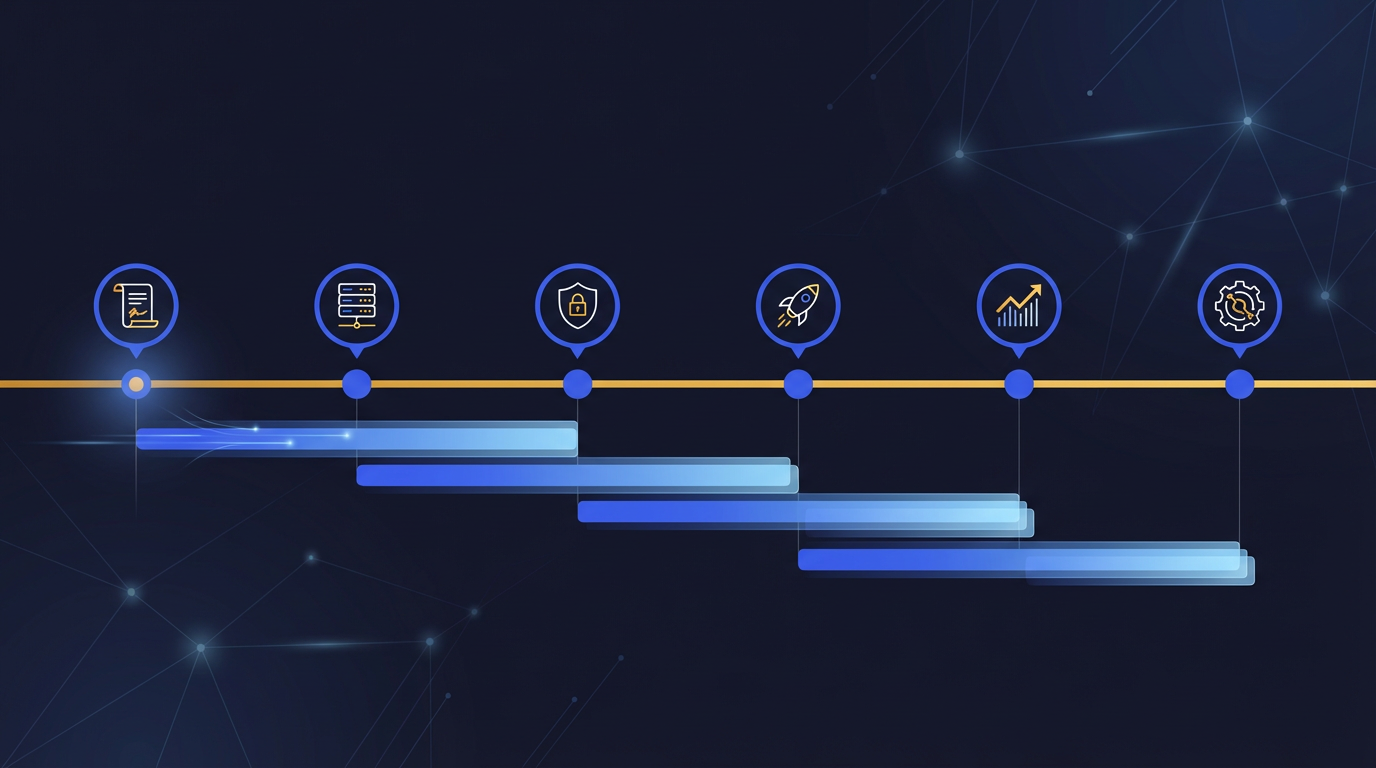
Understanding the dependencies between legal, technical, and marketing tasks prevents costly delays during the STO launch process. The critical path almost always follows the legal and regulatory track, as technical deployment cannot finalize until the legal rules are permanently defined in the offering documents. For example, a startup cannot code the smart contract transfer restrictions until securities counsel finalizes the Private Placement Memorandum, and a transfer agent cannot distribute tokens until funds have cleared the escrow requirements mandated by the specific SEC exemption. Founders who attempt to build the technology before securing legal clarity frequently find themselves paying to rewrite smart contracts to meet unexpected compliance obligations. The following table outlines a standard Gantt-chart-style timeline for an STO launch, detailing the duration ranges and primary dependencies for each of the six phases.
| Phase | Duration Range | Primary Activities | Key Dependencies |
|---|---|---|---|
| Phase 1: Pre-launch preparation | 3 to 6 months | Entity setup, counsel engagement, exemption selection, financial projections | Must precede offering document drafting and platform selection |
| Phase 2: Infrastructure selection | 1 to 2 months | Platform evaluation, blockchain selection, KYC/AML provider, transfer agent | Depends on exemption selection; runs parallel to Phase 1 |
| Phase 3: Offering documents | 1 to 6 months | PPM/Form C/Form 1-A drafting, SEC qualification (Reg A+) | Depends on Phase 1 completion; dictates smart contract rules |
| Phase 4: Smart contracts | 1 to 2 months | Token deployment, compliance programming, security audit | Depends on Phase 3 drafting; runs parallel to document review |
| Phase 5: Launch & distribution | 1 to 6 months | Investor marketing, KYC processing, escrow, token distribution | Depends on Phase 3 and 4 completion; SEC qualification if Reg A+ |
| Phase 6: Post-launch operations | Ongoing | SEC reporting, cap table reconciliation, ATS listing | Depends on Phase 5 closing |
Executing a security token offering requires startups to merge traditional investment banking rigor with modern blockchain deployment. The timeline from initial concept to funded cap table spans 6 to 12 months and demands precise coordination between securities counsel, platform providers, and marketing teams. Founders who succeed in this arena treat the STO as a structured project management exercise, respecting the critical path where legal compliance dictates technical architecture. By understanding the specific phases, timelines, and dependencies outlined in this guide, management teams can avoid the common pitfalls of regulatory delays and platform misalignments. The next step for founders considering a tokenized raise is to evaluate their current corporate structure and engage qualified securities counsel to determine which SEC exemption aligns with their capital requirements and target investor base.
Frequently Asked Questions
How long does an STO for startups take to launch?
A complete STO launch typically takes 6 to 12 months from initial planning to token distribution. Regulation D offerings generally close faster, while Regulation A+ offerings take longer because the Form 1-A requires three to six months for SEC review and qualification.
Can I build the smart contracts before hiring legal counsel?
You should not build smart contracts before engaging securities counsel. The legal exemption you choose dictates the specific transfer restrictions, lock-up periods, and investor limits that must be hard-coded into the token’s architecture to ensure regulatory compliance.
What happens to investor funds during the STO launch phase?
Investor funds are held in a secure third-party escrow account during the active offering period. The funds remain in escrow until the startup reaches its minimum funding target, at which point the capital is released to the company and tokens are distributed to investors.
Do startups need a transfer agent for a security token offering?
Yes, startups conducting an STO generally need an SEC-registered transfer agent. While the blockchain records token movements, the transfer agent maintains the legally authoritative off-chain master securityholder list and ensures all secondary trades comply with securities regulations.