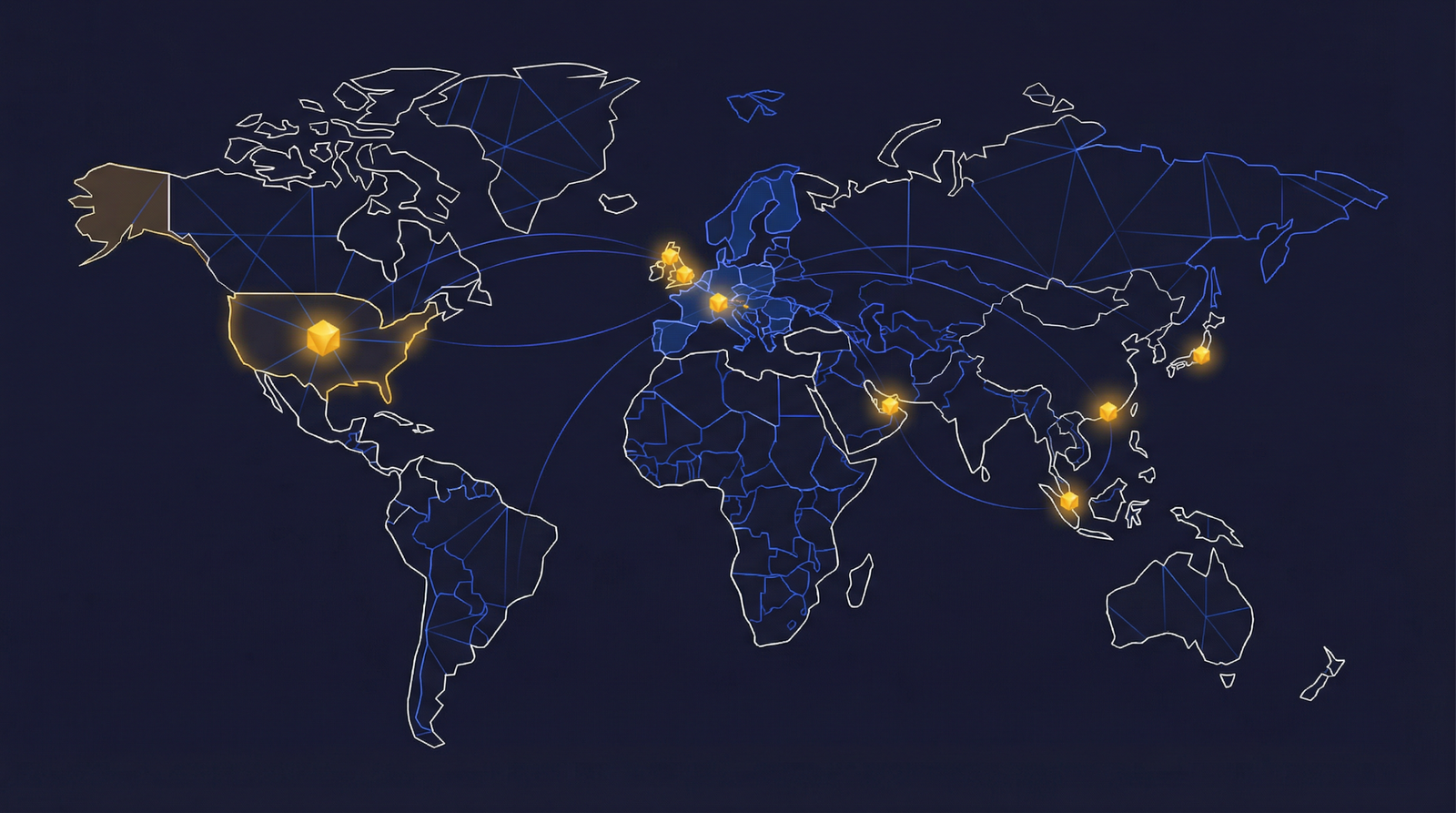
Global Tokenization Regulations: Country-by-Country Guide
Founders launching tokenized assets face a fragmented global legal environment where a single misstep can trigger severe regulatory enforcement. Tokenization regulations determine what you can build, who can invest in your product, and how much capital you will spend on legal compliance before generating a single dollar of revenue. The legal classification of a tokenized asset changes abruptly the moment it crosses international borders, forcing startups to design their corporate structuring and technical architecture around specific jurisdictional requirements.
Regulatory arbitrage is no longer a viable strategy for serious tokenization platforms. Major financial regulators have established clear boundaries for digital securities, enforcing existing capital markets laws on blockchain-based assets while developing targeted sandboxes for secondary market trading. Founders must choose their operating jurisdiction based on hard legal realities rather than regulatory avoidance. This guide breaks down the specific legal frameworks governing security tokens across the world’s primary financial hubs, detailing the exact exemptions, licensing requirements, and compliance burdens associated with each region.
The Global Structuring Standard: Over 75% of cross-border security token offerings do not rely on a single country’s domestic regime. Instead, issuers use a Dual-Tranche Structure—combining U.S. SEC Regulation D Rule 506(c) (for U.S. accredited investors) with Regulation S and an EU/Swiss/Singapore SPV (for international investors) governed by a single permissioned smart contract.
Why jurisdiction dictates tokenization strategy
Choosing a jurisdiction establishes your startup’s entire operational perimeter, dictating your eligible investor base, required licenses, and secondary trading capabilities. Regulators classify tokenized assets differently, meaning a token considered a lightly regulated utility in one country may trigger strict prospectus requirements and broker-dealer licensing mandates in another.
The regulatory framework you select directly impacts your go-to-market timeline and initial capitalization requirements. Operating in a highly regulated environment like the United States requires extensive legal structuring to utilize specific private placement exemptions, limiting your immediate customer base to high-net-worth individuals and institutions. Conversely, jurisdictions with bespoke digital asset frameworks like Switzerland or Liechtenstein offer greater legal clarity for retail distribution but demand significant upfront capital to establish local corporate entities and secure specialized blockchain service provider licenses.
Founders must align their physical corporate presence with their target investor demographics. A startup cannot easily base itself in an offshore zero-tax jurisdiction and freely market yield-bearing tokenized real estate to European or American retail investors without violating foreign offering rules. Cross-border token sales require adherence to the regulations of both the issuer’s home country and the investor’s country of residence. This dual-compliance burden forces most early-stage tokenization platforms to geofence their offerings, blocking IP addresses from restricted regions until they secure the necessary legal opinions and regulatory clearances to expand their geographic footprint.
Global tokenization regulations: 10-country comparison table
The table below outlines the baseline regulatory treatment of tokenized securities across ten major financial jurisdictions. This data reflects the current legal consensus on primary issuance and secondary market operations for digital assets that represent traditional financial instruments like equity, debt, or fund shares.
| Country | Primary Regulator | Token Classification | Licensing Requirement | Key Offering Exemptions | Secondary Trading Rules | Current Status |
|---|---|---|---|---|---|---|
| United States | SEC / FINRA | Security (Howey Test) | Broker-Dealer / ATS | Reg D 506(c), Reg S, Reg A+ | Requires registered ATS | Operational framework |
| European Union | ESMA / NCAs | Financial Instrument | MiFID II Investment Firm | Prospectus Regulation exemptions | DLT Pilot Regime | Operational framework |
| Switzerland | FINMA | DLT Security (Asset Token) | Securities Firm / DLT Trading | Professional investors, small offers | DLT Trading Facility | Operational framework |
| Singapore | MAS | Capital Markets Product | CMS License | Institutional / Accredited investors | RMO License required | Operational framework |
| UAE (ADGM) | FSRA | Security Token | FSP License | Exempt offers, professional clients | MTF License required | Operational framework |
| United Kingdom | FCA | Security Token | Part 4A Permission | Financial Promotions exemptions | Digital Securities Sandbox | Sandbox phase |
| Hong Kong | SFC | Security Token | Type 1, Type 7 Licenses | Professional Investors (PI) only | VATP / Automated Trading | Developing framework |
| Liechtenstein | FMA | Token (TVTG Act) | TT Service Provider | Standard EEA exemptions | Regulated under TVTG | Operational framework |
| Germany | BaFin | Crypto Security (eWpG) | Crypto Custody / Brokerage | Standard EEA exemptions | Requires MTF / OTF | Operational framework |
| Japan | FSA | ERTR (Type 1 Security) | Type 1 Financial Instruments | Qualified Institutional Investors | PTS License required | Operational framework |
Top 5 jurisdictions for tokenized assets
The United States, European Union, Switzerland, Singapore, and the United Arab Emirates represent the most active regulatory environments for asset tokenization. Each region has developed specific mechanisms for handling blockchain-based securities, ranging from strict enforcement of legacy laws to the creation of entirely new digital asset legislation.
United States: SEC framework and exemptions
The US Securities and Exchange Commission regulates tokenized assets primarily through the Securities Act of 1933 and the Securities Exchange Act of 1934. The SEC applies the Howey Test to determine if a digital asset constitutes an investment contract, consistently ruling that tokens representing fractional ownership, revenue sharing, or debt are securities. Startups operating in the US rarely conduct fully registered public offerings due to the prohibitive costs and extensive disclosure requirements. Instead, they rely heavily on private placement exemptions to raise capital and issue tokens legally.
Founders typically utilize Regulation D Rule 506(c), which permits general solicitation and advertising of the tokenized asset but strictly limits sales to verified accredited investors. For startups seeking to sell to international buyers while maintaining a US corporate entity, Regulation S provides a safe harbor for offshore transactions. Companies aiming to reach non-accredited retail investors within the US must utilize Regulation A+ or Regulation Crowdfunding (Reg CF), both of which impose strict capital caps and require SEC qualification before the token sale can commence. Understanding the nuances of US SEC tokenization regulation is critical for any founder touching the American market.
Secondary trading of tokenized securities in the United States remains highly restricted. Tokens issued under Regulation D carry a mandatory one-year lockup period before they can be traded. Once the lockup expires, these digital assets can only be traded on SEC-registered Alternative Trading Systems (ATS) operated by licensed broker-dealers. The SEC has been slow to approve special purpose broker-dealers capable of custodying digital asset securities, creating a significant bottleneck for secondary market liquidity in the American tokenization sector.
European Union: MiCA exclusions and MiFID II
The European Union provides a massive, unified market for tokenized assets, though founders often misunderstand the applicable regulatory framework. The highly publicized Markets in Crypto-Assets (MiCA) regulation explicitly excludes security tokens under Article 2(4). If a token qualifies as a financial instrument-such as a tokenized bond, equity share, or fund unit-it falls entirely outside MiCA’s scope and is governed by existing European securities laws, primarily the Markets in Financial Instruments Directive (MiFID II) and the EU Prospectus Regulation.
Issuing a tokenized security in Europe requires navigating the standard Prospectus Regulation exemptions. Startups typically avoid publishing a full prospectus by limiting their token offerings to qualified investors, restricting the total raise to under €8 million (depending on the specific member state’s implementation), or setting a high minimum investment threshold of €100,000 per investor. Once a token is legally issued in one EU member state, the issuer can leverage passporting rights to market the digital security across all 27 member states, providing a scale advantage that individual fragmented markets cannot match. Reviewing the specific boundaries of EU MiCA and tokenization rules helps founders avoid misclassifying their assets.
To address the technical realities of blockchain settlement, the EU launched the DLT Pilot Regime in March 2023. This regulatory sandbox allows authorized market participants to operate DLT market infrastructures, temporarily exempting them from certain legacy requirements under the Central Securities Depositories Regulation (CSDR). The pilot regime caps the total market value of DLT financial instruments recorded by a single operator at €6 billion, providing a controlled environment for institutions to test primary issuance and secondary trading of tokenized equities and bonds on distributed ledgers.
Switzerland: The DLT Act of 2021
Switzerland maintains one of the most advanced and legally certain environments for asset tokenization globally. The Swiss parliament passed the DLT Act in 2021, which systematically adapted existing federal laws to accommodate blockchain technology rather than creating an isolated crypto-specific regime. This legislation introduced the concept of ledger-based securities (DLT securities), granting electronic tokens the exact same legal standing as traditional certificated securities. The transfer of a token on a blockchain legally executes the transfer of the underlying property right without requiring parallel physical documentation.
The Swiss Financial Market Supervisory Authority (FINMA) provides clear guidance on token classification, categorizing digital assets into payment tokens, utility tokens, and asset tokens. Tokenized equities, bonds, and real estate derivatives fall squarely into the asset token category and are treated as traditional securities. Startups issuing asset tokens must comply with the Swiss Financial Services Act (FinSA), which mandates prospectus publication unless standard exemptions apply, such as targeting only professional clients or limiting the investor count to under 500 individuals. The Switzerland DLT Act framework provides a legally watertight foundation for corporate structuring.
Switzerland also pioneered the DLT Trading Facility license, a specific regulatory category that allows institutions to operate multilateral trading facilities for digital securities. Unlike traditional exchanges that restrict direct access to licensed brokers, a Swiss DLT Trading Facility can offer direct trading access to retail investors. This eliminates intermediaries and allows startups to list their tokenized assets on regulated secondary markets where retail buyers can trade directly against institutional liquidity providers.
Singapore: MAS and Project Guardian
Singapore has established itself as the primary hub for institutional tokenization in Asia, driven by the pragmatic approach of the Monetary Authority of Singapore (MAS). MAS does not have a standalone cryptocurrency law for security tokens; instead, it regulates digital assets based on their economic function. If a token represents ownership in a corporation, a debt owed by the issuer, or a unit in a collective investment scheme, MAS classifies it as a Capital Markets Product under the Securities and Futures Act (SFA). Founders must ensure their issuance platforms hold the appropriate Capital Markets Services (CMS) license.
The regulatory environment in Singapore heavily favors institutional and accredited investor models over retail distribution. Startups typically rely on the SFA’s safe harbor exemptions, which allow them to offer tokenized securities without a registered prospectus if the offer is made exclusively to institutional investors, accredited investors, or if the total raise is limited to S$5 million within a 12-month period. Retail offerings require a fully registered prospectus, a costly and time-consuming process that most early-stage Singapore MAS regulation compliant platforms choose to avoid.
MAS actively drives institutional adoption through Project Guardian, a collaborative initiative with global financial institutions to test asset tokenization and decentralized finance applications. Rather than operating a closed regulatory sandbox, Project Guardian facilitates industry pilots focused on fixed income, foreign exchange, and asset management on public and private blockchains. This proactive regulatory engagement makes Singapore highly attractive for enterprise-grade tokenization startups looking to partner with traditional banks and asset managers.
United Arab Emirates: VARA, ADGM, and DIFC
The United Arab Emirates offers a complex but highly accommodating regulatory landscape split across multiple distinct jurisdictions. Founders must choose between operating onshore in Dubai under the Virtual Assets Regulatory Authority (VARA), or setting up within one of the financial free zones: the Abu Dhabi Global Market (ADGM) or the Dubai International Financial Centre (DIFC). Each zone maintains its own independent financial regulator, civil and commercial laws, and tokenization frameworks.
The ADGM, regulated by the Financial Services Regulatory Authority (FSRA), was the first jurisdiction globally to introduce a comprehensive regulatory framework for digital assets. The FSRA treats security tokens identically to traditional securities, requiring issuers to publish an approved prospectus or utilize standard private placement exemptions. The ADGM is particularly attractive for tokenized real estate and private equity funds due to its English common law foundation and established fund structuring vehicles.
In contrast, Dubai’s VARA operates as the world’s first independent regulator specifically dedicated to virtual assets. While VARA primarily oversees utility tokens, payment tokens, and crypto exchanges, it coordinates closely with the UAE’s federal Securities and Commodities Authority (SCA) regarding digital assets that cross the threshold into traditional securities. Founders exploring UAE VARA tokenization regulation must carefully analyze whether their specific asset structure falls under VARA’s specialized digital asset mandate or the broader securities regulations of the federal government or free zones.
Evaluating jurisdictions: cost, timeline, and passporting
Comparing tokenization jurisdictions requires analyzing the practical trade-offs between setup costs, time-to-market, and geographic reach. Startups must balance the desire for immediate revenue generation against the long-term strategic benefits of operating in a globally recognized financial hub. The optimal choice depends heavily on the startup’s capitalization and target investor demographic.
Jurisdictions like the United States offer a fast time-to-market for startups willing to restrict their offerings to accredited investors. A US company can draft a Private Placement Memorandum (PPM), file a Form D with the SEC, and launch a Regulation D 506(c) offering within weeks. However, the compliance costs remain high, often exceeding $50,000 in legal structuring fees, and the resulting tokens are severely illiquid due to mandatory lockup periods and a lack of active secondary ATS platforms. The US framework prioritizes speed of primary issuance over secondary market functionality.
European jurisdictions require longer lead times but offer superior scalability through regulatory passporting. Establishing an issuance vehicle in Germany or Liechtenstein and securing the necessary regulatory approvals can take six to twelve months and cost upwards of €100,000 in legal and licensing fees. However, once approved, the startup can leverage the EU’s passporting regime to market its tokenized assets to investors across 27 countries under a single regulatory umbrella. This makes the EU highly attractive for platforms planning large-scale, cross-border distribution. Finding the best countries for tokenizing a startup requires mapping these timelines against your runway.
Emerging trends in global crypto securities law
Global financial regulators are converging on a unified approach to tokenization: applying existing securities laws to digital assets while simultaneously upgrading settlement infrastructure to accommodate distributed ledger technology. The era of attempting to classify tokenized equities or real estate as unregulated utility tokens has definitively ended, replaced by a focus on integrating blockchain rails into traditional capital markets.
The United Kingdom exemplifies this integration approach with the launch of the Digital Securities Sandbox (DSS), operated jointly by the Financial Conduct Authority (FCA) and the Bank of England. The DSS allows financial institutions and startups to set up DLT-based financial market infrastructures to trade and settle digital securities. By temporarily modifying existing regulations, the UK aims to test how tokenized assets can function within the broader financial system without compromising market integrity. This sandbox approach allows regulators to observe real-world market operations before drafting permanent legislative changes.
In the United States, legislative efforts like the proposed Financial Innovation and Technology for the 21st Century Act (FIT21) and the Clarity Act aim to resolve the ongoing jurisdictional disputes between the SEC and the Commodity Futures Trading Commission (CFTC). While these bills primarily focus on defining decentralization and classifying pure cryptocurrencies, any resulting legislation will indirectly impact tokenization by establishing clearer boundaries for when a digital asset transitions from a security to a commodity. Until federal legislation passes, US-based tokenization platforms must continue operating under the SEC’s strict enforcement-led interpretation of existing securities laws.
Decision framework: choosing the right regulatory base for your startup
Selecting a jurisdiction is an irreversible strategic decision that dictates your platform’s technical architecture, marketing strategy, and ultimate valuation. Founders should execute a systematic evaluation process before incorporating entities or writing smart contracts. Attempting to retrofit a non-compliant token architecture into a strict regulatory framework post-launch usually results in regulatory fines or forced platform shutdowns.
First, define the exact economic reality of your tokenized asset. If the token provides a right to future profits, represents fractional ownership of a physical asset, or acts as a debt instrument paying yield, it is a security. Do not rely on creative terminology in your whitepaper to bypass this reality. Regulators look strictly at the economic substance of the transaction. Consult a tokenization glossary to ensure your internal terminology matches legal definitions in your target region.
Second, determine your target investor base. If your business model relies on high-volume, low-value investments from retail users globally, you must establish your platform in a jurisdiction with clear retail prospectus exemptions or progressive digital asset frameworks like Switzerland or Liechtenstein. If your model targets institutional capital and family offices, jurisdictions like Singapore or the US offer established private placement exemptions that bypass the need for expensive retail compliance.
Finally, assess your available capital and timeline. Regulatory compliance is the single largest expense for an early-stage tokenization startup. If you have limited seed funding, prioritize jurisdictions that allow fast, exemption-based issuances to accredited investors. If you have substantial backing and aim to build a fully compliant, retail-facing exchange, allocate significant capital toward securing MTF or ATS licenses in tier-one jurisdictions. The regulatory base you choose will ultimately serve as the foundation of your platform’s trust and credibility in the market.
Conclusion
Navigating global tokenization regulations requires accepting that blockchain technology does not exempt a startup from traditional capital markets law. The most successful tokenization platforms treat regulatory compliance as a core product feature rather than an administrative burden. Whether utilizing Regulation D in the United States, leveraging the DLT Act in Switzerland, or operating under MAS exemptions in Singapore, founders must build their technical and corporate structures around the specific legal realities of their chosen jurisdiction.
Stop searching for regulatory loopholes and start building within established legal frameworks. Identify the jurisdiction that aligns with your investor demographics, secure the necessary legal counsel to navigate local exemptions, and structure your tokenized offering to withstand rigorous institutional due diligence. The future of asset tokenization belongs to founders who master the intersection of decentralized technology and traditional securities law.
Practitioner Reality: How Global Issuers Combine U.S. (Reg D) and International (Reg S / MiCA) Capital
1. The Reg D 506(c) + Reg S Dual-Tranche Playbook
Founders outside the United States often assume they must completely block U.S. investors to avoid SEC enforcement, leaving the world’s deepest capital pool on the table. Conversely, U.S. founders often struggle to onboard European or Asian investors cleanly. By deploying a partitioned smart contract (using ERC-3643 or ERC-1400 tranches), an issuer can simultaneously sell Tranche A tokens to verified U.S. Accredited Investors under Rule 506(c) (enforcing a 12-month Rule 144 lockup) and Tranche B tokens to non-U.S. investors under Regulation S (preventing flowback into U.S. wallets during the restricted distribution compliance period).
2. Why MiCA Does NOT Cover Equity or Bond Security Tokens
A frequent legal misconception in Europe is assuming that obtaining a CASP license under MiCA (Markets in Crypto-Assets) allows a company to issue tokenized shares or corporate bonds. Article 2(4) of MiCA explicitly excludes financial instruments that qualify as transferable securities. In the European Union, tokenized equities and bonds are regulated under MiFID II, national electronic securities laws (such as Germany’s eWpG or Luxembourg’s DLT laws), and the EU DLT Pilot Regime.
Frequently Asked Questions
Are tokenized assets considered securities?
Most jurisdictions classify tokenized assets that represent equity, debt, or revenue-sharing rights as securities. The US SEC applies the Howey Test, while the EU uses MiFID II criteria. Classification depends on the economic reality of the token rather than its underlying technology.
How does MiCA affect security tokens in Europe?
The Markets in Crypto-Assets (MiCA) regulation explicitly excludes security tokens under Article 2(4). Tokens qualifying as financial instruments remain governed by existing European securities laws, primarily MiFID II and the Prospectus Regulation, rather than the new MiCA framework.
Can US startups sell tokenized securities to retail investors?
US startups face strict limitations when selling tokenized securities to retail investors. While Regulation D Rule 506(c) limits sales exclusively to accredited investors, startups can use Regulation A+ or Regulation Crowdfunding to access retail buyers, though these exemptions require extensive SEC disclosures.
What is the EU DLT Pilot Regime?
The EU DLT Pilot Regime is a regulatory sandbox operational since March 2023 that allows market participants to operate distributed ledger technology for trading and settling tokenized financial instruments. It provides temporary exemptions from certain MiFIR and CSDR requirements to facilitate blockchain-based capital markets.
Why is Switzerland popular for asset tokenization?
Switzerland passed the comprehensive DLT Act in 2021, providing explicit legal certainty for ledger-based securities. The framework allows the digital transfer of tokens to legally represent the transfer of underlying assets, and FINMA offers clear pathways for licensing secondary market trading facilities.