ERC-3643 Explained: The Institutional Security Token Standard
Capital markets are currently undergoing a massive infrastructure migration toward public blockchains, but the foundational technology of these networks presents a severe regulatory problem. Standard cryptocurrency tokens operate as bearer instruments, meaning anyone holding the digital asset controls it completely and can send it to anyone else without restriction. This permissionless architecture directly violates global securities laws, which require strict identity verification, anti-money laundering checks, and transfer restrictions. To bridge this gap between decentralized ledgers and regulated financial markets, developers created purpose-built smart contract architectures. Getting ERC-3643 explained properly requires understanding that it is not just a token format, but a comprehensive rules engine built directly into the blockchain layer. By embedding compliance at the smart contract level, financial institutions can issue digital securities on public networks like Ethereum while guaranteeing that no non-compliant transfers can ever occur.
Understanding the ERC-3643 security token framework
ERC-3643 is an Ethereum standard specifically built for compliant security tokens, originally developed by Tokeny as the T-REX standard. It enforces identity verification and transfer restrictions directly at the smart contract level. If a transfer violates predefined regulatory rules, the blockchain automatically rejects the transaction before it executes.
The standard originated in 2018 when tokenization infrastructure provider Tokeny developed the T-REX (Token for Regulated EXchanges) protocol to address the glaring compliance gaps in early security token offerings. After years of refinement and real-world testing, the protocol was formally submitted to the Ethereum community as EIP-3643 and officially finalized as a recognized standard in December 2023. Unlike standard ERC-20 tokens that only track balances and total supply, an ERC-3643 security token acts as a gateway to a broader ecosystem of compliance contracts. Every time a user attempts to move a token, the contract pauses the transaction, queries an external registry of verified identities, checks a specific set of rules defined by the asset issuer, and only allows the transfer to proceed if all conditions are met. According to data from the ERC3643 Association, over $28 billion in tokenized assets have been deployed using this standard, making it one of the most widely adopted frameworks for institutional digital securities.
Financial institutions require absolute certainty regarding who holds their assets, and ERC-3643 provides this by eliminating the concept of anonymous bearer shares on the blockchain. When an issuer creates security tokens explained using this framework, they maintain ultimate control over the asset ledger. The standard includes forced transfer and recovery functions, allowing the issuer to burn tokens from a lost or compromised wallet and reissue them to the rightful owner’s new address. This specific capability satisfies the legal requirement that a registered security must reflect the true ownership recognized by the issuer, regardless of who holds the private keys to a specific blockchain address. The standard essentially replicates the traditional transfer agent function using self-executing code on a public ledger.
Technical architecture and the compliance engine
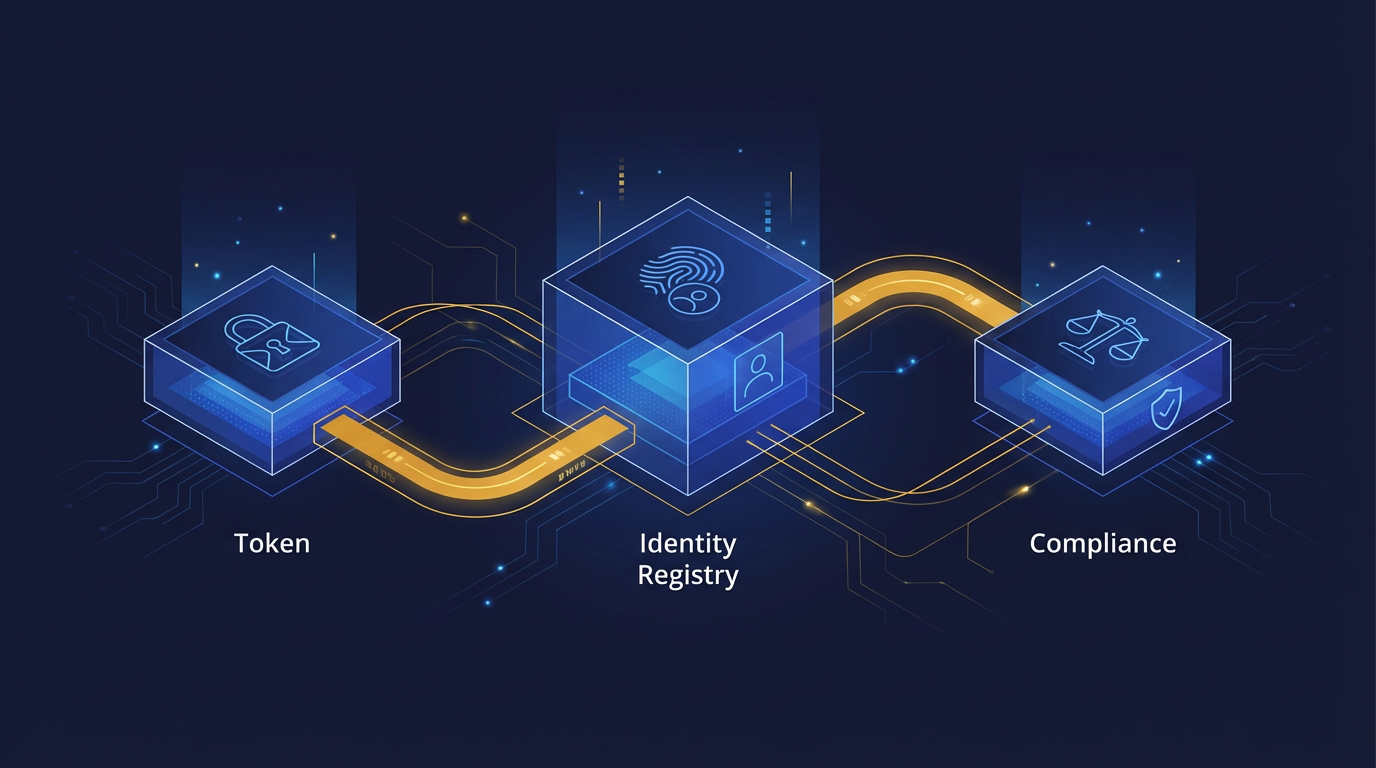
The ERC-3643 architecture relies on three core smart contracts working together: the main token contract, an on-chain identity registry using the ONCHAINID standard, and a dedicated compliance contract. Every token transfer triggers a rules engine that validates both parties’ credentials before execution.
The first component is the token contract itself, which maintains the standard interface required for compatibility with wallets and exchanges while containing the specific hooks that route transfer requests to the compliance layer. The second, and perhaps most critical component, is the identity registry. ERC-3643 relies heavily on the ONCHAINID standard (built on ERC-734 and ERC-735), which creates a unique smart contract for each investor. This identity contract stores cryptographic claims issued by trusted third parties, such as KYC providers or legal firms. Instead of publishing personally identifiable information on the public blockchain, the ONCHAINID contract simply holds a verifiable cryptographic proof that a specific wallet address belongs to an individual who has passed the necessary background checks and resides in an approved jurisdiction.
The third component is the compliance contract, which serves as the programmable brain of the security token. Issuers configure this contract with the specific regulatory logic required for their asset. These rules can include daily volume limits, maximum investor counts to comply with exemptions like SEC Rule 506(c), lock-up periods for early investors, and specific jurisdictional blocklists. When you analyze how tokenization works technically under ERC-3643, the transfer flow becomes a strict sequence of automated checks. Wallet A initiates a transfer to Wallet B. The token contract immediately calls the compliance contract. The compliance contract checks the identity registry to ensure both Wallet A and Wallet B possess valid, unexpired ONCHAINIDs with the correct verification claims. It then calculates whether the transfer would violate any configured rules, such as pushing Wallet B over a maximum holding limit. If any single check fails, the smart contract reverts the transaction, meaning the tokens never leave Wallet A and the blockchain records a failed execution.
Comparing institutional token standards
When evaluating an institutional token standard, developers typically compare ERC-3643 vs ERC-1400. While ERC-3643 mandates a strict identity registry approach, ERC-1400 offers a modular framework that requires custom compliance implementations. Proprietary solutions like Securitize’s DS Protocol and Polymesh’s ST-20 offer alternative ecosystem-specific approaches.
The digital asset industry has produced several frameworks attempting to solve the compliance problem, leading to fragmentation in how security tokens are constructed. ERC-1400, originally spearheaded by Polymath, approaches the problem by creating a highly modular standard with distinct partitions, allowing a single token contract to represent different tranches or classes of the same asset. While technically elegant, ERC-1400 leaves the actual implementation of the compliance logic largely up to the developer, which has led to varying implementations that do not always interoperate smoothly. In contrast, ERC-3643 provides a highly opinionated architecture: you must use the identity registry, and you must use the compliance contract structure. This rigidity is intentionally designed to ensure that any two ERC-3643 tokens can interact with the same compliance infrastructure without custom integration work.
| Feature | ERC-3643 (T-REX) | ERC-1400 | ST-20 (Polymesh) | Securitize DS Protocol |
|---|---|---|---|---|
| Core Architecture | Identity-centric, strict compliance engine | Modular, partition-based | Native to purpose-built chain | Proprietary smart contract suite |
| Identity Integration | Mandatory ONCHAINID integration | Custom implementation required | Native chain-level identity | Securitize iD integration |
| Network | EVM-compatible networks | EVM-compatible networks | Polymesh blockchain | EVM, Solana, Algorand, others |
| Standardization | Officially finalized Ethereum standard | Draft standard, highly fragmented | Proprietary to Polymesh | Proprietary to Securitize |
| Primary Use Case | Cross-platform regulated securities | Complex multi-tranche assets | Institutional tokenization | End-to-end issuance portal |
Beyond Ethereum-based standards, issuers also evaluate network-specific protocols. ST-20 is the native standard for Polymesh, a blockchain built entirely for regulated assets where identity verification happens at the network consensus layer rather than the smart contract layer. This architectural difference requires issuers to decide on the best blockchain for tokenization before selecting their token standard. A comprehensive Polymath and Polymesh review reveals that while layer-1 compliance reduces smart contract complexity, it isolates the asset from the massive liquidity pools available on public Ethereum networks. Meanwhile, the Securitize DS Protocol operates as a proprietary standard. While highly successful in terms of assets under management, it locks issuers into the Securitize ecosystem, whereas ERC-3643 operates as an open standard that any developer or platform can utilize without paying licensing fees to a central entity.
Institutional adoption and network trade-offs
Financial institutions adopt ERC-3643 because it automates regulatory enforcement and provides an immutable audit trail while maintaining compatibility with the broader Ethereum ecosystem. However, this framework introduces operational trade-offs, including higher gas costs, complex identity infrastructure setup, and potential on-chain privacy considerations.
The primary driver for institutional adoption of ERC-3643 is its alignment with emerging regulatory frameworks, particularly the European Union’s Markets in Crypto-Assets (MiCA) regulation and various national digital securities laws. By utilizing a standardized compliance engine, issuers can demonstrate to regulators exactly how transfer restrictions are enforced programmatically. Major financial entities, including apex institutions and asset managers utilizing Tokeny’s infrastructure, have deployed this standard to tokenize private equity funds, real estate investment trusts, and corporate debt instruments. The standard allows these assets to exist on public networks, opening the door to eventual composability with decentralized finance (DeFi) protocols. Developers are actively building permissioned liquidity pools where only wallets holding specific ONCHAINID credentials can participate, effectively creating a parallel, compliant DeFi ecosystem for institutional capital.
Despite these advantages, deploying a security tokens and STOs guide using ERC-3643 requires acknowledging several distinct operational friction points. The most immediate is transaction cost. Executing multiple state reads to check the identity registry and calculate compliance rules requires significantly more computational effort than a simple ERC-20 transfer. On Ethereum mainnet, these complex compliance checks can increase gas costs by 30% to 50% per transaction compared to standard token movements. Consequently, most ERC-3643 deployments occur on layer-2 scaling solutions like Polygon or Arbitrum where computation is cheaper. Furthermore, the reliance on ONCHAINID creates an onboarding hurdle. Investors cannot simply connect a MetaMask wallet and receive tokens; they must go through a centralized KYC process, have an identity contract deployed on their behalf, and wait for the verification claims to be published on-chain.
Privacy also remains a complex consideration within the ERC-3643 framework. While personally identifiable information is never stored directly on the blockchain, the public ledger does record the linkages between specific wallets and their associated identity contracts. Sophisticated blockchain analytics could potentially map out the trading relationships between institutional entities based on these on-chain interactions. As the tokenization industry matures, the focus is shifting toward integrating zero-knowledge proofs into the ERC-3643 compliance engine, allowing the smart contract to verify that a transfer is compliant without exposing the specific rules or the identities of the participants to the public network. Understanding these nuances is essential for any professional navigating the tokenization glossary and selecting the infrastructure that will power the next decade of digital capital markets.
Frequently Asked Questions
What is the difference between ERC-20 and ERC-3643?
ERC-20 is a basic token standard that allows unrestricted, anonymous transfers between any compatible wallets. ERC-3643 is a security token standard that requires both the sender and receiver to have verified on-chain identities and automatically blocks any transfer that violates predefined regulatory rules.
Do I need a special wallet to hold ERC-3643 tokens?
No, you can hold ERC-3643 tokens in any standard EVM-compatible wallet like MetaMask or institutional custody solutions. However, your wallet address must be linked to an approved ONCHAINID identity contract before the token smart contract will allow you to receive the assets.
Can ERC-3643 tokens be traded on decentralized exchanges?
ERC-3643 tokens can technically interact with decentralized exchange protocols, but they will only execute trades if the liquidity pool and the counterparty meet all compliance requirements. This usually requires specialized, permissioned DeFi platforms rather than public automated market makers like Uniswap.
Who controls the compliance rules in an ERC-3643 token?
The asset issuer or their designated compliance agent controls the rules. They retain administrative access to the compliance smart contract, allowing them to update jurisdiction blocklists, adjust investor limits, or force token transfers if required by a legal mandate or court order.