Asset Tokenization: The Definitive Guide (2026 Data)
Capital markets are undergoing a structural upgrade as financial institutions and technology companies transition traditional ledgers to distributed blockchain networks. Asset tokenization represents the core mechanism of this transition, replacing legacy record-keeping systems with cryptographic tokens that represent ownership rights to underlying assets. This process fundamentally changes how financial instruments are issued, traded, and settled across global markets. The shift is no longer theoretical or confined to pilot programs. Major asset managers, sovereign wealth funds, and multinational corporations are actively deploying capital into tokenized structures to capture operational efficiencies and access new liquidity pools. Understanding what is asset tokenization requires examining both the underlying cryptographic infrastructure and the complex legal frameworks that bind digital tokens to real-world value. This guide examines the mechanics of tokenization, the current state of institutional adoption, the evolving regulatory landscape, and the practical realities facing market participants today.
What asset tokenization is and how the mechanics work
Asset tokenization is the process of converting ownership rights of physical or digital assets into blockchain-based digital tokens. This mechanism links a legal ownership contract to a cryptographic token, allowing the underlying asset to be transferred, programmed, and recorded on a distributed ledger without traditional financial intermediaries. The architecture relies on a combination of smart contracts, decentralized networks, and legally binding off-chain agreements.
The mechanics of tokenization require a precise synchronization between the technology layer and the legal layer. At the technological level, developers deploy smart contracts on a blockchain network to mint tokens that represent specific fractional or whole units of an asset. These smart contracts dictate the rules of the token, including total supply, transfer restrictions, and compliance requirements. At the legal level, a Special Purpose Vehicle (SPV) or similar corporate structure is typically established to hold the underlying physical or financial asset. The legal documentation explicitly states that whoever holds the digital token in their cryptographic wallet holds the legal ownership rights to the corresponding shares in the SPV. This dual structure ensures that the digital representation maintains enforceable legal rights in the physical world. Without this legally binding connection, a token is merely a piece of code with no intrinsic value or claim to the referenced asset. Investors seeking to understand the foundational terminology should consult our tokenization glossary for precise definitions of these structural components.
Market participants must distinguish between tokenization and traditional securitization, though the two concepts share similar goals. Securitization involves pooling various financial assets and repackaging them into interest-bearing securities sold to investors, relying heavily on clearinghouses, transfer agents, and broker-dealers to manage the lifecycle of the asset. Tokenization can apply to a single asset or a pooled fund, but it replaces the centralized intermediaries with a shared distributed ledger. A tokenized asset settles atomically, meaning the transfer of the asset and the payment occur simultaneously on the blockchain, eliminating the standard two-day settlement risk found in traditional equities. Furthermore, tokenization bakes the compliance and transfer rules directly into the asset itself through programmable code, whereas securitized assets rely on external compliance departments and manual verification processes to ensure legal trading.
The technology layer powering this ecosystem relies on a mix of public, private, and purpose-built blockchain networks. Ethereum remains the dominant settlement layer for institutional tokenization due to its deep liquidity and established developer tooling, though high transaction costs have pushed many issuers toward Layer-2 scaling solutions like Polygon and Arbitrum. Alternative Layer-1 networks such as Avalanche provide specific subnet architectures that allow institutions to create customized, permissioned environments while maintaining interoperability. Purpose-built networks like Polymesh and Stellar are specifically designed for regulated financial assets, offering native identity verification and compliance features at the base layer rather than requiring complex smart contract overlays. The choice of blockchain directly impacts the asset’s access to secondary market liquidity and integration with decentralized finance protocols.
Token standards define how these digital assets behave and interact within the chosen blockchain ecosystem. While utility tokens commonly use the basic ERC-20 standard, regulated financial assets require sophisticated frameworks like ERC-3643, ERC-1400, or ST-20. The ERC-3643 standard has gained significant traction because it utilizes a decentralized identity framework to ensure that tokens can only be held by verified, whitelisted wallets. If a user attempts to transfer a security token to an unverified wallet, the smart contract automatically blocks the transaction, enforcing regulatory compliance at the code level. Additionally, these systems rely heavily on blockchain oracles to feed off-chain data into the smart contracts. Oracles provide real-time pricing data, verify off-chain asset reserves, and trigger automated corporate actions like dividend distributions based on external market conditions, bridging the gap between the isolated blockchain network and traditional financial data feeds.
Types of tokenized assets and current market adoption
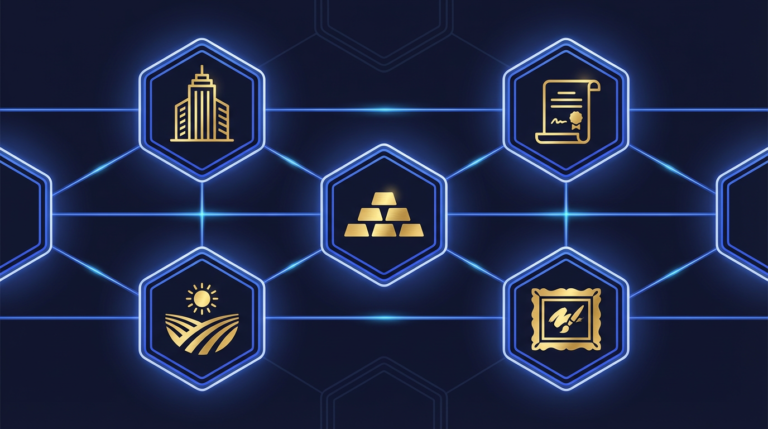
The types of tokenized assets currently dominating the market include United States Treasuries, private credit, corporate bonds, and real estate. Institutional issuers like BlackRock and Franklin Templeton lead the tokenized treasury sector, while platforms facilitating private credit and digital bonds represent the fastest-growing segments by total value locked.
Tokenized United States Treasuries have emerged as the primary catalyst for institutional adoption, serving as a low-risk yield instrument for digital asset treasuries and stablecoin issuers. According to data from rwa.xyz, the total assets under management for tokenized treasuries has grown exponentially, surpassing $2 billion as institutions seek on-chain yield. Franklin Templeton was the first major asset manager to enter this space with its FOBXX fund, represented by the BENJI token on the Stellar and Polygon networks. BlackRock accelerated market momentum in March 2024 with the launch of its USD Institutional Digital Liquidity Fund (BUIDL) on the Ethereum network. BUIDL quickly captured significant market share, allowing qualified investors to earn US dollar yields while holding a blockchain-based asset that can be used as collateral in decentralized finance protocols. These products prove that traditional asset managers are comfortable using public blockchain infrastructure to distribute regulated financial products.
Private credit and corporate debt represent another massive segment of the tokenization of assets. Blockchain networks allow businesses to access debt financing directly from a global pool of investors, bypassing traditional banking intermediaries. Platforms operating in the tokenized private credit space originate loans for real-world businesses, securitize the debt, and issue tokens to investors who earn the interest yields. The rwa.xyz dashboard tracks hundreds of millions of dollars in active loan value across various lending protocols. In the corporate bond sector, multinational conglomerates are issuing debt directly on distributed ledgers. Siemens issued a €60 million digital bond on the Polygon blockchain in 2023, reducing paperwork and eliminating the need for a central clearing depository. JPMorgan’s Onyx platform facilitates billions of dollars in intraday repurchase agreements using tokenized representations of cash and treasury bonds, proving the technology’s viability for high-volume institutional clearing.
Real estate and private equity tokenization offer the promise of fractionalizing highly illiquid asset classes, though adoption has moved slower than fixed-income products. Real estate tokenization typically involves placing a single commercial property or a portfolio of properties into an SPV and issuing tokens that represent equity shares or debt instruments tied to the asset. This structure theoretically lowers the barrier to entry for retail investors and provides liquidity to property developers. Those interested in the specific mechanics of property fractionalization can read our real-world asset tokenization guide. Similarly, private companies are exploring tokenized cap tables to manage employee stock options and facilitate secondary market trading before an initial public offering. Founders looking to leverage this structure should review our complete guide to tokenizing startup equity. While the infrastructure exists for these use cases, secondary market liquidity remains fragmented, and regulatory hurdles complicate cross-border distribution.
The long-term market projections for tokenized assets suggest a fundamental rewiring of global finance over the next decade. A highly cited 2024 report by Boston Consulting Group estimates that the tokenization of global illiquid assets will reach a $16 trillion market size by 2030. McKinsey’s 2024 tokenization analysis similarly points to trillions of dollars in value migrating to blockchain networks, driven primarily by mutual funds, bonds, and exchange-traded notes. These projections rely on the assumption that secondary market infrastructure will mature, regulatory clarity will improve across major jurisdictions, and traditional financial institutions will complete their integration with digital asset custodians. The current market size, while growing rapidly, still represents a fraction of a percent of total global financial assets, indicating that the industry remains in the early stages of a massive structural transition.
Regulatory frameworks governing digital assets
Regulatory frameworks for tokenized assets depend strictly on the underlying asset’s classification. In the United States, the SEC applies the Howey test to determine if a token is a security. European regulators exclude traditional financial instruments from MiCA, while Switzerland and Singapore have established specific distributed ledger technology legal frameworks.
The regulatory treatment of tokenized assets is the single largest variable affecting market expansion and institutional participation. In the United States, the Securities and Exchange Commission (SEC) maintains that the technological wrapper does not change the fundamental nature of the financial instrument. If a token represents an investment of money in a common enterprise with the expectation of profit derived from the efforts of others, it satisfies the Howey test and is classified as a security. Consequently, issuers must register the tokenized asset with the SEC or qualify for an exemption. Most tokenization platforms rely on Regulation D (Rule 506(c)) for domestic offerings, which restricts sales to accredited investors, and Regulation S for international distribution. The SEC’s strict enforcement approach has forced issuers to implement rigorous Know Your Customer (KYC) and Anti-Money Laundering (AML) protocols at the smart contract level. For a deeper understanding of these specific issuance structures, readers can review how security tokens and STOs explained function in the current market.
The European Union has taken a more structured legislative approach, though the rules remain complex for tokenized financial instruments. The Markets in Crypto-Assets (MiCA) regulation provides a comprehensive framework for utility tokens, stablecoins, and cryptocurrency service providers. However, MiCA Article 2(4) explicitly excludes digital assets that qualify as financial instruments under the existing Markets in Financial Instruments Directive (MiFID II). This means that tokenized equities, bonds, and fund shares fall outside of MiCA and must comply with traditional European securities laws. To bridge this gap, the EU implemented the DLT Pilot Regime, a regulatory sandbox that allows financial institutions to trade and settle tokenized securities in a controlled environment while receiving temporary exemptions from certain legacy rules. This parallel approach aims to foster technological innovation without destabilizing existing market safeguards.
Jurisdictions in Europe and Asia are actively competing to establish the most favorable legal environments for digital asset issuance. Switzerland passed its comprehensive DLT Act, which legally recognizes ledger-based securities and allows the transfer of ownership via blockchain transactions without the need for physical signatures or traditional transfer agents. The Swiss Financial Market Supervisory Authority (FINMA) has subsequently approved multiple digital asset exchanges and tokenized fund structures. In Asia, the Monetary Authority of Singapore (MAS) leads institutional experimentation through Project Guardian, a collaborative initiative with global banks to test asset tokenization across fixed income, foreign exchange, and asset management. MAS provides clear guidelines on the treatment of digital payment tokens versus capital markets products, giving institutions the regulatory certainty required to deploy capital. Market participants operating internationally must navigate a patchwork of rules, making our country-by-country regulation guide an essential resource for compliance planning.
Practical implications for founders and investors
Asset tokenization enables fractional ownership, programmable compliance, and continuous global trading for traditionally illiquid markets. However, tokenization does not automatically create market liquidity, eliminate the need for strict regulatory compliance, or remove the inherent technology risks associated with smart contract vulnerabilities and blockchain infrastructure.
The primary advantage of tokenization is the ability to fractionalize high-value assets, lowering the barrier to entry for a broader base of investors. A commercial office building worth $50 million can be divided into one million tokens priced at $50 each, allowing retail and smaller institutional investors to gain exposure to an asset class previously restricted to massive private equity funds. Furthermore, the programmable nature of smart contracts automates corporate actions that traditionally require armies of back-office personnel. Dividend distributions can be executed instantly to thousands of token holders based on real-time revenue data fed through blockchain oracles. The technology also enables 24/7/365 trading globally, moving away from the restricted operating hours of traditional stock exchanges. Investors looking to participate in this emerging ecosystem should research how to invest in tokenized assets to understand the required wallet infrastructure and platform onboarding processes.
Despite these operational advantages, market participants must understand what tokenization does not solve. The most persistent misconception is that tokenizing an asset automatically creates liquidity. A digital token representing a share in an obscure commercial property is only liquid if there is an active buyer willing to purchase it on the secondary market. The blockchain facilitates the transfer, but it does not generate market demand. Additionally, tokenization does not eliminate the friction of regulatory compliance; it merely digitizes it. Issuers still face substantial legal costs to structure the SPV, draft offering memorandums, and conduct ongoing financial audits of the underlying asset. The administrative burden of managing cap tables and investor relations remains, even if the execution is automated through smart contracts. Evaluating the infrastructure providers handling these tasks is critical, and founders should consult our breakdown of the best tokenization platforms compared before selecting a technology partner.
Technology risk introduces an entirely new variable into the financial equation. Traditional assets held in a brokerage account are protected by institutional custody and regulatory insurance frameworks. Tokenized assets rely on cryptographic key management and smart contract security. If a vulnerability exists in the smart contract code governing the token, malicious actors can exploit it to drain funds or manipulate token balances. While institutional-grade platforms utilize multi-signature wallets, cold storage custodians, and rigorous code audits to mitigate these threats, the risk cannot be entirely eliminated. Furthermore, the reliance on public blockchain networks introduces variables related to network congestion, fluctuating transaction fees, and potential consensus failures. Investors and issuers must weigh these novel technological risks against the operational efficiencies gained through distributed ledger technology.
The transition to a tokenized economy requires a fundamental shift in how market participants view ownership, custody, and transfer of value. The underlying technology has proven capable of handling billions of dollars in institutional transaction volume securely. The current phase of market development focuses entirely on regulatory alignment and the integration of legacy financial systems with digital asset infrastructure. As major asset managers continue to push tokenized funds into the market and global regulators establish clear operational frameworks, the friction between traditional finance and blockchain technology will continue to decrease. The ultimate success of asset tokenization will not be measured by the novelty of the technology, but by its ability to operate silently in the background of global capital markets.
Frequently Asked Questions
What is the difference between tokenization and securitization?
Tokenization replaces centralized intermediaries with a distributed blockchain ledger to record ownership and settle transactions atomically. While securitization relies on traditional clearinghouses and manual compliance checks, tokenization embeds regulatory rules directly into the asset’s code through smart contracts.
Does tokenizing an asset automatically make it liquid?
No, tokenization does not automatically generate market liquidity. While the blockchain facilitates faster and cheaper transfers, an asset only becomes liquid if there is active market demand from buyers willing to purchase the tokens on a secondary exchange.
Which blockchain networks are used for asset tokenization?
Ethereum is the dominant network for institutional tokenization, alongside Layer-2 scaling solutions like Polygon. Institutions also utilize alternative networks like Avalanche for custom subnets, and purpose-built financial blockchains like Polymesh and Stellar that offer native compliance features.
How do regulators classify tokenized assets?
Regulators classify tokenized assets based on the underlying asset they represent, not the technology itself. In the United States, if a token represents an investment contract under the Howey test, the SEC regulates it strictly as a security.