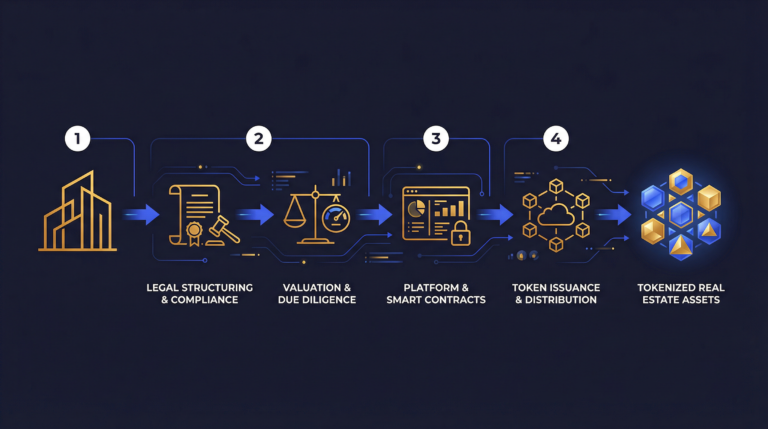
Capital Gains on Tokenized Securities: Tax Guide & Rules
The integration of traditional financial assets with blockchain infrastructure forces investors to navigate two distinct regulatory frameworks simultaneously. Capital gains on tokenized securities follow the fundamental principles of the US tax code, but the mechanics of on-chain settlement, self-custody, and digital asset reporting introduce significant operational complexities. Traditional brokerage accounts automate cost basis tracking and issue standardized tax forms at the end of the year. Investors holding security tokens across multiple platforms or private wallets must often reconstruct their own transaction histories to determine their tax liabilities accurately. Failing to apply the correct cost basis methodology or miscalculating holding periods based on blockchain timestamps can result in substantial tax penalties or missed opportunities for loss harvesting. This guide examines the specific application of capital gains tax rules to tokenized equities, bonds, and real estate assets.
Understanding how the IRS treats these digital representations of traditional assets requires a thorough examination of the Internal Revenue Code (IRC). While the underlying asset determines the general tax character, the tokenized wrapper dictates how transactions are recorded, tracked, and reported. Investors must bridge the gap between immutable blockchain ledgers and the specific reporting requirements of IRS Form 8949. This requires a firm grasp of transaction sequencing, cost basis election rules, and the evolving regulations surrounding digital asset wash sales. We will examine the precise mechanisms for calculating taxes on these instruments and the strategies available to optimize an investor’s after-tax returns.
Holding periods and capital gains rates for tokenized securities
The holding period for a tokenized security dictates whether a profit is taxed at ordinary income rates or preferential long-term rates. The holding period begins the day after the on-chain acquisition transaction settles and ends on the exact date of the disposition transaction.
Traditional securities transactions rely on a structured settlement cycle. Under SEC Rule 15c6-1, standard equities settle on a T+1 basis, meaning the official transfer of ownership occurs one business day after the trade is executed. Tokenized securities operate on distributed ledgers where trade execution and settlement are frequently simultaneous. This near-instant settlement means the trade date and the settlement date are effectively the same. The holding period clock starts ticking the day after the blockchain network confirms the acquisition transaction. When an investor sells the token, the holding period ends on the exact calendar date the disposition transaction is written to the blockchain. This precise timestamping eliminates the traditional trade date versus settlement date ambiguity, but it requires investors to extract the exact block timestamps from their wallet addresses or platform statements to calculate the duration accurately.
Under IRC Section 1222, the classification of capital gains depends strictly on this timeline. Holding a security token for exactly one year or less results in a short-term capital gain or loss. Holding the asset for one year and one day or more triggers a long-term capital gain or loss. Short-term gains are taxed at the investor’s ordinary income tax rates. For the 2024 tax year, these federal tax brackets sit at 10%, 12%, 22%, 24%, 32%, 35%, and 37%. An investor in the highest tax bracket who flips a tokenized real estate share after six months will lose nearly four-tenths of their profit to federal taxes before accounting for any state-level obligations. This steep tax burden makes short-term trading of security tokens highly inefficient from an after-tax perspective.
Long-term capital gains benefit from preferential tax rates designed to encourage sustained investment. The federal tax code applies three distinct brackets for long-term gains based on the investor’s overall taxable income. For the 2024 tax year, single filers earning up to $47,025 pay a 0% federal rate on long-term capital gains. Single filers earning between $47,026 and $518,900 face a 15% rate. Those with taxable income exceeding $518,900 are subject to a 20% long-term capital gains rate. These thresholds adjust annually for inflation. Investors must calculate their total income, including wages, business income, and other investments, to determine which capital gains bracket applies to their tokenized security profits.
High-earning investors face an additional layer of taxation known as the Net Investment Income Tax (NIIT). Implemented under IRC Section 1411, the NIIT imposes an extra 3.8% tax on investment income for taxpayers whose modified adjusted gross income exceeds specific thresholds. The threshold currently stands at $200,000 for single filers and $250,000 for married couples filing jointly. This surtax applies to interest, dividends, capital gains, and rental income. When factoring in the NIIT, the top marginal federal rate on long-term capital gains for tokenized securities reaches 23.8%. The top marginal federal rate for short-term gains hits 40.8%. Understanding these brackets is essential for anyone learning how to invest in tokenized assets with a focus on maximizing net returns.
| Holding Period | Federal Tax Rate (2024) | NIIT Applicability | Top Marginal Federal Rate |
|---|---|---|---|
| 1 Year or Less (Short-Term) | Ordinary Income (10% to 37%) | + 3.8% if over income threshold | 40.8% |
| Over 1 Year (Long-Term) | Preferential (0%, 15%, or 20%) | + 3.8% if over income threshold | 23.8% |
Cost basis methods and tracking challenges on-chain
Cost basis represents the original value of an asset for tax purposes, usually the purchase price plus any acquisition fees. For tokenized securities, investors must use either the First-In, First-Out (FIFO) method or specific identification to determine which tokens were sold and calculate the resulting gain or loss.
The IRS defaults to the First-In, First-Out (FIFO) method for calculating cost basis if an investor does not make a specific election. Under FIFO, the first tokens purchased are considered the first tokens sold. Consider an investor who buys 100 tokens of a commercial building in January at $10 each, another 100 tokens in March at $15 each, and 100 more in May at $20 each. If the investor sells 150 tokens in August at $25 each, the FIFO method dictates that the cost basis comes from the entire January batch (100 tokens at $10) and half of the March batch (50 tokens at $15). The total cost basis for the sale is $1,750 against proceeds of $3,750, resulting in a taxable short-term gain of $2,000. FIFO is the easiest method to track, but it often accelerates tax liabilities by forcing the sale of the oldest, and potentially most appreciated, assets first.
Investors can optimize their tax outcomes by electing to use specific identification. Treasury Regulation 1.1012-1(c) allows taxpayers to identify exactly which shares or tokens they are selling, provided they make adequate identification at or before the time of the sale. In the context of FIFO specific identification tokens, an investor could choose to sell the tokens acquired in May at $20 each rather than the January tokens at $10 each. Using the previous example, selling 100 May tokens and 50 March tokens establishes a cost basis of $2,750. This reduces the taxable gain from $2,000 down to $1,000. To satisfy the IRS adequate identification requirement for decentralized assets, investors must maintain contemporaneous written records detailing the specific wallet addresses, transaction hashes, block times, and purchase prices of the exact tax lots they intend to dispose of.
One method investors cannot generally use for tokenized securities is the average cost method. Under IRC Section 1012(c), the average cost basis method is expressly limited to mutual fund shares. Investors calculate the average price paid for all shares owned and apply that uniform basis to any sale. Unless a specific tokenized asset is legally structured and registered as a mutual fund under the Investment Company Act of 1940, applying the average cost method to tokenized equities, bonds, or real estate violates the tax code. Investors must stick to FIFO or specific identification to remain compliant.
Blockchain mechanics introduce unique basis tracking situations that do not exist in traditional brokerage accounts. When investors transfer tokens between different self-hosted wallets or platform accounts, the transfer itself is not a taxable event. However, these transfers frequently break the cost basis tracking on centralized platform tax reports. A tokenization platform will only know the cost basis of assets purchased directly on its venue. If an investor deposits a token from an external wallet, the platform’s tax reporting software will likely record a cost basis of zero. Investors must maintain independent, aggregated ledgers to track their original cost basis across different custody solutions. For more details on navigating these cross-platform reporting issues, investors should consult a comprehensive US tokenized assets tax guide.
Corporate actions on-chain also complicate basis calculations. If an investor participates in a dividend reinvestment program (DRIP) for tokenized equity dividends, the basis for the newly acquired tokens is the fair market value of the dividend on the distribution date. If a blockchain network undergoes a hard fork resulting in new tokens, the IRS generally treats this as a taxable event establishing the basis at the fair market value upon receipt, provided the investor has dominion and control over the new asset. Keeping track of these micro-transactions requires automated digital asset tax software capable of reading block explorers and mapping them to traditional tax lots.
Tax-loss harvesting and wash sale rules
Tax-loss harvesting involves deliberately selling securities at a loss to offset realized capital gains elsewhere in an investor’s portfolio. This strategy lowers overall tax liability but requires strict adherence to IRS wash sale rules, which prohibit repurchasing substantially identical assets within a 30-day window.
The mechanics of tax-loss harvesting security tokens rely on IRC Section 1211(b). This section allows individual taxpayers to use capital losses to offset unlimited capital gains realized during the same tax year. If an investor realizes $50,000 in gains from selling tokenized real estate and $40,000 in losses from selling tokenized equities, their net taxable capital gain is reduced to $10,000. If capital losses exceed capital gains, the tax code permits investors to use the excess losses to offset up to $3,000 of ordinary income per year. Any remaining losses beyond that $3,000 threshold carry forward indefinitely into future tax years. This carryforward provision makes capturing losses highly valuable, even in years where an investor has no immediate capital gains to offset.
The primary restriction on this strategy is the wash sale rule defined in IRC Section 1091. The rule prohibits taxpayers from claiming a capital loss if they purchase a “substantially identical” security within 30 days before or 30 days after the sale that generated the loss. If a wash sale occurs, the disallowed loss is added to the cost basis of the newly purchased security, and the holding period of the original security is tacked onto the new one. The loss is not permanently denied, but the tax benefit is deferred until the investor eventually sells the replacement position in a non-wash transaction. Tracking this 61-day window (the day of the sale, 30 days prior, and 30 days after) is critical for executing a compliant harvesting strategy.
The application of the wash sale rule to digital assets has been a subject of intense legislative focus. For years, pure cryptocurrencies like Bitcoin were treated as property rather than securities, leading many tax professionals to conclude the wash sale rule did not apply to them. However, tokenized securities are explicitly securities under US law. A token representing a share of Apple stock is subject to the exact same wash sale restrictions as a traditional share of Apple stock held in a brokerage account. The Infrastructure Investment and Jobs Act of 2021 expanded digital asset reporting requirements, and subsequent legislative proposals have consistently aimed to formally extend wash sale rules to all digital assets. Investors dealing with security tokens must operate under the assumption that strict wash sale rules apply to their transactions.
Determining what constitutes a “substantially identical” asset requires careful analysis of the underlying instrument. Selling a tokenized share of an S&P 500 ETF at a loss and repurchases the exact same tokenized ETF on a different blockchain within 20 days clearly triggers a wash sale. The underlying asset is identical regardless of the network it trades on. Conversely, selling a tokenized commercial property in Chicago to buy a tokenized commercial property in Miami generally avoids the wash sale rule because the underlying real estate assets have different risk profiles, tenants, and geographic exposures. Investors must evaluate the economic substance of the underlying asset rather than focusing solely on the token wrapper when assessing wash sale risks. Understanding these nuances is one of the key risks of investing in tokenized assets.
IRS reporting requirements and state-level tax considerations
Reporting tokenized security transactions requires filing IRS Form 8949 and Schedule D. Investors must accurately categorize their transactions based on whether a broker reported the cost basis to the IRS, while also accounting for varying state-level capital gains tax rates.
Taxpayers report every taxable disposition of a tokenized security on IRS Form 8949, “Sales and Other Dispositions of Capital Assets.” The form is divided into two parts: Part I for short-term transactions and Part II for long-term transactions. Within each part, investors must categorize their trades using Box A, B, or C. Box A applies when the broker reported the cost basis to the IRS on Form 1099-B. This is common when using regulated US broker-dealers that operate tokenization portals. Box B applies when the investor received a 1099-B, but the cost basis was not reported to the IRS. Box C is used for transactions where no 1099-B was issued. Box C reporting remains highly common for investors interacting with decentralized exchanges, self-custody wallets, or offshore platforms that do not issue US tax documents.
For each transaction listed on Form 8949, the investor must provide a description of the property, the date acquired, the date sold, the gross proceeds, the cost basis, and the resulting gain or loss. When platform-provided transaction records are incomplete, investors must manually calculate these figures using their blockchain transaction history. The totals from Form 8949 flow directly onto Schedule D, which aggregates all capital gains and losses to determine the final tax impact on the investor’s Form 1040. If an investor lacks the technical knowledge to extract this data from block explorers, they must utilize specialized digital asset tax software to parse their wallet activity and generate the necessary tax forms.
Beyond the transactional reporting, the IRS requires all taxpayers to answer the digital asset question on the first page of Form 1040. The question asks if the taxpayer received, sold, exchanged, or otherwise disposed of a financial interest in any digital asset during the tax year. Selling a tokenized security constitutes a disposition of a digital asset. Checking “No” when an investor has actively traded security tokens constitutes filing a false return under penalty of perjury. The IRS uses this question to identify taxpayers who may be underreporting their digital asset activities, making accurate disclosure mandatory regardless of whether the trades resulted in a net gain or a net loss.
| Form 8949 Category | Condition | Typical Tokenized Asset Scenario |
|---|---|---|
| Box A (Short-Term) / Box D (Long-Term) | 1099-B received, basis reported to IRS | Trades executed on a fully regulated US broker-dealer platform. |
| Box B (Short-Term) / Box E (Long-Term) | 1099-B received, basis NOT reported to IRS | Transfers from external wallets sold on a regulated platform. |
| Box C (Short-Term) / Box F (Long-Term) | No 1099-B received | Trades executed via smart contracts or offshore platforms. |
State-level capital gains treatment significantly alters the total tax burden for tokenized asset investors. The federal tax code provides the baseline, but state tax authorities apply their own rules to investment income. States like Florida, Texas, and Nevada levy no individual income tax, meaning investors residing in these jurisdictions only pay the federal capital gains rates. This provides a massive structural advantage for active investors and is a primary reason many digital asset funds base their operations in these states. Investors looking to understand how these state rules compare to international jurisdictions should consult an EU and international tax guide for cross-border context.
In contrast, high-tax states treat capital gains aggressively. California taxes all capital gains as ordinary income, regardless of the holding period. The state offers no preferential rate for long-term investments. For the highest earners in California, the top marginal state tax rate reaches 13.3%. When combined with the top federal rate of 23.8%, a California resident can lose over 37% of their long-term tokenized security profits to taxation. New York also taxes capital gains at ordinary income rates, which can reach 10.9% at the state level, plus additional local taxes for residents of New York City. Investors must factor these state rates into their after-tax return calculations when evaluating the viability of any tokenized security investment. Understanding the complete tax picture, from the precise definition of a security token in the tokenization glossary to the final state tax bill, is essential for profitable capital allocation.
Frequently Asked Questions
How is the holding period calculated for tokenized securities?
The holding period begins the day after the acquisition transaction is confirmed on the blockchain and ends on the exact date of the disposition transaction. Unlike traditional securities with T+1 settlement, blockchain transactions settle nearly instantly, meaning the trade date and settlement date are identical.
Can I use the average cost method for tokenized assets?
No, investors generally cannot use the average cost method for tokenized securities. Under IRC Section 1012(c), the average cost method is strictly limited to mutual fund shares. Investors must use either First-In, First-Out (FIFO) or specific identification to calculate their cost basis.
Does the wash sale rule apply to security tokens?
Yes, the wash sale rule applies to tokenized securities. Under IRC Section 1091, investors cannot claim a capital loss if they purchase a substantially identical security within 30 days before or after the sale. The loss is disallowed and added to the new asset’s cost basis.
How do I report tokenized security sales to the IRS?
You must report the sale of tokenized securities on IRS Form 8949 and summarize the totals on Schedule D. Additionally, you must check ‘Yes’ on the Form 1040 digital asset question to indicate you disposed of a financial interest in a digital asset during the tax year.
Sources
- [1] SEC Adopts Rules to Accelerate the Settlement Cycle to T+1
- [2] 26 U.S. Code § 1222 – Other terms relating to capital gains and losses
- [3] Questions and Answers on the Net Investment Income Tax
- [4] 26 CFR § 1.1012-1 – Basis of property
- [5] 26 U.S. Code § 1012 – Basis of property-cost
- [6] 26 U.S. Code § 1091 – Loss from wash sales of stock or securities