Tokenized Stocks: How Equity Moves to the Blockchain
The global equity market operates on infrastructure designed decades ago. Trades execute in milliseconds but take a full day to settle. Markets close for weekends and holidays, leaving investors unable to react to macroeconomic shifts. Tokenized stocks offer a structural upgrade to this system by moving equity representation onto distributed ledgers. By converting traditional shares into digital stock tokens, financial institutions can enable continuous trading, instant settlement, and deeper integration with decentralized finance applications. This guide examines how tokenized equity functions, the platforms driving adoption, the regulatory hurdles restricting United States retail access, and the institutional pilots testing blockchain settlement at scale.
Understanding tokenized equity and digital shares
Tokenized stocks are digital representations of equity shares issued and recorded on a blockchain. They exist in two primary forms: tokenized versions of existing publicly traded companies backed one-to-one by physical shares held in custody, and natively tokenized equity issued directly as security tokens by private companies.
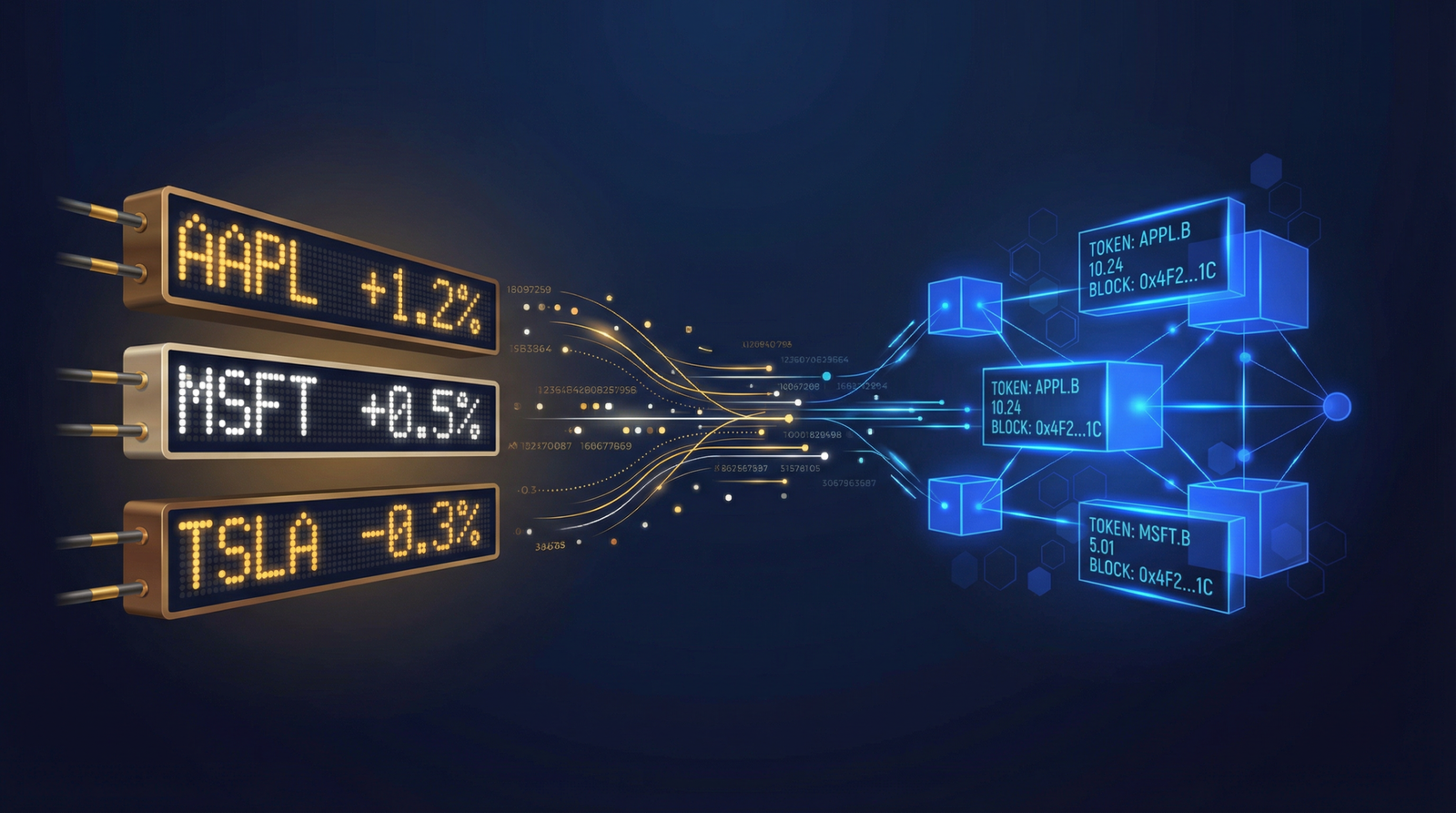
The mechanics of tokenizing existing public stocks require a strict operational bridge between traditional brokerage accounts and blockchain networks. When a platform issues a token representing a share of Tesla or Apple, a regulated custodian purchases and holds the underlying physical stock. The tokenization platform then mints a digital token on a network like Ethereum or Polygon that corresponds directly to that custodied asset. Legal frameworks typically structure these tokens as tracker certificates or derivatives rather than direct equity ownership. This structure allows the issuer to comply with securities laws while giving the token holder economic exposure to the underlying stock price and dividends. If you want to understand the foundational mechanics behind this process, our comprehensive asset tokenization guide breaks down the technical layers of asset digitization.
Natively tokenized equity operates on a completely different legal and technical premise. Instead of wrapping an existing public share, a company issues its actual equity directly on a blockchain cap table from inception. These are pure security tokens, meaning the blockchain record is the legally recognized master ledger of ownership. Companies utilizing this method often work with SEC-registered transfer agents to manage issuance, ensuring compliance with capital formation rules like Regulation D or Regulation A+. Understanding how tokenization works at the smart contract level reveals how these native issuances automate compliance, restricting transfers only to whitelisted, identity-verified investor wallets.
How tokenized shares trading works in practice
Several platforms currently lead the tokenized stock market by bridging traditional finance with blockchain infrastructure. Backed Finance issues tokenized equities and exchange-traded funds for non-US investors, Ondo Finance focuses on tokenized US Treasuries, and Securitize provides the regulatory infrastructure for natively tokenized corporate equity and private funds.
Backed Finance operates out of Switzerland under the Swiss DLT Act, issuing fully backed tokenized equities and exchange-traded funds. According to their platform documentation, Backed holds the underlying assets with regulated custodians and issues bTokens-such as bNVDA for Nvidia or bCSPX for the iShares Core S&P 500 ETF-on networks like Ethereum and Base. Because these tokens are structured as tracker certificates under Swiss law, they are strictly available only to non-US persons and qualified investors. This regulatory moat allows Backed to offer tokenized shares trading that integrates directly into decentralized finance protocols, enabling investors to use tokenized S&P 500 exposure as collateral for stablecoin loans within the decentralized finance ecosystem.
Ondo Finance has taken a parallel approach by focusing heavily on yield-bearing cash equivalents rather than individual tech stocks. Per rwa.xyz dashboard data, Ondo manages hundreds of millions in total value locked across products like USDY and OUSG, which represents tokenized BlackRock short-term US Treasuries. While not individual corporate equities, these tokenized fund shares demonstrate the massive demand for bringing traditional financial returns on-chain. Investors seeking to deploy capital into these instruments must navigate strict onboarding processes, as the platforms mandate comprehensive identity verification to ensure compliance with global anti-money laundering directives. Selecting the best blockchain for tokenization depends heavily on liquidity requirements, which is why platforms like Ondo deploy across multiple Ethereum Virtual Machine-compatible networks.
Securitize dominates the infrastructure layer for natively tokenized equity and private funds in the United States. Operating as an SEC-registered transfer agent and alternative trading system, Securitize allows private companies to issue equity directly as digital tokens. They famously partnered with KKR to tokenize a portion of a private equity fund and currently manage the tokenization for BlackRock’s BUIDL fund. For investors asking security tokens explained in practical terms, Securitize provides the clearest example. The tokens they issue are actual securities, subject to strict lock-up periods and trading restrictions enforced programmatically by smart contracts.
Market benefits and technical advantages
Tokenized stocks provide distinct advantages over traditional equity markets, including instant settlement, fractional ownership, and continuous 24/7 trading. By utilizing blockchain rails, financial institutions eliminate the multi-day clearing process, reduce counterparty risk, and allow investors to purchase precise dollar amounts of high-priced corporate shares.
The most significant structural improvement offered by blockchain stocks is the acceleration of the settlement cycle. In May 2024, the US Securities and Exchange Commission mandated a shift from T+2 to T+1 settlement for traditional equities, meaning trades now take one full business day to officially clear and settle. Tokenized stocks bypass this legacy clearinghouse friction entirely by offering atomic settlement, or T+0. When a buyer and seller execute a trade for a digital stock token on a decentralized exchange or a blockchain-based alternative trading system, the exchange of the token and the payment stablecoin happens simultaneously within the same smart contract transaction. This eliminates the counterparty risk inherent in waiting 24 hours for traditional clearing firms to finalize the transfer of funds and shares.
Beyond settlement speed, tokenized equity breaks down barriers related to market hours and denomination sizes. Traditional stock exchanges operate on strict schedules, typically closing overnight and on weekends, which prevents investors from reacting immediately to breaking news or global macroeconomic events. Tokenized shares trading occurs on blockchain networks that operate continuously, 24 hours a day, 365 days a year. Furthermore, smart contracts allow for infinite divisibility. While some traditional brokerages offer fractional shares through internal ledger entries, tokenized stocks make fractional ownership native to the asset itself. An investor in an emerging market can purchase exactly $10 worth of a tokenized corporate share, hold it in a self-custodial wallet, and transfer it peer-to-peer without relying on a centralized brokerage intermediary.
Regulatory frameworks and institutional adoption
The US Securities and Exchange Commission classifies tokenized stocks as securities, requiring them to trade on registered national exchanges or Alternative Trading Systems. Due to strict compliance requirements, major institutional players are currently testing blockchain settlement through private pilot programs rather than launching public retail trading platforms.
Regulatory friction remains the primary barrier to widespread retail adoption of tokenized stocks in the United States. The SEC maintains that any digital token representing equity, whether a native issuance or a backed derivative, is a security subject to the Securities Act of 1933. Consequently, platforms cannot legally offer tokenized versions of public companies to US retail investors without registering as a national securities exchange-a threshold no crypto-native platform has yet crossed. Instead, most tokenized equity products rely on Regulation S exemptions to serve non-US persons, or Rule 506(c) of Regulation D to serve accredited domestic investors. The SEC tokenization regulation framework heavily penalizes platforms that attempt to bypass these registration requirements, which explains why public tokenized stock offerings currently thrive in jurisdictions like Switzerland and Singapore rather than New York.
Despite the strict retail limitations, institutional capital markets are actively building blockchain infrastructure for equity settlement. The Depository Trust & Clearing Corporation, which processes quadrillions of dollars in securities transactions annually, has conducted extensive pilot programs to test distributed ledger technology. In early 2024, the DTCC collaborated with major financial institutions to demonstrate how traditional financial systems can interact with tokenized assets across different blockchain networks. These pilots focus on utilizing smart contracts to automate corporate actions, such as dividend distributions and proxy voting, which currently require massive manual reconciliation across multiple intermediaries.
Traditional stock exchanges are also positioning themselves for a tokenized future. The London Stock Exchange Group announced plans to build a blockchain-based digital market ecosystem designed to raise capital and transfer assets directly. Similarly, NASDAQ has explored digital asset custody and settlement solutions, recognizing that the underlying technology of blockchain stocks offers massive operational efficiencies. While trading volume for tokenized public equities remains a fraction of traditional market volume, the institutional investment in blockchain rails signals a long-term transition. The end state is not necessarily retail investors trading tokens on decentralized exchanges, but rather the entire backend of the global equity market migrating to distributed ledgers.
The transition of equity to blockchain infrastructure represents a fundamental rewiring of global capital markets. Tokenized stocks solve the persistent inefficiencies of traditional trading, replacing multi-day settlement delays and restricted market hours with instant, continuous, and programmable asset transfers. While platforms like Backed Finance and Securitize have proven the technical viability of digital stock tokens, regulatory clarity in major markets like the United States remains the critical bottleneck for retail participation. As institutional giants like the DTCC and traditional exchanges continue to validate distributed ledger technology through large-scale pilots, the foundation for a fully tokenized equity market is actively being built. Financial professionals and investors must monitor these infrastructure developments, as the shift toward tokenized shares trading will redefine how ownership is recorded, transferred, and leveraged in the coming decade.
Frequently Asked Questions
Are tokenized stocks legal in the United States?
Tokenized stocks are legal in the US but are heavily restricted by the SEC as registered securities. Currently, no crypto-native platform is registered as a national securities exchange, meaning retail investors cannot legally trade tokenized public stocks. Access is largely restricted to accredited investors through private placements.
What is the difference between natively tokenized equity and backed tokens?
Natively tokenized equity is issued directly on a blockchain by a company as its official ownership ledger. Backed tokens are digital derivatives created by a third party, where a traditional custodian holds the physical share of a public company and issues a token representing its value.
Do tokenized stocks pay dividends?
Yes, tokenized stocks can pay dividends to holders. For backed tokens, the issuer receives the traditional dividend from the custodied share and distributes the equivalent value to token holders, often via stablecoins. Native security tokens can automate dividend payments directly to investor wallets using smart contracts.
How does settlement differ for tokenized stocks?
Tokenized stocks offer atomic settlement (T+0), meaning the transfer of the token and the payment occurs simultaneously within a smart contract. Traditional stocks currently operate on a T+1 settlement cycle, requiring a full business day for clearinghouses to finalize the transfer of funds and shares.