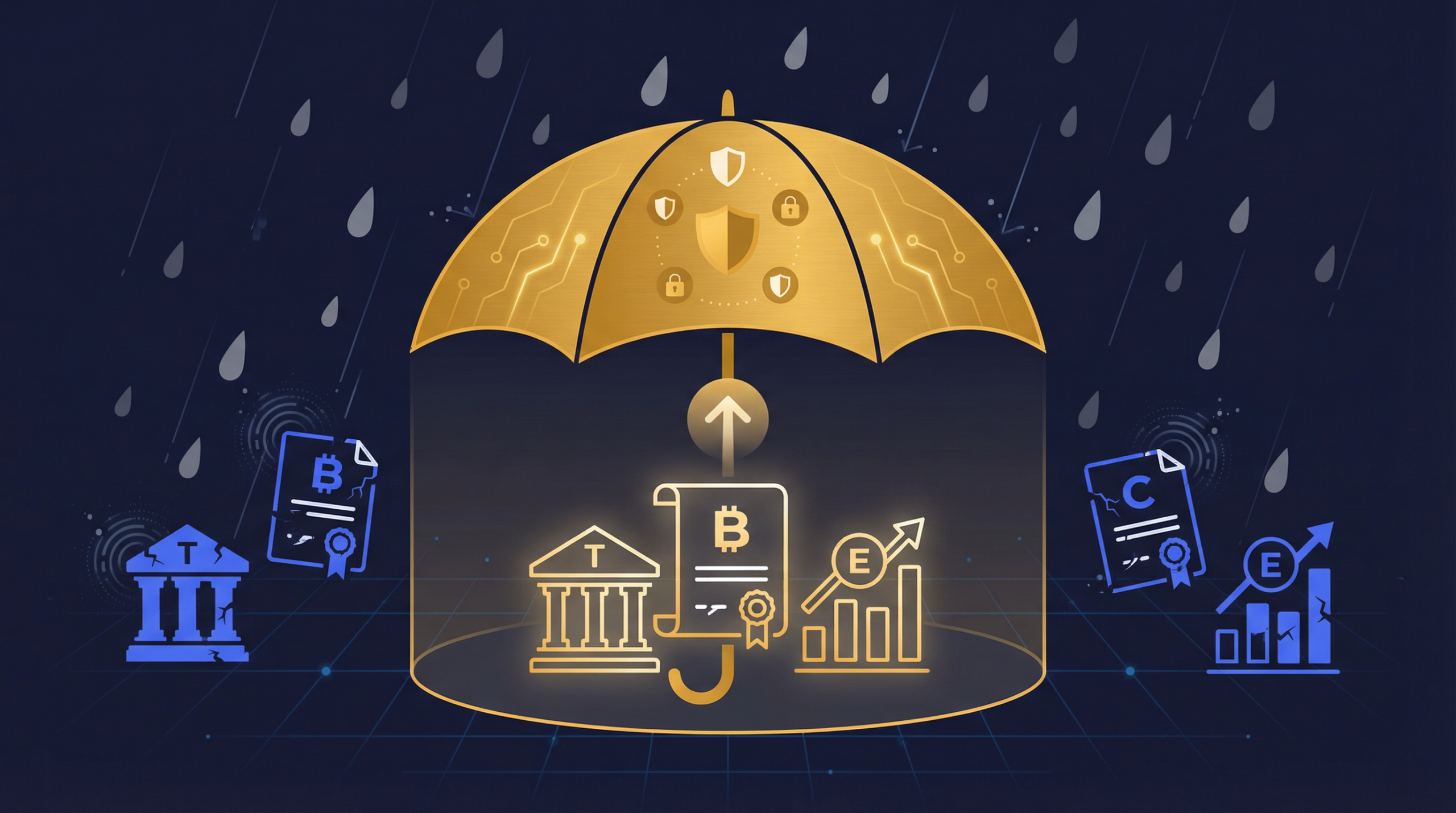
Insurance for Tokenized Portfolios: Coverage & Gaps
Tokenized assets merge traditional financial instruments with blockchain rails, but they often leave behind the established safety nets of legacy brokerage accounts. Investors allocating capital to tokenized real estate, private equity, or private credit face a fractured and developing insurance landscape. Securing insurance for tokenized investment portfolios requires navigating a complex patchwork of commercial custodian policies, decentralized insurance protocols, and significant coverage gaps. The transition from centralized clearinghouses to decentralized ledgers shifts the burden of risk management directly onto the investor. This guide examines exactly what protections exist in the current market, where traditional safeguards fail, and how investors can mitigate the uninsurable risks inherent in digital asset securities.
The structural insurance gap in tokenized assets
Traditional brokerage accounts rely on the Securities Investor Protection Corporation (SIPC) for up to $500,000 in coverage, including $250,000 in cash, while bank deposits receive $250,000 in Federal Deposit Insurance Corporation (FDIC) protection. These standardized safeguards generally do not apply to tokenized assets held on blockchain platforms, creating a substantial exposure gap for investors.
SIPC coverage operates under strict statutory limitations that exclude most tokenized instruments and blockchain-native securities. The protection only triggers if a registered broker-dealer fails and customer assets are missing, requiring the entity to be a SIPC member holding recognized securities. While certain regulated platforms maintain SIPC membership, many tokenization portals operate entirely outside this specific broker-dealer framework. Furthermore, SIPC does not protect against market declines, smart contract failures, or the underlying asset issuer’s bankruptcy. FDIC insurance is even more restrictive, applying exclusively to cash deposits at insured depository institutions. It does not apply to securities, stablecoins, or tokenized representations of value, leaving cash equivalents on blockchain platforms entirely exposed to institutional failure.
This regulatory reality means the digital asset insurance gap is a primary consideration for anyone managing tokenized wealth. When you learn how to invest in tokenized assets, you must recognize that the blockchain infrastructure shifts the custody risk directly onto the investor or the specialized digital asset custodian. If a tokenization platform goes bankrupt or suffers a catastrophic smart contract exploit, investors cannot rely on a government-backed entity to make them whole. The absence of blanket federal protection forces market participants to rely on private commercial insurance or decentralized alternatives, both of which come with strict limits and high premiums. Investors must actively audit the custody chain of their assets to determine exactly where the liability rests at any given moment.
Custodian policies and traditional insurance options
Institutional custodians carry commercial crime and cyber liability insurance, typically underwritten by Lloyd’s of London syndicates, to protect against internal theft and hot wallet breaches. These policies provide shared coverage limits, such as Anchorage Digital’s $350 million policy and BitGo’s $250 million policy, rather than per-customer guarantees.
Leading digital asset custodians utilize specialized commercial insurance to protect the assets under their control, but the mechanics differ fundamentally from traditional retail protections. Anchorage Digital maintains a policy exceeding $350 million arranged through Lloyd’s of London, which covers digital asset theft and specific operational errors. Similarly, BitGo carries a $250 million Lloyd’s policy focused primarily on hot wallet theft and insider collusion. These figures represent aggregate limits shared across the custodian’s entire institutional client base. If a catastrophic breach results in $1 billion of stolen assets, a $250 million policy will only pay out a fraction of each client’s losses. Investors must review the specific institutional client arrangements, such as those offered by Fireblocks or Copper.co, to understand exactly how coverage applies to their specific segregated accounts.
Traditional insurance brokers like Aon and Marsh have established dedicated digital asset practices to arrange bespoke coverage for tokenization platforms and institutional investors. These policies typically include crime and theft insurance, technology errors and omissions, directors and officers liability, and cyber liability. However, securing security token insurance remains an expensive endeavor. Annual premiums for digital asset coverage generally range from 1% to 5% of the total coverage limit, which is significantly higher than the basis-point costs associated with traditional financial insurance. Insurers demand rigorous underwriting processes, requiring detailed security audits, penetration testing results, and comprehensive operational assessments before deploying capital. Knowing where to buy security tokens requires verifying the specific commercial insurance policies maintained by the issuing platform or its designated custodian to ensure these audits have taken place.
DeFi insurance protocols and on-chain coverage
Decentralized finance (DeFi) insurance protocols offer on-chain coverage against smart contract exploits, oracle failures, and custodian insolvency. Nexus Mutual leads the sector, requiring members to stake NXM tokens to underwrite risk, while platforms like InsurAce and Unslashed Finance provide alternative multi-chain coverage options for tokenized assets.
As traditional insurers hesitate to underwrite the technical risks of blockchain infrastructure, DeFi insurance protocols have emerged to fill the void. Nexus Mutual operates as the largest decentralized insurance alternative, functioning as a discretionary mutual where members pool capital to share risk. The protocol offers specific products highly relevant to tokenized portfolios, including Protocol Cover for smart contract bugs, Custody Cover for centralized custodian insolvency or hacks, and Yield Token Cover for depeg events. Members stake NXM tokens against specific protocols they believe are secure, effectively underwriting the risk with their own capital. When a loss event occurs, the members assess the claim through decentralized governance, and approved claims are paid out in ETH or the covered asset. Annual pricing for Nexus Mutual RWA coverage typically ranges from 2% to 5%, depending on the perceived risk of the underlying smart contracts and the available underwriting capacity.
Competing protocols offer similar protections with varying governance models and coverage scopes across different blockchain ecosystems. InsurAce operates as a multi-chain insurance protocol providing smart contract cover, custodian cover, and IDO cover, allowing investors to protect assets across fragmented networks. Unslashed Finance broadens the scope further, offering exchange cover, smart contract cover, and specialized products like validator slashing cover. Both protocols have established track records of paying out claims following major DeFi exploits, proving the viability of decentralized claims assessment. However, underwriting capacity remains a limiting factor. The total value locked in these insurance protocols is a fraction of the broader digital asset market capitalization, meaning large tokenized asset platforms may struggle to secure sufficient coverage limits. Investors evaluating DeFi insurance tokenized assets must weigh the premium costs against the historical reliability of the protocol’s claims-paying process.
Uninsurable risks and self-insurance strategies
Significant coverage gaps remain in the tokenized asset sector, as neither traditional nor DeFi insurance covers market downturns, regulatory seizures, or intentional fraud. Investors must implement self-insurance strategies, including strict portfolio allocation limits, maintaining cash reserves, and diversifying holdings across multiple tokenization platforms and custodians.
Understanding what insurance policies exclude is just as important as knowing what they cover. No commercial policy or DeFi protocol will reimburse an investor if their tokenized real estate loses value due to a macroeconomic downturn or local market conditions. Similarly, regulatory actions, such as a government freezing assets or shutting down a platform, fall completely outside standard coverage parameters. If a token issuer commits intentional fraud or executes a rug pull, insurance rarely applies. Cross-chain bridge exploits and stablecoin depeg events are notoriously difficult and expensive to insure, often leaving investors entirely exposed. Furthermore, if an investor utilizes self-custody and loses their private keys or falls victim to a phishing attack, the resulting loss is entirely uninsured. These exclusions highlight the inherent tokenized asset risks that require proactive portfolio management rather than reliance on third-party indemnification.
Given these structural limitations, sophisticated investors rely heavily on self-insurance and rigorous operational security. The foundation of this approach is platform diversification. By spreading tokenized holdings across multiple issuers and custodians, investors limit their exposure to any single point of failure. Setting strict allocation limits ensures that tokenized assets represent only a risk-appropriate percentage of a broader investment portfolio. Many institutional players maintain a dedicated cash reserve fund, typically equivalent to 5% to 10% of their tokenized portfolio value, to self-fund potential uninsured losses. Conducting proper due diligence for tokenized securities is non-negotiable; investors should only deploy capital into smart contracts audited by reputable security firms like Trail of Bits, OpenZeppelin, or Consensys Diligence. Reading a comprehensive Securitize platform review or examining a platform’s technical documentation helps verify these security practices before capital is committed.
The future of digital asset protection points toward automated, data-driven solutions that bypass traditional claims processing. Parametric insurance products are gaining traction, designed to trigger automatic payouts based on observable on-chain events, such as a smart contract exploit or a verifiable oracle failure. This eliminates the lengthy human claims assessment process and provides immediate liquidity to affected investors. Industry consortiums are also exploring shared insurance pools, where multiple tokenization platforms contribute capital to a mutual fund that backstops catastrophic losses. As regulatory frameworks mature, there is potential for SIPC-like protections to eventually encompass registered digital asset securities. Until these systemic solutions materialize, investors must actively manage their exposure, understand the specific definitions in their tokenization glossary, and build resilient portfolios that can withstand the inevitable shocks of a developing financial ecosystem.
Frequently Asked Questions
Does SIPC insurance cover tokenized assets?
SIPC insurance generally does not cover tokenized assets unless they are held by a registered broker-dealer that is a SIPC member, and the assets qualify as recognized securities. Most tokenized assets held on blockchain platforms or in self-custody wallets fall entirely outside of SIPC protection.
How much insurance do digital asset custodians carry?
Major digital asset custodians carry commercial policies ranging from $250 million to over $350 million. These are aggregate limits shared across all institutional clients, meaning in the event of a catastrophic total loss, individual investors would only receive a proportional fraction of the payout.
What is Nexus Mutual and how does it protect tokenized assets?
Nexus Mutual is a decentralized insurance protocol that allows users to purchase coverage against smart contract exploits, oracle failures, and custodian insolvency. It operates as a discretionary mutual where members stake NXM tokens to underwrite risk and vote on claims assessments.
What risks are excluded from tokenized asset insurance?
Insurance policies for tokenized assets universally exclude market losses, regulatory seizures, and intentional fraud by the issuer. Additionally, losses resulting from an investor mismanaging their own private keys or falling victim to a phishing attack are not covered by custodian or DeFi insurance.