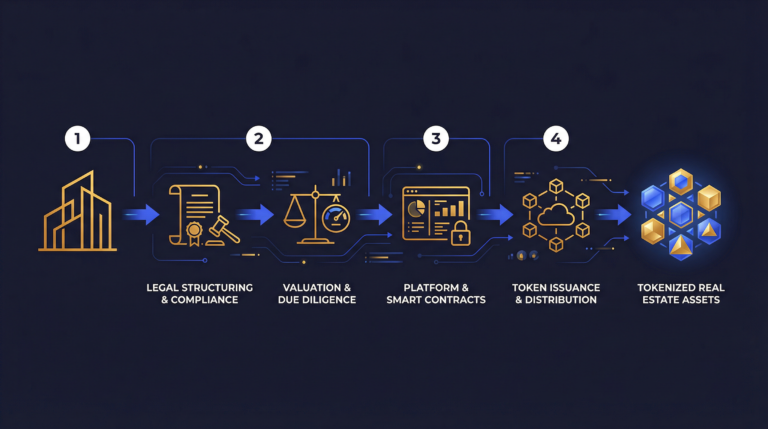
Building a Tokenized Real Estate Portfolio: A Complete Guide
Investors moving beyond single-property exposure now have the infrastructure to build a highly diversified tokenized real estate portfolio. Historically, achieving meaningful diversification across property types, tenant profiles, and geographic regions required millions of dollars in upfront capital and extensive operational overhead. Today, blockchain-based fractionalization allows investors to construct institutional-grade property portfolios with starting capital ranging from $10,000 to $50,000. This technological shift fundamentally alters real estate investment strategy, moving the focus away from slow capital accumulation toward precise, immediate asset allocation. Rather than saving for years to acquire a single rental property that concentrates risk in one local market, investors can deploy capital across dozens of distinct real estate markets globally in a matter of hours. This guide examines how to allocate capital across different property types, compare the major tokenization platforms, optimize yield generation, and manage the unique risks associated with blockchain-based property rights.
Principles of fractional real estate portfolio construction
Constructing a tokenized real estate portfolio requires applying traditional asset allocation theory to micro-investments. Investors should target 15 to 30 distinct properties across multiple geographic regions and asset classes to minimize idiosyncratic property risk while optimizing for a blended target yield of 6% to 9%.
Traditional real estate portfolio theory emphasizes diversification across property types, lease durations, and tenant credit profiles to smooth cash flows during economic cycles. The primary advantage of fractional real estate portfolio construction is the ability to execute this strategy with a fraction of the traditional capital requirements. Instead of concentrating risk in a single $500,000 rental property, an investor can distribute $50,000 across 50 different properties in 10 different markets. Determining the optimal portfolio size depends on the investor’s capacity to monitor the assets, but mathematical diversification benefits typically begin to diminish after 20 to 30 uncorrelated positions. Investors must decide between equal-weighting their positions or using a risk-adjusted sizing model where lower-risk multifamily properties receive larger allocations than higher-risk hospitality assets. Establishing strict position limits, such as allocating no more than 5% of total capital to any single property, protects the overall portfolio from localized vacancies or unexpected maintenance emergencies.
Diversification across property types is critical for managing economic exposure and stabilizing returns across different market environments. Multifamily residential properties generally offer lower volatility and highly predictable cash flows, typically yielding 4% to 7% annually on platforms that specialize in residential assets. Commercial office space presents higher risk in the post-pandemic environment but occasionally offers distressed pricing opportunities through specialized institutional portals for investors with higher risk tolerance. Industrial and logistics properties currently demonstrate strong fundamentals driven by e-commerce demand, though tokenized supply remains limited compared to residential assets. Hospitality and short-term rentals offer higher yield potential, often reaching 8% to 12%, but introduce significant seasonal volatility and higher operational risks that require careful monitoring. Retail properties present mixed fundamentals, with grocery-anchored centers providing stability while discretionary retail faces ongoing macroeconomic headwinds. Self-storage facilities offer historically recession-resistant characteristics and are increasingly available in tokenized formats for investors seeking defensive allocations during economic uncertainty.
Geographic diversification further protects the portfolio from localized economic downturns, municipal regulatory changes, and natural disasters. United States properties currently dominate the market, accounting for approximately 70% of all tokenized real estate by value according to industry data. However, investors can now access international markets to hedge against domestic economic concentration and currency fluctuations. Opportunities exist in Dubai and the broader United Arab Emirates through regional platforms, while European properties are increasingly accessible through compliance-focused infrastructure providers. Emerging markets in Latin America and Southeast Asia offer higher growth potential but introduce significant currency risk and complex legal jurisdiction variables that require thorough evaluation. When investing across borders, investors must carefully evaluate how local property laws interact with digital token ownership and whether the platform has established bankruptcy-remote structures in each specific jurisdiction. Understanding tokenized real estate investing basics is essential before allocating capital across multiple international legal frameworks and tax regimes.
Platform selection and yield analysis
Selecting the right platforms is critical for a tokenized property investment strategy, as each provider offers different regulatory structures, property types, and liquidity mechanisms. Investors should diversify across at least three major platforms to mitigate smart contract and counterparty risks while accessing different geographic markets and asset classes.
The tokenized real estate market features several dominant platforms, each operating on different blockchain networks with distinct operational models and target demographics. RealT operates primarily on Ethereum and Gnosis Chain, offering a portfolio of over 350 properties heavily concentrated in Detroit, Chicago, and other Midwestern markets. The platform requires a $50 minimum investment and distributes rental income daily in USDC, typically generating average yields between 8% and 12%. Lofty utilizes the Algorand blockchain to offer fractional ownership of US properties, also featuring $50 minimums and daily rent distributions, with historical yields generally ranging from 5% to 9%. Arrived takes a different regulatory approach, operating under SEC Regulation A+ and Regulation D exemptions to offer single-family homes and vacation rentals to both retail and accredited investors. Arrived requires a $100 minimum investment and processes distributions quarterly, producing average yields of 3% to 7% depending on the specific property type and leverage used. Blocksquare focuses on the European market, providing a compliance-first infrastructure protocol for real estate tokenization rather than acting as a direct-to-consumer marketplace, allowing local operators to issue tokens under European regulatory frameworks.
| Platform | Blockchain Network | Minimum Investment | Distribution Frequency | Average Yield | Primary Property Focus |
|---|---|---|---|---|---|
| RealT | Ethereum / Gnosis | $50 | Daily (USDC) | 8% – 12% | US Midwestern Residential |
| Lofty | Algorand | $50 | Daily | 5% – 9% | US Residential & Mixed-Use |
| Arrived | Off-chain (SEC Regulated) | $100 | Quarterly | 3% – 7% | US Single-Family & Vacation |
| Blocksquare | Ethereum | Varies by issuer | Varies by issuer | Varies | European Commercial & Residential |
Real estate token yield optimization requires a thorough understanding of how different platforms calculate and distribute returns to token holders. Total return consists of net rental income, property appreciation, and occasionally platform-specific incentives like governance tokens or staking rewards. Net rental income is the most predictable component, but investors must carefully review the fee structures, as property management fees, platform administration fees, and maintenance reserves can significantly reduce the gross yield. Property appreciation is typically realized only when the underlying asset is sold, though some platforms allow tokens to trade on secondary markets where prices may reflect estimated appreciation based on third-party appraisals. Investors must evaluate whether stated yields are sustainable by analyzing local vacancy rates, the quality of the property management team, and the physical condition of the asset prior to tokenization. Reinvesting distributions systematically is one of the most effective strategies for compounding returns, especially on platforms that offer daily or weekly payouts with minimal transaction friction.
Evaluating platform mechanics is just as important as analyzing the underlying real estate when deciding where to buy security tokens. Liquidity remains a significant variable across the ecosystem, with some platforms offering automated market makers for instant liquidity while others rely on bulletin boards or periodic redemption windows that can freeze capital during market downturns. Investors must also consider the underlying blockchain infrastructure, as network congestion and transaction fees on Layer 1 networks can quickly erode the returns of small daily distributions. To build a resilient portfolio, investors should allocate capital across platforms that use different custody models, legal wrappers, and regulatory frameworks. Understanding how to invest in tokenized assets across different technical standards ensures that a failure in one specific smart contract architecture does not compromise the entire real estate portfolio.
Risk management and portfolio monitoring
Managing a tokenized real estate portfolio requires monitoring property-level fundamentals, platform counterparty health, and broader macroeconomic conditions. Investors should utilize on-chain tracking tools to verify rent distributions and maintain strict position limits to protect against localized vacancies, natural disasters, or technical vulnerabilities.
Property-specific risks remain the foundation of real estate investment, regardless of the technological wrapper used to issue shares. Vacancy represents the most immediate threat to yield, particularly in single-tenant properties where a departure drops revenue to zero until a replacement is found. Maintenance emergencies, natural disasters, and tenant defaults can quickly deplete property reserve funds and force platforms to suspend dividend distributions to rebuild capital buffers. Investors mitigate these risks through broad diversification, ensuring that a major roof replacement on one property only impacts a tiny fraction of the total portfolio yield. Reviewing property inspection reports, monitoring local market employment data, and tracking neighborhood crime statistics are necessary steps for maintaining a healthy portfolio over a multi-year time horizon. While the tokenization layer provides transaction efficiency, the underlying asset still requires traditional real estate due diligence and ongoing performance monitoring.
Platform and technical risks introduce new variables that traditional real estate investors rarely encounter in conventional markets. Smart contract vulnerabilities could allow malicious actors to drain distribution pools or manipulate token balances, making comprehensive third-party smart contract audits a mandatory prerequisite for platform selection. Regulatory shutdown or platform insolvency presents another severe risk, highlighting the importance of bankruptcy-remote legal structures that separate the property-holding entities from the platform’s operating company. If a platform ceases operations, investors need clear legal mechanisms to replace the property manager and continue receiving returns without interruption. These tokenized asset risks require investors to monitor platform financial statements, regulatory filings, and executive team changes just as closely as they monitor the real estate itself. Setting up automated alerts for platform news and regulatory developments helps investors react quickly to structural changes in the market before liquidity dries up.
Market risks affect property valuations and rental rates across broad geographic areas, independent of specific property or platform performance. Rising interest rates generally exert downward pressure on commercial real estate valuations while simultaneously increasing the cost of debt for properties carrying mortgages. Local market downturns driven by major employer relocations or demographic shifts can depress rental rates and increase vacancy periods across an entire city or region. To effectively monitor these macroeconomic factors, investors should utilize specialized on-chain tools that aggregate token values and distribution histories across multiple wallets and platforms into a single dashboard. Cross-referencing on-chain distribution data with traditional real estate market indices provides a comprehensive view of portfolio performance relative to broader market benchmarks. Familiarity with specific tokenization glossary terms is helpful when configuring these portfolio tracking dashboards to ensure accurate data aggregation and reporting.
Tax implications for multi-platform holdings
The taxation of tokenized real estate involves tracking ordinary income from rent distributions and capital gains from token sales across multiple platforms. Investors face significant administrative burdens in reconciling micro-transactions and must navigate unclear regulatory guidance regarding the applicability of traditional real estate tax benefits.
Rental income generated by tokenized real estate is generally treated as ordinary income in most tax jurisdictions, subject to standard income tax rates rather than preferential dividend rates. Because platforms distribute this income at different frequencies ranging from daily micro-payments to quarterly lump sums, tracking the cost basis and income realization across dozens of properties creates a substantial administrative burden. Investors must aggregate these distributions across all platforms and wallets to ensure accurate reporting to tax authorities at the end of the fiscal year. Some platforms simplify this process by issuing consolidated tax forms like the 1099-DIV or Schedule K-1 in the United States, while decentralized protocols often place the entire reporting burden squarely on the investor. The complexity multiplies for investors holding international properties, as foreign withholding taxes may apply to rental distributions before they ever reach the investor’s wallet, requiring careful navigation of international tax treaties to avoid double taxation.
Capital gains treatment applies when an investor sells real estate tokens on a secondary market or when the underlying property is liquidated and the proceeds are distributed to token holders. Calculating capital gains on tokenized securities requires precise tracking of the acquisition date and purchase price for every token, which becomes complicated when investors use automated reinvestment programs that purchase fractional tokens daily at varying price points. Short-term capital gains rates apply to tokens held for less than a year, while lower long-term rates apply to positions held longer. A major unresolved issue in the United States is whether tokenized real estate qualifies for Section 1031 like-kind exchanges, which allow investors to defer capital gains taxes when swapping one investment property for another. Currently, the IRS has not provided clear guidance on whether real estate tokens represent real property or intangible digital assets for the purposes of 1031 exchanges, prompting conservative tax professionals to advise against attempting these deferrals until formal rulings are issued.
Conclusion
Building a diversified tokenized real estate portfolio offers unprecedented access to global property markets without the traditional barriers of massive capital requirements and geographic constraints. By strategically allocating capital across residential, commercial, and industrial properties using multiple issuance platforms, investors can construct resilient portfolios that generate consistent yield while mitigating localized risks. The key to long-term success lies in balancing the pursuit of high-yield opportunities with rigorous platform due diligence, strict position sizing rules, and an understanding of the underlying legal frameworks governing digital property rights.
As the market matures and total tokenized real estate assets are projected to grow significantly through 2026, the infrastructure for tracking, trading, and managing these fractional positions will continue to improve. Investors should begin by selecting two or three reputable platforms, deploying capital across a mix of asset classes, and establishing automated systems for monitoring distributions and tax liabilities. By treating tokenized real estate with the same analytical rigor as traditional property investments, investors can fully leverage the benefits of a tokenized real estate portfolio to build sustainable, diversified wealth.
Frequently Asked Questions
How many properties should be in a tokenized real estate portfolio?
A well-diversified tokenized real estate portfolio typically contains 15 to 30 distinct properties. This quantity provides sufficient geographic and asset-class diversification to minimize the impact of individual property vacancies or maintenance issues without creating an unmanageable administrative burden for the investor.
What are the average yields for tokenized real estate?
Average yields generally range from 4% to 12% annually, depending heavily on the property type and platform. Residential platforms like Lofty typically yield 5% to 9%, while short-term rental properties or specific Midwestern markets on platforms like RealT can occasionally reach 8% to 12%.
Can I use a 1031 exchange for tokenized real estate?
The IRS has not provided clear guidance on whether tokenized real estate qualifies for Section 1031 like-kind exchanges. Because tokens might be classified as intangible digital assets or securities rather than direct real property, most tax professionals currently advise against attempting 1031 exchanges with real estate tokens.
Do I need a crypto wallet to build a tokenized real estate portfolio?
It depends on the platform you choose to use. Decentralized platforms like RealT and Lofty require a compatible cryptocurrency wallet to receive tokens and daily rent distributions, while regulated platforms like Arrived hold the assets off-chain and deposit returns directly into a standard bank account.
Sources
- [1] Boston Consulting Group, Asset Tokenization Market Size and Geographic Distribution Projections 2024-2026
- [2] RealT Platform Documentation, Historical Yields and Property Distribution Statistics
- [3] Securities and Exchange Commission, Regulation A+ and Regulation D Exemptions for Fractional Real Estate Issuers
- [4] Internal Revenue Service, Digital Asset Tax Guidance and Section 1031 Exchange Limitations