Tokenized Music Royalties Investing: Complete Guide
Global recorded music revenue has transformed into a highly predictable, recurring cash flow engine driven by subscription streaming services. For decades, the financial benefits of this catalog revenue were locked behind private equity doors or major label balance sheets. Today, tokenized music royalties investing allows retail and institutional buyers to acquire fractional ownership of these cash flows directly. By converting legal rights to future streaming payouts into digital tokens, blockchain technology is creating a new alternative asset class with yields that operate independently of traditional stock and bond markets. Investors who understand how to navigate copyright mechanics and platform risks can now build portfolios that generate income every time a user presses play on Spotify or Apple Music.
The institutional appetite for music rights was clearly established by entities like the Hipgnosis Songs Fund and Round Hill Music Royalty Fund, which spent billions acquiring massive catalogs over the past decade. These funds proved that music royalties behave similarly to commercial real estate or corporate bonds, offering steady, long-term cash flows that remain largely unaffected by macroeconomic downturns. People continue listening to their favorite songs during recessions, providing a defensive characteristic to the asset class. However, these traditional funds faced significant structural and valuation challenges, highlighting the difficulty of managing opaque intellectual property assets in legacy financial wrappers. The transition toward blockchain-based fractionalization attempts to solve some of these structural inefficiencies by automating royalty distribution and creating programmable, transparent ownership records.
Understanding what asset tokenization means in this context requires separating the underlying legal rights from the technological wrapper. When you purchase music royalty tokens, you are not buying the copyright itself, but rather a contractual right to a specific percentage of the future cash flows generated by that copyright. This legal assignment is recorded on a blockchain, and smart contracts automatically route incoming royalty payments to the current token holders. As the global streaming economy continues to expand, these digital assets provide a direct mechanism for investors to capture the upside of subscription growth without needing the millions of dollars previously required to buy a complete song catalog.
The mechanics of music royalty tokenization
Tokenized music royalties transform future streaming revenue into investable digital assets. Rights holders assign a percentage of their earnings to a smart contract, which issues fractional tokens to investors who then receive proportional payouts as songs generate streams on major audio platforms.
The fundamental economic driver behind this asset class is the massive scale of the modern streaming industry. According to the International Federation of the Phonographic Industry (IFPI), global recorded music revenue reached $28.6 billion in 2023. Streaming accounted for a dominant 67 percent of that total, representing $19.3 billion in revenue. This capital flows from monthly subscriptions on platforms like Spotify, Apple Music, YouTube Music, and Amazon Music, creating a massive, predictable pool of capital. Because copyright protections in the United States last for 70 years after the death of the last surviving author, a successful song can generate these streaming royalties for decades. This long-tail revenue profile makes investing in streaming royalties highly attractive to fixed-income investors seeking assets with low correlation to broader equity markets.
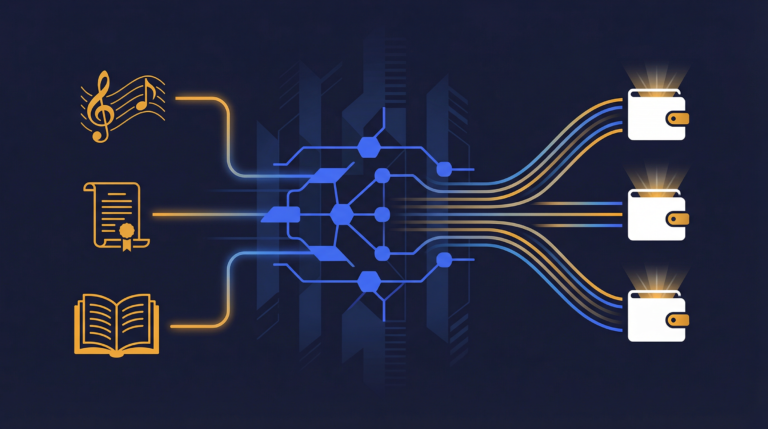
The tokenization process begins when an artist, songwriter, producer, or existing rights holder decides to monetize a portion of their future income. They might choose to tokenize 10 percent of the streaming royalties for a specific hit song or an entire catalog. A specialized platform then creates digital tokens representing fractional ownership of that specific royalty stream. These tokens are sold to investors, and the raised capital is paid upfront to the rights holder. As the song continues to generate streaming revenue, the collection societies and distributors route the funds to the tokenization platform. The platform’s smart contracts then distribute the capital proportionally to the wallets holding the tokens, typically paying out in stablecoins like USDC. This creates a direct, automated pipeline from the listener’s subscription fee to the investor’s digital wallet.
Navigating the legal mechanics is complex because music rights are divided into multiple distinct categories. The two primary halves are master recording rights (the specific audio recording of a song) and publishing rights (the underlying composition, lyrics, and melody). Tokenized music rights can represent either or both of these revenue streams, and investors must read the legal disclosures carefully to understand exactly what they are buying. In a direct royalty tokenization model, the token represents a direct economic interest backed by a legal assignment of that specific cash flow. In a fund model, tokens represent shares in a Special Purpose Vehicle (SPV) that holds the actual music rights. Both structures rely on traditional copyright law to enforce the revenue collection, using the blockchain simply as an efficient accounting and distribution ledger.
Major platforms driving fractional music investment
Several specialized platforms facilitate investing in streaming royalties by navigating complex copyright laws and securities regulations. Royal and Anotherblock lead the direct-to-fan tokenization space, while SongVest operates under specific SEC exemptions to offer fractional music investment to retail buyers.
Royal.io, co-founded by electronic musician DJ 3LAU, is one of the most prominent platforms for fractional music investment. The platform allows fans and investors to buy fractional ownership of music streaming royalties directly from artists. High-profile musicians including Nas, The Chainsmokers, and Diplo have successfully tokenized portions of their catalogs through Royal. The platform lowers the barrier to entry significantly, with minimum investments sometimes starting as low as $50. Royalties are distributed to token holders based on actual, verifiable streaming data collected from digital service providers. The investor experience is designed to be seamless, bridging the gap between traditional music fans and cryptocurrency investors while providing transparent yield data on past payouts.
Anotherblock, a Swedish tokenization platform, takes a slightly different approach by frequently working with rights holders rather than the performing artists themselves. The platform has successfully tokenized shares of music royalties for globally recognized tracks performed by Rihanna, Justin Bieber, and The Weeknd. Because a single hit song has multiple rights holders-including producers, co-writers, and session musicians-Anotherblock can tokenize a producer’s cut of a massive pop hit even if the headline artist is not involved in the deal. This provides investors with access to top-tier, proven catalog assets that generate highly predictable streaming volumes. The platform focuses heavily on the financial metrics of the underlying tracks, providing detailed historical streaming data to help buyers model their expected returns.
Operating within a strict traditional regulatory framework, the US-based platform SongVest utilizes SEC Regulation A+ to offer music royalty tokenization. This regulatory status allows them to sell fractional shares of music royalties to non-accredited retail investors legally. By filing offering circulars with the Securities and Exchange Commission, SongVest provides a level of disclosure and regulatory oversight that many offshore crypto platforms lack. Meanwhile, platforms like Opulous combine music royalty tokenization with decentralized finance lending mechanics, allowing artists to borrow against their future royalties rather than selling them permanently. As you learn how to invest in tokenized assets, understanding the regulatory and structural differences between these platforms is critical for assessing counterparty risk.
Yield dynamics and valuation models for music rights
Music royalty tokens generate yields based on streaming volume, platform payout rates, and the initial purchase price. Valuation typically relies on a multiple of Net Publisher Share, with established catalogs trading at 10 to 20 times their annual revenue depending on historical stability.
The actual returns an investor earns depend entirely on the microeconomics of the streaming industry. Different platforms pay vastly different rates per stream based on their subscription models and regional user bases. According to industry data, Spotify currently pays an average of approximately $0.003 to $0.005 per stream. Apple Music generally offers a higher payout rate, averaging approximately $0.007 to $0.01 per stream. To generate meaningful yield, a tokenized song must maintain millions of streams across these platforms consistently. Typical yield ranges for popular catalog songs fall between 5 and 15 percent annually, though this varies significantly based on the entry price. Seasonal patterns also heavily influence these yields; holiday music generates massive spikes in the fourth quarter, while summer anthems peak in the third quarter, creating lumpy but predictable cash flow distributions for token holders.
Valuing music royalty tokens requires applying traditional catalog valuation metrics to the fractional shares. The standard industry approach uses a multiple of Net Publisher Share (NPS), which is the gross royalty income minus administration fees. Established, well-known music catalogs typically trade at 10 to 20 times their annual NPS. Newer music trades at much lower multiples because the long-term streaming trajectory is highly uncertain. Most songs experience a rapid decline in streaming volume within 12 to 18 months of release before stabilizing at a lower baseline for the remainder of their copyright life. For tokenized assets, the pricing should reflect this underlying catalog valuation, though platforms sometimes charge a premium for the liquidity and accessibility the token format provides.
Institutional investors evaluating music NFT royalties often use a Discounted Cash Flow (DCF) model to determine fair value. This involves projecting the future streaming revenue over the remaining life of the copyright and discounting it back to present value. The discount rate applied to music royalties typically ranges from 8 to 12 percent, reflecting the unique risk profile of the asset class. When a platform prices a token offering, investors should run their own DCF calculations based on historical streaming decay curves rather than assuming the current year’s revenue will remain flat forever. Understanding these valuation mechanics is just as important when analyzing music rights as it is when evaluating an Ondo Finance review for tokenized Treasury yields.
Risk factors and portfolio construction strategies
Investing in tokenized music rights carries distinct risks including streaming platform payout reductions, AI-generated music competition, and complex copyright disputes. Investors should limit allocations to 1 to 5 percent of their portfolio while diversifying across different artists, genres, and release vintages.
The most significant systemic threat to music royalty investments is streaming rate risk. If major platforms like Spotify or Apple Music face margin pressure and successfully negotiate lower per-stream payouts with the major labels, the value of all music royalty tokens will decline proportionally. Additionally, technological disruption poses a severe long-term threat. As AI-generated music floods streaming platforms, it competes directly for listener attention and algorithmic placement, potentially reducing the market share of human-created catalog music. Investors must also consider platform risk; if the tokenization entity goes bankrupt, the administrative process of collecting and routing the royalties to token holders could break down, stranding the assets. Finally, artist risk remains a unique factor, as public controversies or cancellations can cause immediate, severe drops in a specific artist’s streaming numbers.
To mitigate these tokenized asset risks, investors must focus on rigorous portfolio construction. A single song or a small catalog is highly undiversified compared to a traditional music royalty fund. Investors should build a basket of tokens spread across multiple artists, distinct musical genres, and different vintage years to smooth out the revenue curve. Older, established catalog tracks provide stability, while newer releases offer higher initial yields with faster decay rates. Financial advisors typically suggest limiting music royalty allocations to 1 to 5 percent of a broader portfolio, positioning it as a specialized alternative income stream. It is also vital to understand the tax implications, as music royalty payouts are generally taxed as ordinary income rather than qualified dividends or capital gains, which significantly impacts the actual after-tax yield of the investment.
Integrating music royalties alongside other tokenized real-world assets can create a highly resilient alternative income portfolio. By combining the uncorrelated yields of music streaming with the macroeconomic sensitivity of tokenized real estate or private credit, investors can achieve superior risk-adjusted returns. If you are exploring what is RWA tokenization, music rights offer one of the clearest examples of how blockchain technology can democratize access to institutional-grade cash flows. As the legal frameworks mature and secondary market liquidity improves, tokenized music royalties are positioned to become a standard component of modern income-focused investment strategies.
Frequently Asked Questions
How much do streaming platforms actually pay per stream?
Streaming payouts vary by platform, region, and user subscription type. Spotify typically pays between $0.003 and $0.005 per stream, while Apple Music pays slightly more at approximately $0.007 to $0.01 per stream. These fractional pennies accumulate rapidly for songs with millions of monthly listeners.
Do I own the copyright when I buy a music royalty token?
No, you do not own the underlying copyright. You are purchasing a contractual right to receive a specific percentage of the future cash flows generated by that copyright. The original artist or rights holder retains actual ownership and creative control over the music.
How are tokenized music royalty earnings taxed?
Music royalty income is generally treated as ordinary income by tax authorities, not as capital gains or qualified dividends. This means the yields you receive will be taxed at your standard marginal income tax rate, which you must factor into your net return calculations.
What happens if the tokenization platform goes out of business?
If a platform fails, the legal rights to the royalties still exist, but the collection and distribution mechanics may break down. Regulated platforms often use bankruptcy-remote Special Purpose Vehicles (SPVs) to protect the assets, ensuring a third-party administrator can continue paying token holders.
Why do newer songs have different valuation multiples than older songs?
Newer songs have highly unpredictable future streaming volumes, often dropping significantly 12 to 18 months after release. Older catalog songs have established, stable listening baselines. Therefore, older catalogs trade at higher multiples because their future cash flows are much more certain.