Ondo Finance Update (2026): OUSG, USDY Yields & RWA TVL
The intersection of traditional fixed income and decentralized finance has matured rapidly, creating a distinct market for on-chain government securities. This Ondo Finance 2026 update examines how the platform has positioned itself within this expanding sector. Institutional investors and crypto-native treasuries increasingly require yield-bearing assets that operate seamlessly within blockchain environments without sacrificing regulatory compliance or asset security. Ondo Finance addresses this demand by wrapping traditional financial instruments into programmable tokens that can be transferred, traded, and utilized as collateral across multiple decentralized applications.
Evaluating the current state of the platform requires a detailed look at its product architecture, total value locked metrics, and cross-chain deployment strategy. The market for tokenized real-world assets has grown highly competitive, with traditional asset managers and specialized crypto firms vying for market share. Understanding how Ondo Finance structures its products, manages regulatory boundaries, and generates yield provides necessary context for investors navigating this space. This analysis covers the platform’s core offerings, fee structures, and overall market position based on current on-chain data and institutional integrations.
• Ondo Finance 2026 update and platform overview: This Ondo Finance 2026 update reveals a platform that transitioned from decentralized finance structured products to a leading issuer of tokenized real-world assets.
• Ondo USDY growth and tokenized treasury products: Ondo USDY growth has accelerated significantly, pushing total platform value locked past $600 million as of early 2026.
• Fee structure, pricing, and regulatory compliance: Ondo Finance charges a management fee of 0.15% annually for its OUSG product, while USDY generates revenue through a yield spread rather than direct management fees.
Ondo Finance 2026 update and platform overview
This Ondo Finance 2026 update reveals a platform that transitioned from decentralized finance structured products to a leading issuer of tokenized real-world assets. Founded in 2021 by Nathan Allman, Ondo operates across Ethereum, Solana, and several alternative layer-one networks to provide institutional-grade yield products to on-chain investors.
The initial iteration of Ondo Finance focused on decentralized finance vaults that offered structured risk products to liquidity providers. The platform eventually pivoted entirely toward real-world assets, recognizing a broader market opportunity in bringing traditional financial yields on-chain. This strategic shift allowed the company to capitalize on the rising interest rate environment of 2022 and 2023. By establishing a legal and technical bridge between traditional banking infrastructure and public blockchains, Ondo created a mechanism for capital to flow from crypto ecosystems into United States government securities. The underlying technology stack relies on standard ERC-20 smart contracts on Ethereum, augmented by native deployments on alternative networks to reduce transaction costs and increase accessibility.
Understanding exactly what is asset tokenization requires looking at how Ondo structures its legal entities. The platform uses bankruptcy-remote special purpose vehicles to hold the underlying traditional assets, separating the financial risk of the assets from the corporate risk of Ondo Finance Inc. This structure ensures that if the technology company ceases operations, the underlying assets remain protected and accessible to token holders. The smart contracts governing the tokens enforce transfer restrictions based on investor compliance status, utilizing a whitelist system managed by the platform. This technical enforcement of legal rules allows the tokens to exist on permissionless blockchains while remaining compliant with securities regulations.
The ONDO token serves as the governance mechanism for the Ondo DAO, which controls certain parameters of the protocol and manages the treasury. The governance model allows token holders to vote on proposals related to product expansions, fee adjustments, and strategic partnerships. While the core asset management functions remain centralized for regulatory reasons, the decentralized autonomous organization provides a layer of community oversight regarding the protocol’s integration into the broader decentralized finance ecosystem. This hybrid approach attempts to balance the strict compliance requirements of traditional finance with the community-driven ethos of blockchain technology.
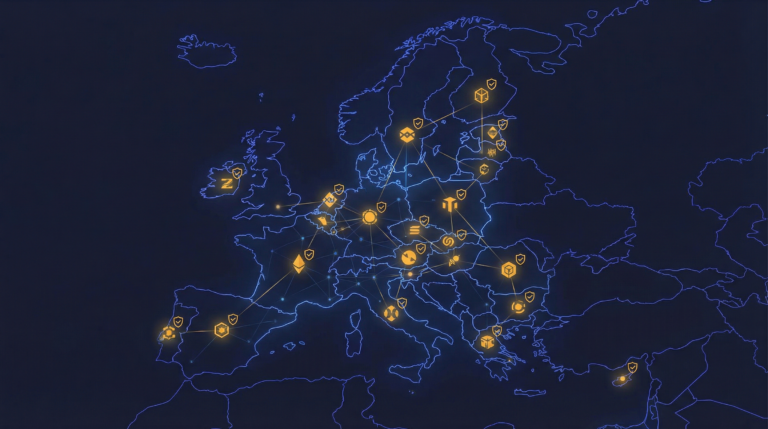
Cross-chain expansion has become a primary focus for the platform’s engineering team over the past year. Rather than relying solely on bridged assets, which introduce additional smart contract risks, Ondo has pursued native token deployments across networks like Solana, Sui, Aptos, and Mantle. This strategy requires maintaining separate smart contract architectures and liquidity pools on each chain, but it provides users with faster transaction times and lower fees compared to the Ethereum mainnet. By deploying natively, Ondo ensures that its yield-bearing tokens can integrate directly into the decentralized applications native to those specific ecosystems without friction.
Ondo USDY growth and tokenized treasury products
Ondo USDY growth has accelerated significantly, pushing total platform value locked past $600 million as of early 2026. The platform dominates the tokenized treasury sector alongside major asset managers by integrating its yield-bearing products directly into decentralized finance protocols like Pendle and Morpho across multiple blockchain networks.
The flagship product driving the Ondo Finance TVL is the US Dollar Yield token, commonly referred to as USDY. This instrument is structured as a tokenized note secured by short-term United States Treasuries and bank demand deposits. Unlike algorithmic or fiat-backed stablecoins that typically do not pass yield to holders, USDY accrues value based on the interest generated by its underlying reserve assets. The token is designed for non-US investors and operates under Regulation S exemptions, providing global crypto users with access to institutional-grade dollar yields. According to data from rwa.xyz published in January 2026, USDY currently accounts for approximately $400 million of the platform’s total assets under management.
The second core product is the Ondo Short-Term US Government Bond Fund, known by the ticker OUSG. This product targets a different demographic, specifically institutional and accredited investors who can pass stringent regulatory checks. OUSG represents fractional ownership in a fund heavily invested in short-term government securities. The underlying assets for OUSG have evolved, with the platform increasingly utilizing BlackRock’s BUIDL token as a core reserve asset to improve subscription and redemption times. This integration demonstrates the growing composability between different tokenized asset providers, where one platform utilizes the infrastructure of another to optimize capital efficiency and liquidity management.
Decentralized finance integrations represent a critical component of the Ondo tokenized treasury strategy. Yield-bearing assets lose their utility if they cannot be deployed within lending markets or decentralized exchanges. Ondo has successfully integrated USDY and OUSG into major protocols, allowing users to post these tokens as collateral to borrow stablecoins or other crypto assets. Integrations with platforms like Curve Finance provide deep liquidity pools for swapping between Ondo products and standard stablecoins, while partnerships with yield-stripping protocols like Pendle allow users to separate the principal from the yield for advanced trading strategies. These integrations create secondary utility for the tokens beyond simple yield accumulation.
Tracking the exact trajectory of Ondo Finance TVL requires analyzing data across its supported blockchains. According to DefiLlama metrics from February 2026, the total value locked fluctuates based on both organic demand for yield and the broader crypto market cycles. When crypto-native yields drop, capital tends to flow into tokenized treasuries like USDY for stable returns. Conversely, during aggressive bull markets, users often leverage their Ondo assets as collateral to borrow funds for higher-risk investments. This dynamic positions Ondo products as foundational collateral layers within the decentralized finance ecosystem, similar to how traditional government bonds function in conventional banking.
For users exploring how to invest in tokenized assets, the mechanics of acquiring these tokens vary by product. Minting USDY or OUSG directly through the platform requires completing a comprehensive verification process and funding an account via wire transfer or stablecoin deposit. However, because USDY trades on secondary decentralized markets, eligible users can often acquire the token through decentralized exchanges without directly interacting with the Ondo platform’s primary issuance infrastructure. This secondary market liquidity is maintained by market makers and incentivized liquidity pools, ensuring that users can enter and exit positions with minimal slippage.
Fee structure, pricing, and regulatory compliance
Ondo Finance charges a management fee of 0.15% annually for its OUSG product, while USDY generates revenue through a yield spread rather than direct management fees. The platform enforces strict regulatory compliance through automated smart contract whitelists and mandatory identity verification for all primary issuance customers.
The cost of interacting with tokenized assets often involves multiple layers of fees, and Ondo structures its pricing differently depending on the specific product. For the OUSG fund, the platform charges a transparent 0.15% annualized management fee, which is deducted from the overall yield generated by the underlying assets. Investors must also account for the fees associated with the underlying exchange-traded funds or tokenized funds that OUSG holds, such as the management fees charged by BlackRock for the BUIDL token. Per Ondo Finance documentation updated in January 2026, the platform covers the costs of custody and administration, but users are responsible for network gas fees incurred during minting and redemption transactions.
The revenue model for USDY operates differently, utilizing a spread mechanism rather than a explicit management fee. Ondo sets the yield rate for USDY slightly below the actual interest rate earned by the underlying bank deposits and treasury bills. The difference between the actual yield and the distributed yield constitutes the platform’s revenue. This model mirrors traditional banking practices and allows Ondo to offer the token without complex fee deduction mechanics on-chain. The specific yield rate for USDY is adjusted periodically based on prevailing macroeconomic conditions and federal funds rate changes, with announcements made transparently to the community.
Regulatory compliance dictates the entire operational structure of the platform. Because the underlying assets are traditional securities, Ondo must navigate complex jurisdictional rules regarding who can purchase and hold the tokens. Compared to our recent Securitize review, Ondo takes a similarly rigorous approach to primary issuance but structures its secondary market restrictions differently based on the specific exemptions utilized. OUSG is issued under Rule 506(c) of Regulation D, restricting it entirely to verified accredited investors. The smart contracts governing OUSG enforce this by requiring every wallet address to be cryptographically whitelisted before it can send or receive the token.
USDY utilizes a different regulatory framework, operating under Regulation S, which governs offers and sales made outside the United States. This means USDY cannot be offered to, purchased by, or held by US persons or entities. The platform employs geographic blocking, identity verification, and strict terms of service to enforce this restriction during primary issuance. While USDY is designed to be more freely transferable on secondary markets than OUSG, the smart contracts still contain administrative functions that allow the protocol to freeze assets if necessary to comply with law enforcement or regulatory mandates. These administrative controls are a standard requirement for regulated on-chain assets.
Navigating tokenized asset risks requires understanding both the financial and technical vulnerabilities of the platform. Financially, the products carry counterparty risk associated with the banking partners and custodians holding the reserve assets. Technically, the platform relies on the security of its smart contracts and the underlying blockchain networks. To mitigate these risks, Ondo conducts regular security audits with top-tier blockchain security firms and maintains a public bug bounty program. Additionally, the platform provides daily transparency reports detailing the exact composition of the reserve assets, verified by independent third-party accounting firms to ensure the tokens remain fully backed at all times.
Ondo Finance 2026 update scoring and evaluation criteria
Our evaluation of Ondo Finance balances its strong liquidity profile and extensive decentralized finance integrations against the strict regulatory gating of its products. The platform scores highly for transparency and multi-chain architecture but loses points for the geographic restrictions limiting access for retail investors.
Evaluating platforms in this sector requires a consistent methodology focused on asset security, liquidity, compliance, and user experience. We assess these platforms by analyzing on-chain transaction data, reviewing legal structuring documents, and testing the user interface for primary issuance. Ondo Finance stands out primarily for its aggressive integration strategy. By ensuring that its tokens can be utilized in lending and borrowing protocols, Ondo has solved the utility problem that plagues many other tokenized real-world assets. The ability to use government-backed yield as collateral in decentralized finance represents a significant advancement in capital efficiency for crypto-native institutions.
The competitive landscape provides necessary context for this Ondo Finance 2026 update. The platform competes directly with traditional financial heavyweights like Franklin Templeton and BlackRock, as well as crypto-native issuers like Mountain Protocol and Superstate. Ondo maintains its market share by acting as a bridge between these two worlds. For instance, rather than competing directly with BlackRock’s BUIDL, Ondo utilizes it as a backend asset for OUSG, effectively acting as a distribution layer that connects traditional asset management with decentralized finance liquidity pools. This strategic positioning makes Ondo one of the best tokenization platforms for users seeking deep on-chain composability.
| Evaluation Category | Score (out of 5) | Evaluation Notes |
|---|---|---|
| Asset Security & Transparency | 4.8 | Daily attestations, bankruptcy-remote structures, and audited smart contracts provide high confidence. |
| Liquidity & Composability | 4.9 | Extensive DeFi integrations and secondary market liquidity across multiple blockchains. |
| Fee Structure | 4.5 | Competitive 0.15% fee for OUSG and a reasonable yield spread for USDY. |
| Regulatory Compliance | 4.7 | Strict adherence to Reg D and Reg S frameworks, utilizing automated smart contract controls. |
| Accessibility | 3.2 | Heavy geographic and accreditation restrictions limit access for the average retail user. |
The primary drawback of the platform remains its accessibility. The regulatory environment in the United States forces Ondo to exclude US retail investors from accessing USDY, which limits the total addressable market. Furthermore, the accreditation requirements for OUSG mean that only high-net-worth individuals and institutions can participate in that specific fund. While these restrictions are necessary for legal compliance, they create friction for users accustomed to the permissionless nature of decentralized finance. Readers can refer to our tokenization glossary for detailed definitions of these regulatory classifications.
Despite the access limitations, the technical execution of the platform remains exceptional. The multi-chain strategy ensures that users are not locked into the high gas fees of the Ethereum mainnet, and the native deployments on networks like Solana and Sui demonstrate a commitment to scalable infrastructure. The user interface for the primary application is clean, professional, and clearly outlines the yield calculations and underlying asset compositions. According to SEC Form D filings and public disclosures reviewed in early 2026, the corporate structure supporting these operations remains robust and well-capitalized.
The ongoing growth of Ondo Finance reflects a broader market acceptance of tokenized treasuries as a standard portfolio component for crypto investors. As the platform continues to expand its product offerings and integrate with new blockchain networks, it is well-positioned to capture further market share. The success of USDY in particular demonstrates that there is massive global demand for dollar-denominated yield products that operate efficiently on-chain. Investors should monitor the platform’s TVL metrics and new protocol integrations as leading indicators of its continued relevance in the market.
Key Compliance & Market Questions
What is the current Ondo Finance TVL?
Ondo Finance total value locked exceeds $600 million as of early 2026. This metric includes capital allocated across all their tokenized products, heavily driven by the expansion of USDY and OUSG across multiple blockchain networks and decentralized finance protocols.
Can US investors buy Ondo USDY?
United States investors cannot purchase or hold USDY. The token is issued under Regulation S exemptions, which strictly limits the offering to non-US persons. The platform enforces this restriction through mandatory identity verification and geographic blocking during the onboarding process.
What assets back the OUSG token?
OUSG is backed primarily by short-term United States government securities. The fund currently utilizes BlackRock’s tokenized BUIDL fund as a core reserve asset, allowing Ondo to offer institutional investors exposure to treasury yields with improved on-chain subscription and redemption mechanics.
Which blockchains support Ondo Finance products?
Ondo Finance supports native token deployments on Ethereum, Solana, Sui, Aptos, and Mantle. This multi-chain strategy allows users to interact with yield-bearing assets in lower-fee environments while integrating directly with the decentralized applications native to those specific ecosystems.