SWIFT Chainlink Tokenized Assets Integration Analysis
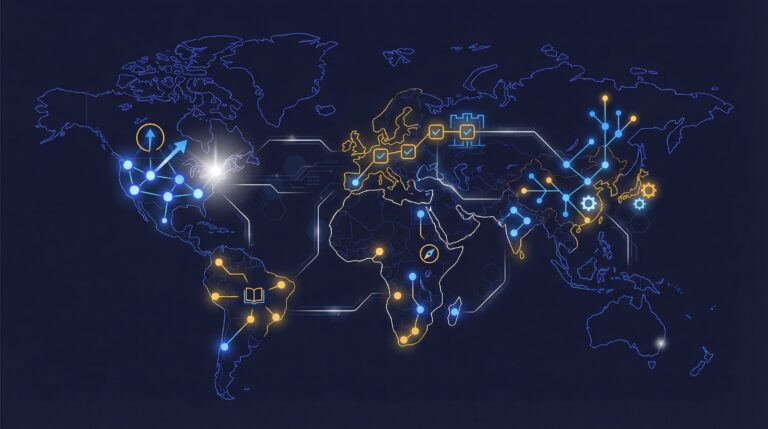
Global capital markets are currently building isolated digital islands. Major financial institutions recognize the efficiency gains of distributed ledger technology, but their proprietary development creates a fragmented landscape. The SWIFT Chainlink tokenized assets integration aims to solve this critical infrastructure gap by connecting existing financial messaging systems to multiple blockchain networks. Without a unified connective layer, the transition to blockchain-based financial markets risks recreating the exact silos that digital assets were designed to eliminate. This analysis examines how the world’s largest interbank messaging network plans to route institutional capital on-chain, effectively bridging traditional finance with decentralized infrastructure.
The Blockchain Interoperability Problem
The primary barrier to institutional blockchain adoption is interoperability. Financial institutions currently operate proprietary tokenization platforms that cannot communicate with each other. SWIFT addresses this by leveraging its existing network of 11,000 institutions across 200 countries to provide a single point of entry for cross-chain asset transfers.
To understand the magnitude of the interoperability problem, one must look at how banks are currently deploying capital into distributed ledger technology. Major financial institutions are launching their own proprietary blockchain networks to handle digital assets. JPMorgan has developed Kinexys, Goldman Sachs operates GS DAP, and HSBC uses its Orion platform. While these private networks function efficiently in isolation, they represent walled gardens that cannot natively interact with one another. If a client holding a tokenized bond on the Goldman Sachs network wishes to use that asset as collateral for a transaction on the JPMorgan network, the transfer requires complex, custom-built bridges or a reversion to legacy traditional finance rails. This fragmentation entirely defeats the purpose of blockchain technology, which promises unified, atomic settlement across a shared state. If you want to understand the foundational mechanics of this transition, reviewing exactly what is asset tokenization reveals why unified ledgers are so critical to market efficiency.
The scale of traditional financial infrastructure highlights why building custom bridges between every individual bank chain is mathematically and operationally impossible. The SWIFT network currently connects more than 11,000 financial institutions across over 200 countries, processing more than 45 million financial messages every single day. If even a fraction of these institutions built their own blockchain networks, the number of required point-to-point connections would number in the millions. This creates an urgent need for a universal translation layer. Instead of forcing thousands of banks to overhaul their core backend systems to interact with dozens of different public and private blockchains, the logical solution is to upgrade the existing central router. By enabling SWIFT messages to trigger on-chain events, banks can interact with digital assets using the exact same backend infrastructure they currently use for traditional fiat transfers.
Market projections indicate that the tokenization market size could reach trillions of dollars by the end of the decade, but this capital cannot flow efficiently without standardized rails. Traditional finance relies on a complex web of correspondent banking relationships, where institutions hold accounts with one another to facilitate cross-border transfers. Blockchain technology was supposed to eliminate this friction by allowing direct peer-to-peer transfers on a shared ledger. However, because different asset classes require different regulatory and technical environments, multiple ledgers will inevitably persist. The industry needs a protocol that allows a standard financial message to cross the boundary between traditional databases and distributed ledgers securely. This requirement set the stage for SWIFT to begin exploring how its secure messaging standard could be adapted for a tokenized economy.
The SWIFT Chainlink Tokenized Assets Integration
SWIFT partnered with Chainlink in 2022 to test cross-chain interoperability using the Cross-Chain Interoperability Protocol (CCIP). Initial trials included 12 major institutions like BNY Mellon and Euroclear, successfully demonstrating that standard SWIFT messages could instruct the transfer of tokenized value across both public and private blockchains.
SWIFT’s journey into distributed ledger technology did not begin recently. The cooperative began exploring blockchain in 2017 with various proof-of-concept projects aimed at reconciling international Nostro accounts. However, the turning point occurred in 2022 when SWIFT officially announced a collaboration with Chainlink to tackle the specific problem of cross-chain interoperability. The thesis was straightforward: SWIFT would continue to act as the secure messaging layer that banks already trust, while Chainlink’s Cross-Chain Interoperability Protocol (CCIP) would act as the transport layer, translating those messages into executable smart contract commands on various blockchains. The initial 2022 to 2023 experiments brought together an unprecedented consortium of traditional market infrastructure providers. Twelve major financial institutions participated, including BNP Paribas, BNY Mellon, Citi, Clearstream, Euroclear, and the Depository Trust & Clearing Corporation (DTCC).
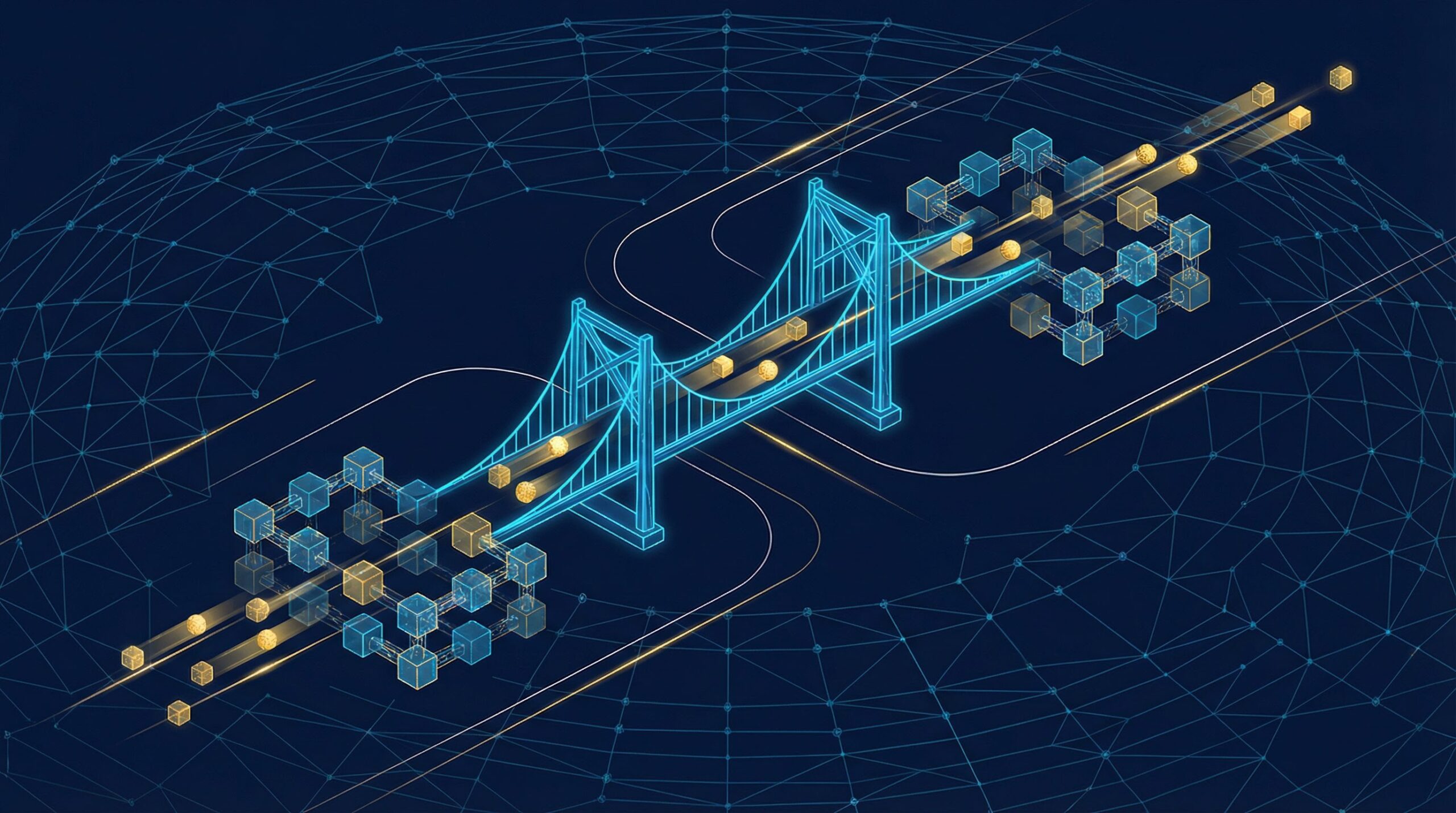
The technical architecture of this integration relies on separating the instruction from the execution while maintaining cryptographic security throughout the lifecycle of the transaction. When a bank wants to transfer a tokenized asset, it sends a standard SWIFT message from its existing terminal. This message is routed to a central SWIFT gateway that connects to Chainlink’s CCIP. The CCIP architecture handles the heavy lifting of cross-chain communication through several distinct components:
- Router Contracts: The primary entry and exit points for all cross-chain transactions, responsible for routing messages to the correct destination.
- OnRamp Contracts: These contracts verify the message details, check fee payments, and prepare the data for cross-chain transmission on the source blockchain.
- OffRamp Contracts: Located on the destination chain, these contracts execute the final transfer or smart contract call once the message is validated.
- Decentralized Oracle Network (DON): A network of independent node operators that observe the source chain, reach consensus on the transaction, and generate cryptographic proofs.
- Risk Management Network: An entirely independent secondary network that monitors the primary DON for anomalous activity and can halt cross-chain transfers if malicious behavior is detected.
Following the success of the initial proof of concept, SWIFT aggressively expanded its testing parameters. The 2023 to 2024 expanded experiments grew to include over 30 participating institutions and focused on highly complex use cases that mirror real-world capital markets operations. Specifically, the trials tested delivery-versus-payment (DvP) settlement, where tokenized securities are exchanged for tokenized cash simultaneously. These tests involved moving assets between different wallet environments on disparate blockchain networks, proving that a single SWIFT message could orchestrate a multi-chain transaction. For institutions looking to build out their digital asset capabilities, understanding this infrastructure is as important as reading a comprehensive RWA tokenization guide, because the transport layer dictates the liquidity of the underlying asset.
Evaluating SWIFT CCIP Blockchain Interoperability
The expanded SWIFT and Chainlink trials demonstrated near-instant delivery-versus-payment settlement, reducing standard T+2 timeframes to minutes. The integration successfully executed simultaneous settlement across multiple ledgers while significantly lowering reconciliation error rates, prompting SWIFT to target live commercial tokenization services for 2025 to 2026.
The empirical data generated from the 2023 and 2024 experiments provided the traditional financial sector with concrete evidence that blockchain interoperability is technically viable at an institutional scale. According to SWIFT’s official reports on the trials, the most significant achievement was the successful execution of delivery-versus-payment (DvP) settlement across different blockchain networks. In traditional finance, settling a securities trade often takes two full business days (T+2) because multiple intermediaries must update their respective ledgers, reconcile discrepancies, and manually process exceptions. During the SWIFT and Chainlink trials, the settlement time between tokenized securities and tokenized cash was reduced to near-instant execution. The systems achieved atomic settlement, meaning either both legs of the transaction succeeded simultaneously, or neither did, completely eliminating principal risk.
Beyond sheer speed, the experiments demonstrated a massive reduction in operational friction and reconciliation errors. Because the Chainlink CCIP infrastructure ensures that the state of the asset is cryptographically verified before the SWIFT message executes the final transfer, the traditional problem of mismatched trade details was practically eliminated. The trials also successfully tested the use of central bank digital currencies (CBDCs) as the cash leg in these transactions, proving that sovereign digital money can interact seamlessly with private bank tokens and public blockchain assets. This capability is vital for the institutional market, as seen in the recent success of products bridging traditional treasury yields with blockchain rails. A detailed BlackRock BUIDL fund analysis shows that institutional demand for tokenized yield is accelerating, but that demand requires secure, bank-grade settlement rails to scale beyond early adopters.
Based on the conclusive success of these multi-institution trials, SWIFT has publicly outlined a timeline to move from experimentation to commercial reality. The organization has indicated plans to offer live tokenization services starting in the 2025 to 2026 timeframe. This timeline aligns with the broader regulatory and institutional maturity of the digital asset space. If SWIFT successfully deploys this infrastructure into production, it fundamentally alters the go-to-market strategy for every major bank. Instead of spending tens of millions of dollars building proprietary blockchain nodes and hiring specialized Web3 engineering teams, banks will be able to access the global tokenized asset market through their existing SWIFT API connections. For wealth managers and institutions exploring tokenized bonds investing, this means liquidity will no longer be fragmented across dozens of incompatible platforms.
Scaling the SWIFT Chainlink Tokenized Assets Integration
The SWIFT network effect presents a formidable advantage over competing interoperability solutions like the Regulated Liability Network. While critics question relying on a centralized legacy messaging system for decentralized assets, the pragmatic reality is that banks require familiar infrastructure to scale tokenized asset adoption globally.
While the SWIFT and Chainlink collaboration is currently the most visible interoperability initiative, it is not operating in a vacuum. The competitive landscape for institutional blockchain infrastructure is intensely contested. Fnality International is advancing its utility settlement coin model, which focuses on creating a peer-to-peer network backed directly by central bank reserves. Similarly, the Regulated Liability Network (RLN) proposes a shared unified ledger where commercial bank money, central bank money, and regulated digital assets all exist on the same foundational network. Furthermore, enterprise blockchain providers like R3 are continuing to push interoperability solutions specifically designed for their Corda networks. However, SWIFT possesses an insurmountable structural advantage: its existing network effect. Connecting 11,000 banks to a new shared ledger requires thousands of individual complex integrations. Connecting 11,000 banks to blockchain networks via a protocol upgrade to the SWIFT messages they already send daily is a path of significantly less resistance.
Despite the technical success, serious challenges and open questions remain before this infrastructure can handle trillions of dollars in daily volume. Regulatory jurisdiction remains a complex hurdle. When a tokenized asset moves from a blockchain node hosted in Singapore to a wallet controlled by a bank in London via a SWIFT message routed through Belgium, determining which legal framework governs the finality of that settlement is difficult. Furthermore, there are technical challenges regarding latency and finality across different chains with different consensus mechanisms. A transaction on a private permissioned subnet achieves finality differently than a transaction on the public Ethereum mainnet. The Chainlink Decentralized Oracle Network must account for these variations in block times and finality guarantees to ensure that a cross-chain transfer cannot be reversed on the source chain after it has been executed on the destination chain. Readers navigating these technical distinctions should consult a comprehensive tokenization glossary to understand the nuances of cross-chain finality.
The ultimate lesson from the SWIFT and Chainlink experiments is a pragmatic compromise between the radical decentralization envisioned by early blockchain pioneers and the strict risk management requirements of global banking. Purists argue that routing digital asset transfers through a centralized messaging cooperative like SWIFT undermines the fundamental ethos of distributed ledger technology. They contend it recreates the exact intermediary chokepoints that blockchain was invented to bypass. However, the institutional reality is that banks will not abandon their legacy systems overnight. The SWIFT Chainlink tokenized assets integration provides the necessary transitional architecture. By abstracting the complexity of cross-chain communication into standard financial messaging, this collaboration provides the realistic, secure, and compliant infrastructure required to bring the traditional financial system fully on-chain.
Frequently Asked Questions
How does the SWIFT and Chainlink integration work?
The integration uses SWIFT as the secure messaging layer and Chainlink’s Cross-Chain Interoperability Protocol (CCIP) as the transport layer. Banks send standard SWIFT messages from their existing terminals, which CCIP then translates into executable smart contract commands to move tokenized assets across different blockchains.
Which banks participated in the SWIFT tokenization trials?
The initial 2022 to 2023 experiments involved 12 major traditional finance institutions. Key participants included BNP Paribas, BNY Mellon, Citi, Clearstream, Euroclear, and the Depository Trust & Clearing Corporation (DTCC). The subsequent 2023 to 2024 expanded trials included over 30 financial institutions.
What is Chainlink CCIP?
The Cross-Chain Interoperability Protocol (CCIP) is a standardized infrastructure for sending messages and transferring tokens across different blockchains. It utilizes a Decentralized Oracle Network and an independent Risk Management Network to validate and secure cross-chain transactions before they are executed.
When will SWIFT launch live tokenization services?
Following the successful completion of multiple multi-institution trials demonstrating near-instant delivery-versus-payment settlement, SWIFT has indicated plans to offer live, commercial tokenization services starting in the 2025 to 2026 timeframe.
Sources
- [1] Connecting digital islands: SWIFT successfully pilots interoperability across tokenised assets
- [2] Cross-Chain Interoperability Protocol (CCIP) Architecture and Security Model
- [3] On-Chain Asset Tokenization: A $16 Trillion Opportunity
- [4] Advancing Institutional Digital Assets: SWIFT and Chainlink Interoperability Proof of Concept