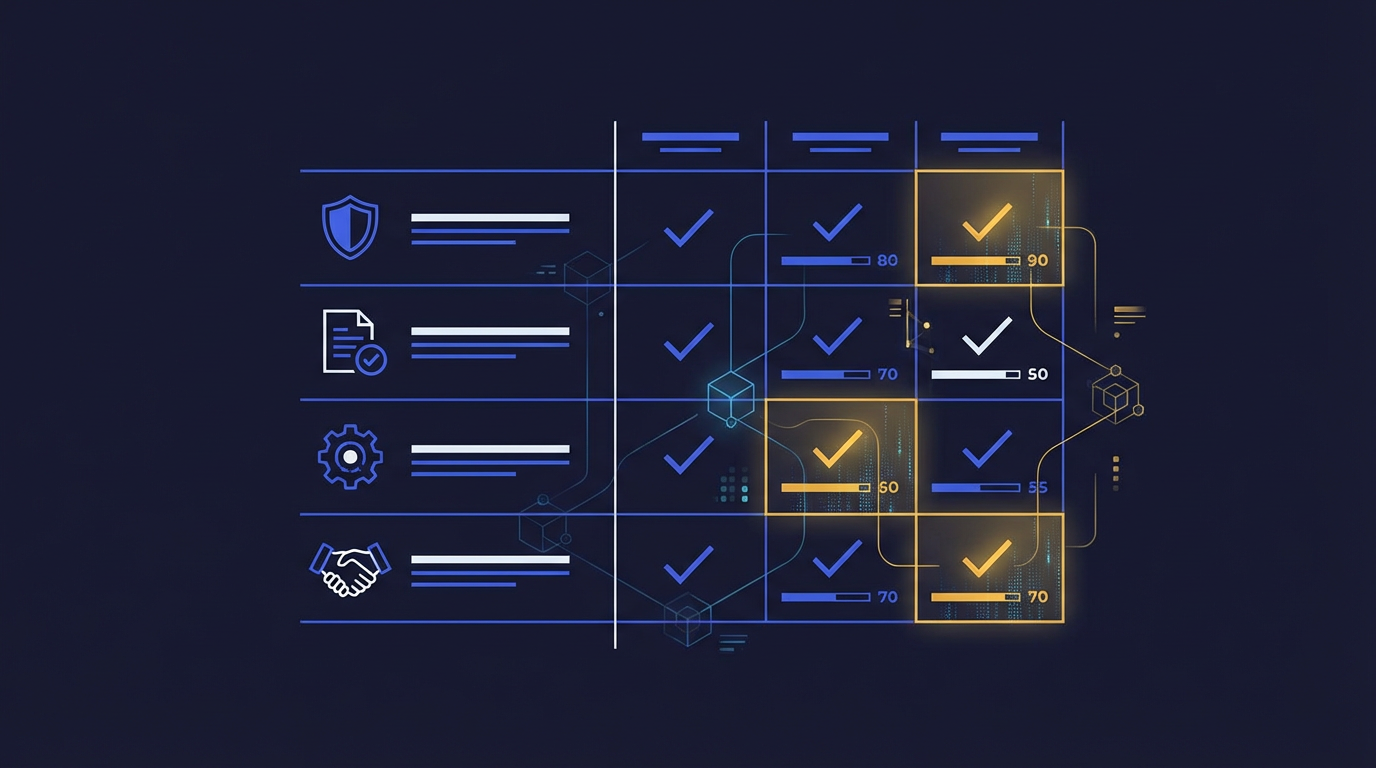
Best tokenization platform for startups: Decision matrix
Founders preparing to issue digital securities face a complex market of technology providers and compliance partners. The decision of where to mint and manage your digital assets will dictate your legal standing, your total capital raised, and your investors’ liquidity options. When you apply the choose tokenization platform criteria to your business, you are essentially selecting a regulatory partner for the lifespan of your company. Many founders make the dangerous mistake of evaluating these providers purely as software vendors rather than highly regulated financial institutions. This guide provides a complete framework to evaluate an STO platform based on regulatory reality, total cost of ownership, and technical infrastructure. You will learn exactly how to weigh different platform features, what questions to ask during sales calls, and how to spot warning signs before signing a contract. By following this methodology, founders can bypass marketing claims and secure a platform that actually delivers compliant capital formation.
Essential tokenization platform criteria for founders
The most critical choose tokenization platform criteria involve regulatory status, supported exemptions, and total cost. Founders must verify broker-dealer and transfer agent registrations first, which carry a 35 percent weight in evaluation. Secondary market access, technical standards, and geographic coverage round out the essential requirements for a compliant launch.
The foundation of any tokenization platform selection guide rests entirely on regulatory infrastructure and legal standing. Regulatory status deserves a 35 percent weight in your evaluation because an unregistered platform exposes the issuer to severe legal penalties and potential SEC enforcement. You must verify whether the provider operates as a registered broker-dealer, holds an Alternative Trading System registration, and functions as a registered transfer agent. Founders can and should verify these claims independently using the FINRA BrokerCheck database and the SEC EDGAR system 1, 2. Supported regulatory exemptions carry the next heaviest weight at 15 percent of your total decision. The platform must natively support your intended legal framework, whether that is Regulation D 506(b), Regulation D 506(c), Regulation S for international investors, Regulation CF for retail, or Regulation A+ for a mini-IPO. If a platform lacks the proper licenses for your specific exemption, their technology stack is useless to your operation regardless of how polished the user interface appears.
Pricing and fee structure account for 10 percent of the evaluation weight and require rigorous financial modeling. Founders must demand total transparency regarding upfront setup costs, per-investor onboarding fees, ongoing maintenance charges, and capital raising success fees. You need to understand exactly how these costs scale as your issuance grows from fifty investors to five thousand investors over a multi-year period. Secondary market availability also requires a 10 percent weight in your decision matrix, as liquidity is often the primary reason founders choose to tokenize assets. You should determine if the platform provides direct access to an internal ATS or maintains active integrations with external secondary trading venues. Reviewing the historical trading volumes on these venues will tell you if the liquidity promises match market reality. Many platforms boast about secondary trading capabilities while generating zero actual daily volume. Checking tokenization platform fees comparison data will help you benchmark the quotes you receive against industry averages.
Technical architecture and token standards represent 5 percent of the total criteria, focusing heavily on interoperability. You must evaluate which blockchains the platform supports and whether their smart contract standards are proprietary or open-source. Open standards prevent vendor lock-in and allow you to migrate your capitalization table if the platform fails or changes its pricing model. Minimum issuance requirements carry another 5 percent weight because platforms often reject deals below specific capital thresholds. You need to ensure their minimum raise or engagement size aligns precisely with your offering scale so you do not waste time in the sales pipeline. Time-to-launch also accounts for 5 percent of the evaluation, requiring founders to ask for hard data on the typical duration from the signed engagement letter to the live offering. While some providers promise a four-week turnaround, complex regulatory filings often push the reality closer to three or four months for a fully compliant launch.
The final three criteria each carry a 5 percent weight to complete the objective evaluation model. Track record requires you to verify how many security token offerings the platform has successfully completed and their total assets under management. You can often cross-reference these claims using third-party analytics like the rwa.xyz dashboard to confirm real on-chain activity. Customer support and onboarding quality determine how much friction your investors will experience during the KYC and AML process. A clunky onboarding portal will directly reduce your conversion rate and cost you capital during an active raise. Finally, geographic coverage dictates where you can legally source capital for your offering. You must confirm exactly which jurisdictions the platform supports for both the issuing entity and the participating investors. Reviewing the best tokenization platforms will give you a baseline for what top-tier geographic coverage looks like in practice.
Platform Evaluation Scoring Template
Founders should use this weighted scoring matrix to evaluate multiple platforms side by side. Score each platform from 1 to 10 in the raw score column, then multiply by the weight to get the final score for that category.
| Evaluation Criteria | Weight | Platform A Raw | Platform A Weighted | Platform B Raw | Platform B Weighted |
|---|---|---|---|---|---|
| 1. Regulatory status (Broker-dealer, ATS, Transfer Agent) | 35% | ||||
| 2. Supported regulatory exemptions | 15% | ||||
| 3. Pricing and fee structure | 10% | ||||
| 4. Secondary market availability | 10% | ||||
| 5. Token standards and blockchain support | 5% | ||||
| 6. Minimum issuance requirements | 5% | ||||
| 7. Time-to-launch | 5% | ||||
| 8. Track record and total AUM | 5% | ||||
| 9. Customer support and onboarding | 5% | ||||
| 10. Geographic coverage | 5% | ||||
| Total Score | 100% | 0.00 | 0.00 |
Critical questions and warning signs for founders
Founders should ask platforms 15 specific due diligence questions covering regulatory standing, fee structures, and technical architecture. You must immediately disqualify any unregistered platform offering securities, promising guaranteed returns, or lacking audited smart contracts. These red flags indicate severe legal risks that transfer directly to the issuer.
When you evaluate an STO platform, the sales process should function as a rigorous mutual due diligence exercise. Platform representatives will ask detailed questions about your business model, and you must interrogate their operational infrastructure with equal intensity. The answers to these questions will reveal whether the provider operates as a true financial institution or merely a software wrapper built on top of third-party APIs. Founders must document these responses carefully and compare them against public regulatory filings to ensure accuracy. If a sales representative hesitates or provides vague answers regarding their broker-dealer status, you should note that as a significant risk factor. We use a similar framework in our internal review methodology to separate legitimate infrastructure providers from opportunistic marketing agencies.
- Are you a registered broker-dealer, and with which specific regulators do you hold active licenses?
- Do you provide registered transfer agent services natively, or do I need to hire a separate transfer agent?
- What is your verified average time from the signed engagement letter to a live, compliant offering?
- How many security token offerings have you successfully completed to date?
- What is the total verifiable assets under management you have processed through your infrastructure?
- What are all the exact fees I will pay, including setup, per-investor, ongoing, and hidden costs?
- What specific blockchains do you support, and can I migrate my tokenized assets if needed?
- What token standard do you use, and is the underlying code proprietary or open-source?
- Do you provide direct access to a secondary trading venue or Alternative Trading System?
- What are the actual typical trading volumes on your affiliated secondary market?
- What specific regulatory exemptions do you legally support for capital formation?
- What investor verification services do you provide regarding KYC, AML, and accreditation checks?
- Can you provide three references from previous issuers of similar size and asset type?
- What exactly happens to my tokens and investor data if your platform shuts down or goes bankrupt?
- Do you actively support international investors, and which specific jurisdictions are restricted?
Understanding how to select tokenization platform partners requires knowing exactly when to walk away from a negotiation. You must treat unregistered platforms claiming to offer securities services as an immediate and non-negotiable disqualification. Engaging an unlicensed entity to issue digital securities exposes the founder to personal liability and guarantees regulatory intervention. You should also run away from any platform making guaranteed return claims, as this is a blatant regulatory violation that indicates a complete lack of compliance oversight. Unrealistically low pricing often suggests the provider is cutting corners on compliance infrastructure or plans to extract hidden fees later in the process. You can reference the typical cost to tokenize a startup to understand what legitimate compliance actually costs in the current market.
A complete absence of clear compliance infrastructure or in-house regulatory counsel serves as another fatal warning sign for founders. Legitimate tokenization platforms employ former regulators and experienced securities attorneys to guide their product development and review client offerings. You should also disqualify any provider that operates without audited smart contracts, as a single vulnerability could drain your investors’ assets entirely. The inability to provide references from completed issuances means you are acting as their beta tester, paying them to learn how to do their job. Finally, you must reject any platform that uses pressure tactics or creates false urgency to sign a contract before your legal team completes their due diligence.
A practical tokenization platform selection guide
The optimal platform selection process requires a seven-step funnel approach, starting with a broad market scan and ending with deep reference checks. Founders should map their specific use case, such as real estate or fund tokenization, to platforms with proven track records in those exact regulatory environments.
Moving from a list of potential vendors to a final signed contract requires a disciplined elimination process based on hard data. The shortlist approach prevents founders from wasting hours on product demos with platforms that lack the correct regulatory licenses for their specific offering. You begin by filtering the entire market based purely on objective binary criteria like broker-dealer registration and supported exemptions. This ruthless initial filtering usually eliminates 80 percent of the available options immediately, saving you weeks of wasted effort. From there, you can evaluate the remaining candidates based on subjective factors like user experience, roadmap stability, and long-term relationship potential.
- Narrow the initial field to five to seven platforms based strictly on regulatory status and exemption support.
- Eliminate any platforms that do not meet your minimum requirements for geographic coverage or issuance size.
- Request detailed, itemized pricing proposals from the three strongest remaining finalist platforms.
- Schedule comprehensive technical demos with each finalist to evaluate the investor onboarding experience.
- Conduct independent reference checks with previous issuers who ran similar capital campaigns.
- Compare the final pricing proposals against the total value and liquidity options provided.
- Evaluate the long-term relationship potential based on company stability, product roadmap, and support models.
Your specific asset class and target investor profile should heavily influence your final decision when selecting a technology partner. A platform that excels at tokenizing commercial real estate might lack the necessary infrastructure or regulatory approvals for a venture capital fund. Similarly, a provider built specifically for US accredited investors will struggle to manage a global retail offering under Regulation CF. Founders must match their precise capital formation strategy to the platform that has executed that exact playbook dozens of times before. Reading a detailed Securitize review or a Securitize vs tZERO vs Polymath comparison will show how different architectures serve entirely different use cases in practice.
Platform Recommendations by Use Case
| Issuance Scenario | Recommended Platforms | Key Advantage |
|---|---|---|
| US accredited investors only (Reg D) | Securitize, KoreConX | Deep integration with US securities law and automated accreditation |
| Retail investors (Reg CF) | Republic | Massive existing retail investor base and compliant portal |
| Mini-IPO (Reg A+) | Republic Capital, StartEngine | Infrastructure built for high-volume retail onboarding |
| European issuance | Tokeny (T-REX) | Compliance with EU DLT Pilot Regime and European banking standards |
| Real estate tokenization | Securitize, RealT, Lofty | Specialized property holding company structures |
| Fund tokenization | Securitize | Automated distribution of dividends and fund administration |
| Maximum secondary market liquidity | Securitize Markets, tZERO ATS | Direct integration with active Alternative Trading Systems |
| Compliance-first architecture | Polymath/Polymesh | Purpose-built blockchain for regulated securities |
Applying the correct choose tokenization platform criteria protects your company from catastrophic legal and technical failures down the line. The evaluation process demands patience, rigorous questioning, and a clear understanding of your own capital raising strategy before you ever speak to a sales representative. You must prioritize regulatory compliance and transfer agent capabilities above flashy user interfaces or marketing promises about future features. The platform you select will serve as the foundation for your capitalization table and investor relations for years to come. Take the time to run the weighted scoring template, verify all regulatory licenses independently, and speak with past issuers before signing any agreements.
Frequently Asked Questions
What is the most important factor when choosing a tokenization platform?
Regulatory compliance is the most important factor when evaluating a tokenization platform. You must verify that the provider holds the appropriate broker-dealer and transfer agent licenses for your specific jurisdiction. Operating without these registrations exposes the issuer to severe legal and financial penalties.
How much does a tokenization platform typically cost?
Tokenization platform costs vary widely based on the size of your offering and the regulatory exemption used. Founders should expect to pay upfront setup fees, per-investor onboarding charges, and ongoing maintenance costs. Some platforms also charge a percentage-based success fee on the total capital raised.
Can I change tokenization platforms after issuing my digital securities?
You can migrate to a different tokenization platform, but the process requires significant administrative work and legal coordination. Choosing a provider that uses open-source token standards makes migration easier. Proprietary smart contracts often lock issuers into a single vendor, complicating future transitions.
Do all tokenization platforms provide secondary market liquidity?
Not all tokenization platforms provide access to secondary market liquidity. Some providers focus exclusively on primary issuance and capitalization table management. If liquidity is a priority, you must select a platform that operates an Alternative Trading System or integrates directly with external secondary markets.