Cross-Chain Interoperability Tokenized Assets Guide
The financial industry is rapidly digitizing real-world assets, but this transition has created an unintended consequence of severe market fragmentation. Institutional issuers and native decentralized finance protocols are deploying assets across dozens of incompatible blockchain networks. This isolation prevents a tokenized treasury bond on Ethereum from being used as collateral for a tokenized real estate transaction on Polygon. Establishing robust cross-chain interoperability tokenized assets architecture is the most pressing technical challenge facing digital capital markets today. Without secure communication layers connecting these disparate networks, the tokenized economy risks replicating the siloed infrastructure of traditional finance rather than improving upon it. This guide examines how the major interoperability protocols function, the severe security risks associated with blockchain bridges, and the emerging compliance standards designed to move regulated securities safely across networks.
The fragmentation problem in multi-chain tokenization
Market fragmentation occurs when tokenized assets are issued across isolated blockchain networks that cannot natively communicate. This forces investors to manage multiple wallets and prevents liquidity from pooling efficiently, meaning a tokenized security on Ethereum cannot easily interact with decentralized finance applications on Solana or Polygon.
Ethereum remains the dominant network for security tokens, but high transaction costs have pushed issuers toward alternative networks to achieve scale. Polygon attracts platforms seeking lower gas fees, while Avalanche hosts institutional projects like Spruce and Intain. Stellar serves as the foundation for Franklin Templeton’s BENJI fund, demonstrating that major asset managers are willing to bypass Ethereum entirely for purpose-built infrastructure. Private and permissioned chains, such as JPMorgan’s Onyx and HSBC Orion, further compound the isolation by operating entirely outside public network ecosystems. This multi-chain reality means that what is asset tokenization today is largely a story of isolated liquidity pools rather than a unified global market.
This multi-chain tokenization environment creates severe friction for institutional and retail investors navigating the digital asset space. An investor holding assets across three different blockchains must manage multiple wallet interfaces, fund transaction fees in three different native cryptocurrencies, and secure distinct private keys or custody arrangements. Liquidity becomes fractured, resulting in wider bid-ask spreads and reduced market depth for identical assets trading on different networks. An institutional buyer looking to acquire $10 million of a specific tokenized treasury fund might find $4 million available on Ethereum, $3 million on Polygon, and $3 million on Solana. Executing this acquisition requires three separate trades across three networks, each with different slippage profiles and settlement times. If you want to understand how tokenization works at an institutional scale, you must account for this fragmentation, which currently prevents the seamless global liquidity that blockchain technology originally promised.
How cross-chain bridges and messaging protocols work
Cross-chain interoperability relies on token bridges, messaging protocols, and shared settlement layers. Bridges lock assets on one chain and mint wrapped versions on another, while messaging protocols transmit complex data and smart contract commands. Shared settlement layers provide a neutral environment for assets from multiple chains to interact securely.
Traditional token bridges operate through lock-and-mint or burn-and-mint mechanisms to move value across networks. When a user transfers an asset, the bridge protocol locks the original token in a smart contract on the source chain and instructs a contract on the destination chain to mint an equivalent wrapped token. The LayerZero OFT (Omnichain Fungible Token) standard has gained significant traction by allowing tokens to be burned on the source chain and minted natively on the destination, eliminating the need for wrapped assets and reducing the honeypot risk of locked tokens. While bridges facilitate basic asset transfers, they often lack the capacity to transmit the complex compliance metadata required for regulated financial instruments. This limitation forces developers to seek more sophisticated communication layers when building cross-chain bridge tokenized securities infrastructure.
Messaging protocols move beyond simple token transfers by enabling smart contracts on different networks to exchange arbitrary data and execute complex commands. Chainlink’s Cross-Chain Interoperability Protocol (CCIP) has positioned itself as the institutional-grade messaging layer for the financial sector. CCIP utilizes a three-layer architecture consisting of a committing Decentralized Oracle Network (DON), an executing DON, and an independent Risk Management Network. The committing DON monitors the source chain and builds a cryptographic Merkle tree of transactions, while the executing DON submits this proof to the destination chain. The Active Risk Management layer operates as an entirely independent network written in a different programming language, constantly monitoring transactions for anomalies and holding the power to halt operations if malicious activity is detected. This infrastructure has already seen institutional adoption, with SWIFT partnering with Chainlink for cross-chain settlement experiments and ANZ Bank utilizing CCIP for cross-chain stablecoin transfer pilots.
Shared settlement layers offer a different architectural approach by creating a neutral hub for cross-chain interactions. The Cosmos Inter-Blockchain Communication (IBC) protocol and Polkadot’s Cross-Consensus Messaging (XCM) allow disparate chains to communicate through a central relay or hub network using light client verification. This method provides strong security guarantees because it relies on the consensus mechanisms of the participating chains rather than a third-party bridge validator set. However, this approach requires participating blockchains to adopt specific architectural standards, limiting its utility for connecting entirely distinct ecosystems like Ethereum and Solana. These messaging and settlement protocols allow what is RWA tokenization to evolve from static asset issuance into dynamic, cross-network financial products that can react to state changes across multiple blockchains simultaneously.
Security risks and bridge exploits for tokenized securities
Cross-chain bridges represent the most vulnerable infrastructure in the digital asset ecosystem, suffering over $2.5 billion in exploit losses between 2021 and 2023. For tokenized securities, a bridge hack poses an existential threat, potentially allowing attackers to mint counterfeit security tokens without corresponding real-world assets backing them.
The historical track record of blockchain bridges is marked by catastrophic security failures that have destroyed billions in user value. According to industry data, major exploits include the $325 million Wormhole hack, the $625 million Ronin network breach, the $190 million Nomad exploit, and the $126 million Multichain collapse. These breaches typically occur when attackers manipulate the smart contracts responsible for verifying cross-chain messages or compromise the private keys of the validators securing the bridge. In the Ronin exploit, attackers gained control of five out of nine validator signatures, allowing them to drain the bridge’s reserves completely. When dealing with unregulated cryptocurrencies, these losses are absorbed by the market, but applying this vulnerable infrastructure to regulated financial instruments creates unacceptable risks for institutional issuers. Understanding tokenized asset risks requires a thorough evaluation of any interoperability solution used to move assets between networks.
For a tokenized security, a bridge exploit creates a fundamental breakdown in the capitalization table of the underlying asset. If an attacker breaches a bridge contract and mints counterfeit tokens on a destination chain, they can sell those unbacked shares on a decentralized exchange. The issuer then faces a severe legal and financial crisis where the total number of circulating tokens exceeds the actual shares of the underlying real-world asset. Because of this double-spending equivalent, most institutional tokenization platforms currently avoid bridges entirely, preferring to issue and manage assets natively on a single blockchain. Investors evaluating an Ondo Finance review or similar platform analysis should carefully check whether the protocol relies on third-party bridges or maintains assets natively on each supported network to avoid these existential security vulnerabilities.
Investors and asset managers must adopt strict risk management frameworks when interacting with cross-chain infrastructure. The most prudent approach is to prefer single-chain strategies wherever possible, completely avoiding the smart contract risk associated with bridges. If cross-chain exposure is necessary, institutions should restrict their operations to the most thoroughly audited messaging protocols that feature active risk management layers and proven track records. Furthermore, market participants must verify that their chosen digital asset custodians actually support wrapped or bridged token standards. Many regulated custodians strictly limit their coverage to native assets on primary networks and will not process deposits of bridged assets, leaving investors unable to secure their cross-chain holdings properly.
Regulatory compliance and emerging cross-chain standards
Moving regulated assets across blockchains creates complex compliance challenges regarding transfer restrictions, jurisdictional authority, and anti-money laundering enforcement. Emerging technical frameworks, such as the ERC-3643 standard and the Cross-Chain Token standard, aim to embed regulatory rules directly into the asset regardless of which network it occupies.
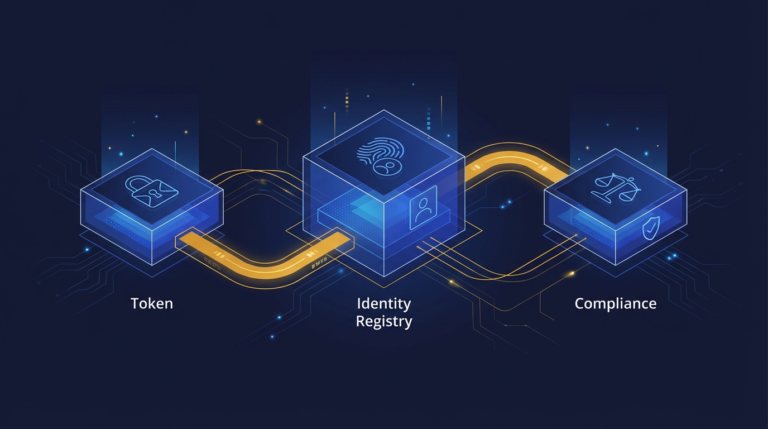
When a security token moves from Ethereum to Polygon, the compliance mechanisms do not automatically travel with the asset. The ERC-3643 standard uses an on-chain identity registry to ensure tokens can only be held by verified investors. If an asset is wrapped and bridged using standard infrastructure, the destination chain receives a generic ERC-20 token that lacks the specific smart contracts required to enforce investor whitelists or holding limits. This technical gap allows restricted securities to be traded freely on decentralized exchanges by unverified participants, directly violating securities laws. Furthermore, cross-chain transfers obscure the transaction trail, complicating anti-money laundering monitoring and creating jurisdictional ambiguity. If a token issued under United States regulations is bridged to a network operated by validators in foreign jurisdictions, determining which regulatory body holds authority becomes a complex legal dispute that current frameworks are ill-equipped to handle.
To resolve these compliance gaps, the industry is developing specialized token standards designed specifically for interoperability tokenized RWA applications. The ERC-3643 standard, also known as the T-REX protocol, is currently the most widely adopted framework for security tokens. While it includes robust transfer restriction modules, it was fundamentally designed for single-chain deployment, prompting developers to build new extensions for cross-chain functionality. The older ERC-1400 standard offers partitioning for partial transfers but features limited native cross-chain support. Looking forward, protocols are designing assets that maintain their compliance logic across networks natively. Chainlink’s Cross-Chain Token (CCT) framework provides built-in compliance hooks that travel with the token, ensuring that transfer restrictions are evaluated against the issuer’s requirements before any cross-chain minting occurs. Global organizations, including the IETF and ISO working groups, are actively exploring standardized frameworks to ensure regulated financial instruments can traverse networks without shedding their legal restrictions. Familiarity with these frameworks is essential, and referencing a comprehensive tokenization glossary helps investors navigate the evolving technical vocabulary of multi-chain finance.
The fragmentation of digital capital markets presents a formidable barrier to the widespread adoption of blockchain-based finance. Issuing assets across Ethereum, Polygon, Stellar, and private ledgers allows platforms to optimize for specific use cases, but it severely degrades market liquidity and creates operational friction for investors. Cross-chain interoperability solutions, particularly advanced messaging protocols like Chainlink CCIP, offer a viable path toward unifying these isolated networks. The catastrophic history of bridge exploits proves that moving assets between blockchains introduces severe security vulnerabilities that institutional issuers cannot ignore when handling regulated securities. As the industry matures, developers must abandon basic token bridges in favor of sophisticated, compliance-aware messaging layers that enforce regulatory restrictions across all networks. Investors and asset managers should prioritize single-chain deployments for high-value securities today, while closely monitoring the development of standardized cross-chain protocols that will eventually enable a truly global, interconnected digital asset economy.
Frequently Asked Questions
What is the fragmentation problem in tokenized assets?
The fragmentation problem occurs when tokenized assets are issued across isolated blockchains that cannot communicate with one another. This divides market liquidity, forces investors to manage multiple wallets, and prevents a seamless global market for digital securities.
How do cross-chain bridges work for tokenized securities?
Cross-chain bridges typically lock the original token on the source blockchain and mint a wrapped version on the destination network. For tokenized securities, this process introduces severe security risks and often strips away the smart contract compliance rules required by regulators.
What is Chainlink CCIP and how does it help tokenization?
Chainlink CCIP is a cross-chain messaging protocol that allows smart contracts on different blockchains to exchange data securely. It uses an independent Risk Management Network to monitor transactions, making it a preferred solution for institutions moving tokenized assets across networks.
Why are blockchain bridges dangerous for security tokens?
Blockchain bridges are dangerous because smart contract exploits can allow attackers to mint unbacked tokens on the destination chain. For a security token, this creates counterfeit shares that break the capitalization table and expose the issuer to massive legal liability.