Smart Contracts Security Tokens: On-Chain Compliance
Regulated financial markets require strict adherence to securities laws, and bringing these assets on-chain demands programmable enforcement mechanisms. Utility tokens operate in a permissionless environment where anyone can hold or transfer assets freely, but tokenized securities must restrict ownership to verified, eligible investors. This fundamental difference is why smart contracts security tokens represent a distinct architectural paradigm in blockchain development. When a startup or institution issues digital equity, debt, or real estate funds, every secondary market transfer carries regulatory weight. If an unverified wallet receives a tokenized share, the issuer violates securities law. By embedding compliance rules directly into the protocol layer, issuers ensure that non-compliant transfers are physically impossible to execute on the blockchain. This technical deep dive examines how token compliance automation operates, the dominant standards driving institutional adoption, and the architectural trade-offs technical founders face when building regulated digital asset infrastructure.
How smart contracts security tokens enforce on-chain compliance
Smart contracts enforce on-chain compliance by evaluating every token transfer against a predefined set of regulatory rules before executing the transaction. If the sender or receiver fails identity verification, geographic restrictions, or holding period requirements, the smart contract automatically reverts the transaction, preventing regulatory breaches at the protocol level.
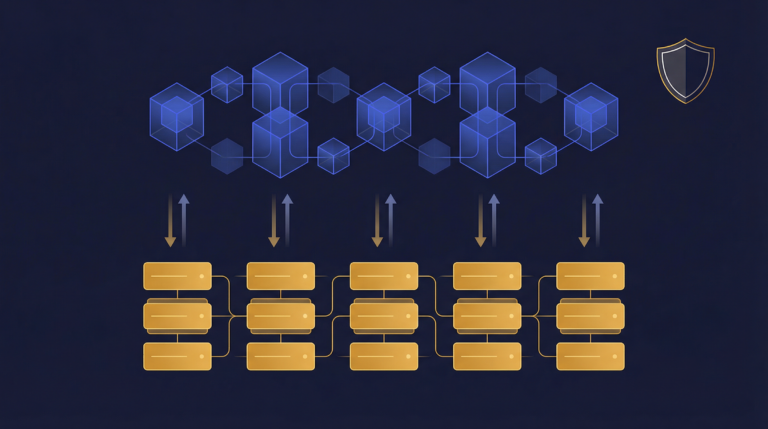
The base layer of any security token architecture relies on strict whitelisting mechanisms tied to off-chain identity verification. Before an investor can receive a tokenized security, they must complete specific onboarding procedures, which a platform operator then records on-chain by adding the investor’s wallet address to an approved registry. When a transfer is initiated, the token contract queries this registry to confirm both the sender and receiver possess the necessary authorization flags. This process automates the enforcement of complex regulatory frameworks like SEC Rule 506(c), which restricts private placements strictly to accredited investors. If a token holder attempts to send their shares to a non-accredited friend or an unverified decentralized exchange liquidity pool, the smart contract evaluates the receiver’s address, finds no accreditation flag in the registry, and immediately rejects the transfer. This mechanism shifts the burden of compliance from post-trade reconciliation to pre-trade cryptographic validation.
Beyond basic identity checks, smart contract transfer restrictions manage time-based and volume-based compliance requirements. Many private securities carry mandatory lock-up periods, such as the six-month or one-year holding requirements mandated by SEC Rule 144. Developers program these time constraints directly into the token’s compliance module, setting timestamp parameters that block any outgoing transfers from a specific wallet until the exact expiration date passes. The contracts also monitor global state variables like maximum investor thresholds to prevent private companies from accidentally triggering public reporting requirements under the Exchange Act. If a proposed transfer would push the total number of non-accredited token holders above the legal limit, the protocol halts the transaction entirely. Furthermore, geographic restrictions are enforced by mapping country codes to wallet addresses, allowing issuers to block transfers to residents of sanctioned nations or jurisdictions where the security is not registered for sale.
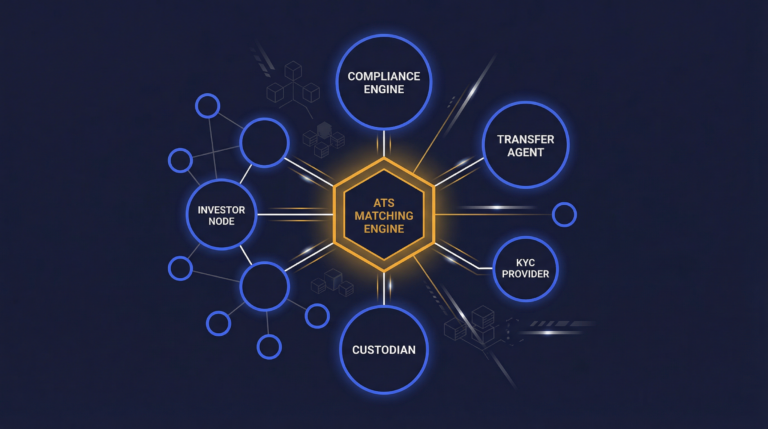
While cryptographic self-sovereignty defines public blockchains, regulated securities require administrative override capabilities. Security token smart contracts include forced transfer functions that allow authorized operators to move or burn tokens without the holder’s private key signature. This mechanism is legally required to execute court orders, recover assets when investors lose their private keys, or enforce regulatory clawbacks. The transfer agent role in tokenization relies heavily on these operator permissions to maintain the definitive capitalization table and resolve disputes. Additionally, these smart contracts automate complex corporate actions and dividend distributions. By taking a precise snapshot of token balances at a specific block height, the contract can autonomously calculate proportional revenue shares and distribute stablecoins directly to thousands of investor wallets simultaneously. For stock splits or mergers, developers typically deploy upgradeable contract patterns or execute coordinated token migrations to reflect the new corporate structure on-chain.
Architecture of dominant security token smart contract standards
The tokenization industry relies primarily on three dominant smart contract standards to manage regulated assets. ERC-3643 provides a modular compliance engine integrated with decentralized identity, ERC-1400 offers partitioned balances for complex asset tranches, and ST-20 leverages the purpose-built Polymesh blockchain to embed compliance directly into the base layer.
The ERC-3643 standard, originally developed by Tokeny under the T-REX moniker, has emerged as the most widely adopted framework for institutional asset tokenization. According to a 2024 report by rwa.xyz, the ERC-3643 standard explained in depth secures billions in tokenized assets across multiple Ethereum Virtual Machine (EVM) networks. Its architecture relies on a strict separation of concerns across three distinct modules: the core token contract, the identity registry, and the compliance contract. The token contract extends standard ERC-20 functionality but overrides the default transfer functions to mandate compliance checks. The identity registry maps anonymous wallet addresses to verified identities using the ONCHAINID standard, which stores cryptographic attestations of identity as verifiable claims rather than exposing raw personal data on public ledgers. The compliance contract acts as a highly configurable rules engine, evaluating every proposed transfer against a modular sequence of regulatory conditions. When a user initiates a transfer, the token contract pauses the execution, queries the identity registry for both counterparties, passes those identity claims to the compliance contract, and only finalizes the state change if all rules return a positive validation.
Developers requiring highly complex asset structures often turn to the ERC-1400 standard, which prioritizes modularity and advanced financial engineering. The defining feature of ERC-1400 is its support for partitioned balances, allowing a single smart contract to manage different tranches of the same underlying asset with distinct rights and restrictions. For example, an issuer can use partitions to separate founders’ shares from investor shares, applying different voting weights and lock-up periods while maintaining a unified token supply. The standard also natively supports document management, enabling issuers to cryptographically link off-chain legal documents, term sheets, and offering memorandums directly to the on-chain token state. This standard grants explicit operator permissions, allowing designated entities to execute forced transfers for regulatory compliance or asset recovery. While ERC-1400 provides immense flexibility for complex financial instruments, its lack of strict standardization means implementations vary significantly across different platforms, creating interoperability challenges for secondary market venues.
Diverging from the EVM ecosystem, the ST-20 standard operates on Polymesh, a specialized Layer 1 blockchain engineered specifically for regulated securities. Unlike Ethereum-based standards that must bolt compliance onto a permissionless network via complex smart contract architectures, Polymesh integrates identity and compliance at the protocol layer. Every node operator and network participant must complete onboarding procedures before interacting with the chain, effectively eliminating the need for separate identity registries and compliance modules at the token level. ST-20 tokens interact directly with Polymesh’s native identity framework, significantly reducing the gas costs and computational overhead associated with evaluating complex transfer restrictions. Technical founders evaluating the best blockchain for tokenization comparison must weigh this streamlined execution against the vendor lock-in inherent to a specialized ecosystem. While Polymesh offers superior performance for compliance-heavy transactions, issuers sacrifice access to the massive liquidity pools and composable decentralized finance protocols available on public EVM networks.
Security, auditing, and upgradeability for tokenized assets
Security token smart contracts require rigorous auditing by specialized security firms to identify logic errors, access control flaws, and reentrancy vulnerabilities. Audits typically take two to six weeks and cost between $10,000 and $50,000, ensuring the code safely manages regulated assets while maintaining upgradeable proxy patterns for future compliance updates.
Deploying programmable financial instruments that control millions of dollars in regulated capital demands uncompromising security practices. A single logic flaw in a compliance module could allow unauthorized transfers, permanently lock investor funds, or enable malicious actors to mint infinite shares. Consequently, institutional issuers mandate comprehensive code audits from top-tier security firms such as OpenZeppelin, Trail of Bits, CertiK, or Quantstamp before executing a security token offering guide implementation. These specialized auditors analyze the codebase for common EVM vulnerabilities, including reentrancy attacks, integer overflows, and improper access controls that might allow unauthorized users to modify compliance parameters. The audit process typically spans two to six weeks, depending on the complexity of the token architecture and the number of custom compliance rules implemented. Costs for these professional security reviews generally range from $10,000 to $50,000 or more for highly complex, multi-contract architectures. The final audit report becomes a critical component of the tokenization compliance checklist, providing institutional investors and regulators with mathematical assurance that the smart contracts function exactly as specified in the legal offering documents.
Regulatory frameworks evolve continuously, requiring a security token smart contract to remain adaptable long after its initial deployment. Because blockchain code is inherently immutable, developers utilize proxy contract patterns to enable updates without disrupting the token’s operational history or requiring users to migrate to a new contract address. The most common architectures employ the Universal Upgradeable Proxy Standard (UUPS) or Transparent Proxy patterns. In these setups, a permanent proxy contract holds the state variables and user balances, while pointing to a separate implementation contract that contains the actual logic. When compliance rules change or new features are required, the issuer deploys a new implementation contract and updates the proxy to reference the new logic, leaving all investor balances intact. While this upgradeability is necessary for long-term compliance, it introduces significant centralization risks. If an attacker compromises the admin keys controlling the proxy, they can rewrite the token’s rules entirely. To mitigate this threat, issuers secure proxy administration functions behind multi-signature wallets and implement mandatory time-locks, ensuring no single entity can execute unilateral changes to the protocol.
Choosing the right smart contract framework for security tokens
Selecting the optimal smart contract framework requires balancing ecosystem compatibility, gas efficiency, and specific regulatory requirements. Issuers must evaluate whether to deploy modular EVM standards like ERC-3643 for maximum interoperability or utilize purpose-built institutional chains for streamlined compliance execution and lower transaction costs.
The architectural decisions made during the planning phase dictate the long-term operational costs and market reach of the tokenized asset. Implementing comprehensive compliance checks on public EVM networks significantly increases the computational overhead of every transaction. A standard ERC-20 transfer typically consumes around 65,000 gas, whereas a compliance-checked transfer using ERC-3643 or ERC-1400 can consume upwards of 250,000 to 400,000 gas as the protocol queries multiple external identity registries and evaluates complex rule sets. This disparity makes gas optimization a critical priority for technical teams designing high-velocity trading instruments. To address this challenge, the industry is moving aggressively toward highly modular compliance designs. By separating the core token logic from the compliance engine, developers can build lightweight tokens that bridge easily across multiple networks while relying on asynchronous, off-chain computation or Layer 2 rollups to handle the heavy lifting of KYC and AML for tokenized assets. This modularity also allows issuers to plug into different identity providers in different jurisdictions without rewriting their core token contracts.
Ultimately, the choice of standard depends heavily on the issuer’s target audience and the specific nature of the underlying asset. ERC-3643 remains the pragmatic choice for most institutional issuers because it provides a battle-tested, standardized framework that integrates smoothly with existing EVM infrastructure, custodians, and decentralized exchanges. Its reliance on the ONCHAINID standard creates a reusable identity layer that reduces onboarding friction for investors participating in multiple offerings. Conversely, projects requiring complex tranche structures, automated dividend waterfalls across different asset classes, or tight integration with off-chain legal workflows often benefit from the flexibility of ERC-1400. For enterprises prioritizing regulatory certainty and low transaction costs over DeFi composability, purpose-built networks utilizing standards like ST-20 offer a compelling alternative. As the regulatory environment matures, technical founders must refer to a comprehensive tokenization glossary and consult with specialized legal counsel to ensure their chosen smart contract architecture perfectly mirrors the real-world legal obligations of the securities they intend to issue.
The integration of programmable compliance directly into the asset layer represents a structural upgrade for global capital markets. By relying on smart contracts security tokens to automate the enforcement of transfer restrictions, investor limits, and geographic boundaries, issuers eliminate the manual reconciliation processes that have historically plagued private market settlements. The technical frameworks available today, from the modular architecture of ERC-3643 to the protocol-level integration of Polymesh, provide developers with the exact tools needed to digitize regulated financial instruments safely. As institutional adoption accelerates and regulatory clarity improves, the ability to architect secure, upgradeable, and gas-efficient compliance engines will remain a defining competitive advantage for platforms operating in the tokenized economy.
Frequently Asked Questions
How do smart contracts enforce compliance for security tokens?
Smart contracts enforce compliance by checking every token transfer against a predefined set of regulatory rules before execution. If the sender or receiver fails identity verification, geographic restrictions, or holding period requirements, the protocol automatically rejects the transaction to prevent regulatory breaches.
What is the ERC-3643 standard for security tokens?
The ERC-3643 standard is a modular smart contract framework designed specifically for institutional asset tokenization. It utilizes a three-part architecture consisting of a core token contract, an identity registry using ONCHAINID, and a compliance contract that evaluates transfer restrictions.
How much does a smart contract audit cost for a security token?
A comprehensive security audit for a tokenized asset smart contract typically costs between $10,000 and $50,000, depending on the complexity of the compliance logic. The audit process usually takes two to six weeks and is performed by specialized firms like OpenZeppelin or Trail of Bits.
What are forced transfers in security token smart contracts?
Forced transfers allow authorized operators, such as transfer agents, to move or burn tokens without requiring the holder’s private key signature. This administrative override capability is legally necessary to execute court orders, recover lost assets, or enforce regulatory clawbacks.