Custody solutions for tokenized securities: qualified custodians
Institutional capital requires institutional infrastructure. The transition of traditional financial assets onto blockchain networks introduces complex operational challenges for asset managers and technology providers. When evaluating the digital asset ecosystem, the requirements for custody tokenized securities differ fundamentally from holding decentralized cryptocurrencies. Tokenized securities remain regulated financial instruments subject to strict federal oversight and compliance mandates regardless of their underlying technological wrapper. Market participants must navigate a complex intersection of cryptographic key management, traditional securities law, and evolving regulatory frameworks. This guide examines how financial institutions manage digital asset custody, the regulatory rules defining qualified custodians, and the technical infrastructure required to secure tokenized financial products.
The tension between blockchain architecture and traditional financial custody creates unique engineering requirements. On a public blockchain, custody is determined entirely by the control of cryptographic private keys. Whoever holds the private key possesses absolute unilateral control over the tokenized assets associated with that address. This bearer-asset model conflicts directly with traditional securities market structures, where custodians hold assets in street name and manage beneficial ownership rights through centralized ledger systems. Financial institutions must implement systems that secure the private keys against theft or loss while simultaneously enabling the token holder to exercise their legal ownership rights. These rights include voting in corporate governance, receiving automated dividend distributions, and participating in corporate actions without exposing the underlying cryptographic material to unnecessary risk.
The regulatory mandate for qualified custodians
Under SEC Rule 206(4)-2, investment advisers must hold client funds and regulated financial instruments with a qualified custodian. For tokenized securities, this means a federally chartered bank, registered broker-dealer, or state-chartered trust company must maintain control of the blockchain private keys representing the regulated assets.
The Investment Advisers Act of 1940 imposes a strict fiduciary duty on registered investment advisers to protect client assets from theft, loss, or misappropriation. The Securities and Exchange Commission enforces this obligation primarily through Rule 206(4)-2, widely recognized as the custody rule. This regulation mandates that advisers maintaining custody of client funds or securities must hold them with a qualified custodian. The statutory definition of a qualified custodian strictly limits eligible institutions to federally chartered banks, registered broker-dealers, futures commission merchants, and specific state-chartered trust companies. When investment advisers allocate capital to tokenized private equity, real estate, or debt funds, they cannot simply hold the private keys in a corporate hardware wallet. They must engage a regulated entity that meets these strict definitions to manage the cryptographic infrastructure on their behalf.
Regulatory expectations surrounding digital asset custody expanded significantly with the SEC’s 2023 proposed enhanced custody rule. Officially titled the Safeguarding Advisory Client Assets proposal, this regulatory update seeks to expand the scope of the custody rule beyond traditional funds and securities to encompass all client assets, explicitly including crypto assets and tokenized financial instruments. The proposed framework introduces more rigorous auditing requirements, mandates written agreements between advisers and custodians, and establishes strict liability standards for the loss of client assets. For institutions building compliance layers in tokenization, this proposed rule signals that regulatory agencies expect digital securities to adhere to the exact same safeguarding standards as conventional equities and fixed-income products.
Banking regulators have also established specific frameworks enabling traditional financial institutions to participate in digital asset custody. The Office of the Comptroller of the Currency (OCC) issued Interpretive Letter 1170 in 2020, formally clarifying that national banks and federal savings associations possess the legal authority to provide cryptocurrency custody services for their customers. This was followed by Interpretive Letter 1201, which further defined the risk management expectations for banks engaging in these activities. These federal guidelines operate alongside innovative state-level frameworks designed specifically for digital assets. The Wyoming Special Purpose Depository Institution (SPDI) framework and the South Dakota trust company regulations allow specialized financial firms to operate as qualified custodians while focusing exclusively on blockchain-native assets and tokenized securities.
Institutional custody architecture and MPC wallet mechanics
Institutional custody digital securities rely predominantly on Multi-Party Computation (MPC) architecture rather than multi-signature smart contracts. MPC distributes private key shares across multiple independent servers and organizations, requiring a mathematical threshold to sign transactions without ever assembling the complete key in a single vulnerable location.
Multi-Party Computation has emerged as the dominant cryptographic architecture for institutional digital asset custody. In a traditional blockchain wallet, a single private key exists as an alphanumeric string that grants total control over the associated assets. If a malicious actor compromises the server or hardware device holding that key, the assets are permanently lost. MPC eliminates this single point of failure by ensuring the complete private key never actually exists in one place. Instead, the cryptographic generation process creates distributed key shares that are divided among multiple independent parties. A typical institutional setup might distribute these shares between the custodian’s primary servers, a secure backup facility, and the client’s own mobile or hardware device.
Executing a transaction using MPC requires a predefined threshold of these independent parties to participate in the signing process. For example, a 2-of-3 or 3-of-5 threshold requires multiple distinct entities to approve the movement of a tokenized security. The mathematical magic of MPC allows these parties to collaboratively compute the final cryptographic signature without any party ever exposing their individual key share to the others. This protocol-agnostic approach works on any blockchain network because the final signature broadcast to the network appears identical to a standard single-key signature. This flexibility makes MPC highly attractive for institutions managing diverse portfolios across multiple layer-1 and layer-2 networks. It allows asset managers executing a security token offering guide to launch tokens on Ethereum, Polygon, or Avalanche using the exact same underlying custody infrastructure.
While Multi-Party Computation dominates the institutional landscape, multi-signature (multi-sig) wallets provide an alternative approach with different technical tradeoffs. Multi-sig architecture requires multiple separate private keys to sign a transaction, but it relies on specialized smart contracts deployed on the blockchain to enforce these rules. The blockchain itself verifies that the required number of independent signatures has been submitted before executing the transfer. While highly secure and transparent, multi-sig is fundamentally limited by blockchain compatibility. An institution must deploy and audit custom multi-sig smart contracts for every individual blockchain they wish to support. Furthermore, multi-sig transactions consume more computational resources and incur higher network gas fees because the blockchain must process multiple distinct cryptographic signatures.
Leading qualified custodian security tokens providers
The dominant providers of custody for tokenized securities include Anchorage Digital, Fireblocks, BitGo, and Coinbase Custody. These institutions combine specialized cryptographic infrastructure with formal regulatory charters backed by substantial insurance policies covering key compromise and internal fraud.
Anchorage Digital operates as a federally chartered digital asset bank and serves as a qualified custodian regulated directly by the OCC. The institution combines advanced biometric security measures with hardware security modules (HSMs) to protect digital assets while maintaining rapid transaction capabilities. Anchorage supports a wide variety of security tokens and tokenized real-world assets, offering institutional clients the ability to participate in on-chain governance and staking mechanisms directly from cold storage. By securing a federal banking charter, Anchorage provides investment advisers with absolute regulatory certainty regarding their compliance with SEC custody mandates.
Fireblocks approaches the market primarily as an infrastructure provider rather than a standalone chartered custodian, though its technology underpins many of the world’s largest financial institutions. The company utilizes a proprietary direct MPC architecture that allows institutions to build their own customized custody workflows. Fireblocks holds SOC 2 Type II certification and maintains insurance coverage exceeding $500 million against cyber attacks, internal fraud, and software vulnerabilities. The platform integrates seamlessly with the best tokenization platforms, allowing issuers to mint, manage, and distribute tokenized securities entirely within a secure MPC environment. Institutions often license Fireblocks technology to build their own custody solutions or use it to connect securely with various decentralized finance protocols.
BitGo operates as a qualified custodian through its South Dakota trust company registration, offering both multi-sig and MPC custody architectures depending on client requirements. The company maintains a comprehensive $250 million insurance policy covering the physical loss or theft of cryptographic keys. BitGo has focused heavily on building integrations with alternative trading systems (ATS) and secondary markets, ensuring that tokenized securities held in their custody can be actively traded without requiring clients to move assets into vulnerable hot wallets.
Coinbase Custody operates through the Coinbase Custody Trust Company, a New York state-chartered limited liability trust company. While historically focused on highly liquid cryptocurrencies like Bitcoin and Ethereum, the institution has steadily expanded its infrastructure to support tokenized securities and real-world assets. Coinbase utilizes a consensus-based cold storage architecture that requires multiple geographic locations and human approvals to move funds.
| Custody Provider | Regulatory Framework | Primary Architecture | Insurance Coverage | Tokenization Integration |
|---|---|---|---|---|
| Anchorage Digital | OCC Federal Bank Charter | HSM and Biometrics | High-limit commercial | Direct API support |
| Fireblocks | Technology Provider | Direct MPC | $500M+ policy | Extensive native support |
| BitGo | South Dakota Trust Company | Multi-sig and MPC | $250M policy | Broad ATS compatibility |
| Coinbase Custody | NY State Trust Company | Geographic Cold Storage | High-limit commercial | Expanding asset support |
The technical and compliance limits of self-custody
While individuals can technically hold security tokens in self-hosted wallets, self-custody fails to meet institutional regulatory requirements. Investment advisers cannot use self-custody to satisfy SEC mandates, and lost private keys create severe recovery complications that require manual intervention from the security’s designated transfer agent.
The fundamental appeal of blockchain technology lies in the ability to hold bearer assets without relying on centralized intermediaries. While an individual investor can technically generate a private key and hold tokenized securities in a hardware wallet, this self-custody approach introduces severe technical and legal complications. Tokenized securities are not decentralized cryptocurrencies; they represent legal claims on real-world assets or cash flows. If an investor loses the private key to a Bitcoin wallet, the asset is permanently inaccessible and effectively destroyed. If an investor loses the private key to a tokenized private equity share, the underlying legal ownership of that equity remains intact. The issuer or the transfer agent role in tokenization must intervene to recover the asset.
Recovering a self-custodied tokenized security requires specialized smart contract functions. Most security tokens utilize standards like ERC-1400 or ERC-3643, which include forced transfer or forced burn capabilities. If an investor loses their private keys, they must prove their identity to the transfer agent, sign legal indemnification agreements, and request manual intervention. The transfer agent then uses their administrative cryptographic keys to burn the inaccessible tokens from the lost wallet and mint replacement tokens to a new address. This process is legally complex, time-consuming, and operationally expensive. It highlights why institutional capital relies on regulated custodians rather than individual hardware devices to manage these risks at scale.
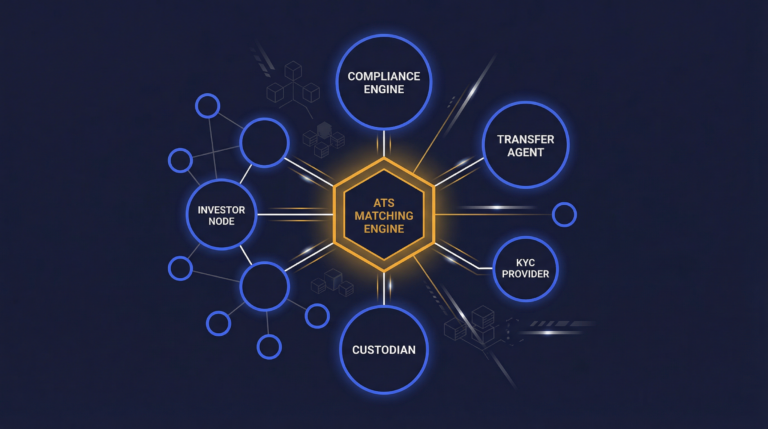
Self-custody also presents significant hurdles for secondary market liquidity and corporate actions. Many digital asset securities are traded on regulated Alternative Trading Systems (ATS) that require participants to hold assets in designated custodial accounts to ensure immediate settlement and prevent counterparty failure. Furthermore, executing corporate actions like dividend distributions or shareholder voting requires precise synchronization between the blockchain ledger and the off-chain cap table. When analyzing a Securitize platform review or similar issuance infrastructure, it becomes clear that automated compliance checks and distributions function much more efficiently when the assets reside within known, verified custodial environments rather than scattered across thousands of individual self-hosted wallets.
Evaluating custody infrastructure for tokenized asset platforms
Selecting a custody provider requires analyzing regulatory charters, cryptographic architecture, and insurance coverage limits. Institutional investors must verify that the custodian integrates seamlessly with their chosen tokenization issuance platforms and secondary trading venues while maintaining compliance with current SEC regulations.
Due diligence for digital asset custody requires examining factors that do not exist in traditional finance. Financial institutions must thoroughly review the exact nature of the provider’s regulatory charter to ensure it satisfies the SEC’s definition of a qualified custodian. A technology provider offering highly secure software does not automatically qualify as a legal custodian under the Investment Advisers Act. Institutions must request formal documentation of the provider’s trust charter, banking license, or broker-dealer registration. They must also examine the specific legal agreements governing the custody relationship, ensuring the assets are held in bankruptcy-remote accounts fully segregated from the custodian’s corporate balance sheet.
Insurance coverage requires careful technical scrutiny during the evaluation process. Traditional financial custody insurance typically covers gross negligence or employee theft. Digital asset custody insurance policies are highly specific regarding what constitutes a covered loss. Most institutional policies cover the physical theft of hardware devices, the compromise of cryptographic keys by external hackers, and internal collusion by employees. However, these policies almost universally exclude losses resulting from smart contract exploits, underlying blockchain protocol failures, or errors made by the client when initiating a transaction. Asset managers must understand exactly where the custodian’s liability ends and their own operational risk begins.
Fee structures for digital asset custody vary significantly based on the architecture and the service model. Fully regulated qualified custodians typically charge an asset-based fee calculated as a percentage of assets under management (AUM), similar to traditional finance models. This fee often ranges from 5 to 50 basis points depending on the total volume and the specific assets held. In contrast, technology providers offering direct MPC infrastructure often charge flat software-as-a-service (SaaS) licensing fees combined with per-transaction costs. Institutions must model these costs against their expected trading frequency and total asset value. They must also verify that the chosen custody solution integrates directly with their existing KYC and AML for tokenized assets providers to ensure seamless onboarding.
The successful deployment of institutional capital into digital assets relies entirely on robust infrastructure. By understanding the regulatory mandates, evaluating MPC cryptographic architectures, and selecting appropriate qualified partners, asset managers can safely custody tokenized securities while meeting their fiduciary obligations to clients.
Frequently Asked Questions
What is a qualified custodian for digital assets?
A qualified custodian is a federally chartered bank, registered broker-dealer, or state-chartered trust company authorized to hold client assets. Under SEC regulations, investment advisers must use these specific regulated entities to secure the private keys associated with tokenized financial instruments.
How does an MPC wallet differ from a multi-sig wallet?
An MPC wallet distributes cryptographic key shares across multiple parties to sign transactions without assembling the full key, making it protocol-agnostic. A multi-sig wallet requires multiple separate private keys to sign a transaction and relies on blockchain-specific smart contracts to enforce the approval rules.
Can I use self-custody for tokenized securities?
Individual investors can technically self-custody tokenized securities, but registered investment advisers cannot use self-custody to satisfy SEC regulatory requirements. Furthermore, losing the private keys to a self-custodied security token requires manual intervention and forced transfer procedures initiated by the asset’s transfer agent.
Does digital asset custody insurance cover smart contract hacks?
Digital asset custody insurance generally does not cover losses resulting from smart contract exploits or underlying blockchain protocol failures. Institutional custody policies typically only cover the physical theft of hardware, external compromise of cryptographic keys, or internal fraud by the custodian’s employees.