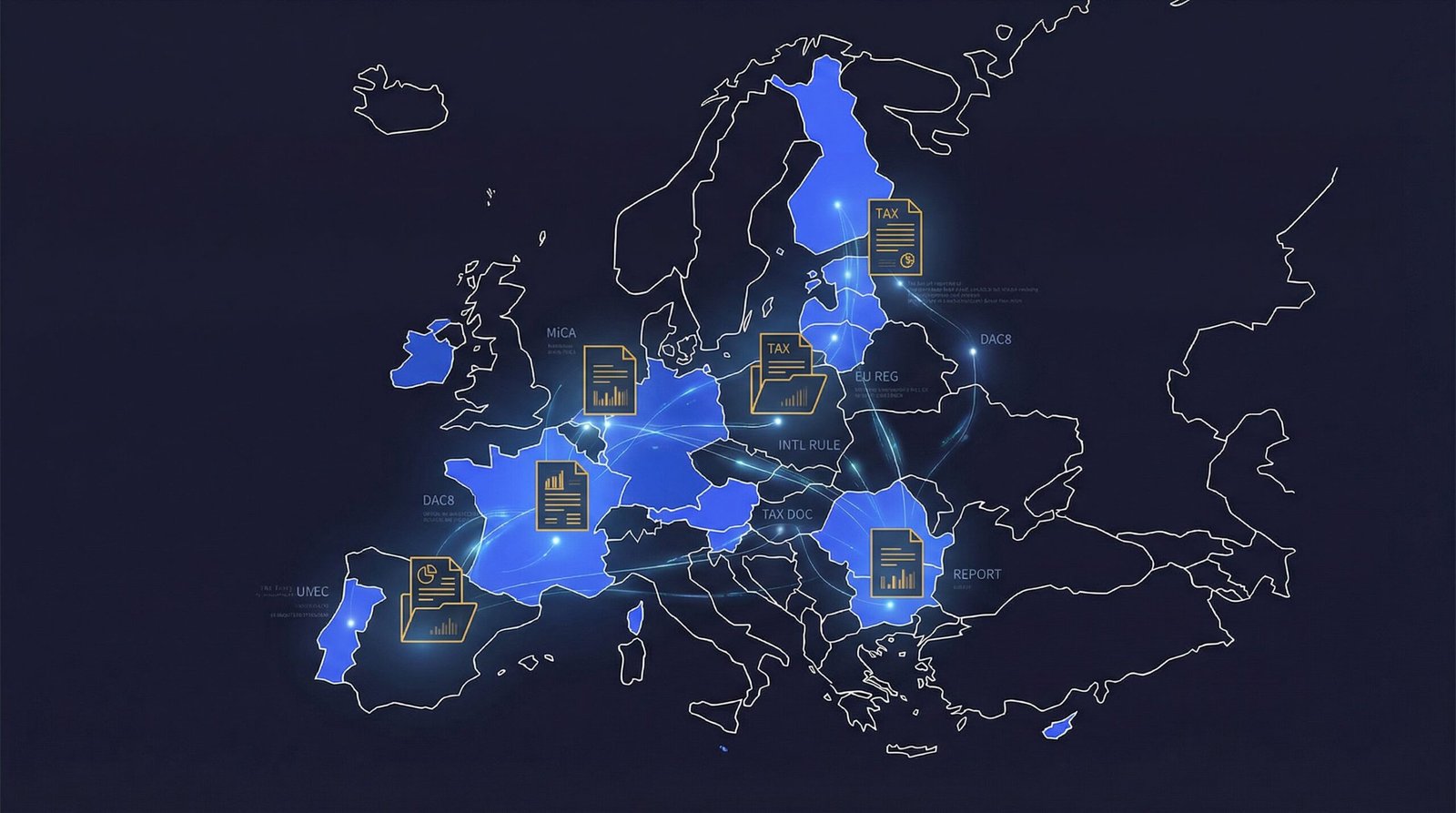
Tokenized Assets Tax Europe: Complete Guide to MiCA & DAC8
European investors face a complex web of national tax codes and supranational directives when allocating capital to digital securities. The intersection of blockchain technology and traditional finance creates unique classification challenges for revenue authorities across the continent. While some jurisdictions treat digital assets as private property with generous holding exemptions, others apply strict capital gains frameworks or annual wealth taxes based on assumed returns. The rollout of the Markets in Crypto-Assets (MiCA) regulation and the Directive on Administrative Cooperation (DAC8) fundamentally alters the compliance environment, stripping away the pseudonymity that early cryptocurrency adopters relied upon. Tax authorities will soon share transaction data automatically across borders, forcing investors to establish rigorous reporting habits. This guide examines how tokenized assets tax in Europe operates across major jurisdictions, detailing the specific mechanisms that trigger capital gains, income tax, and withholding obligations. Understanding these rules is a necessary foundation for anyone learning how to invest in tokenized assets safely and legally. Readers will find specific statutory references to help navigate the shifting regulatory environment.
The EU regulatory framework: DAC8, CARF, and MiCA
The European Union governs tokenized asset taxation through DAC8, which mandates transaction reporting by crypto-asset service providers starting in 2026. This directive implements the OECD’s Crypto-Asset Reporting Framework across member states. Meanwhile, MiCA classifies digital assets but explicitly excludes tokenized securities that qualify as financial instruments under MiFID II.
The Directive on Administrative Cooperation, specifically its eighth iteration known as DAC8, represents the most aggressive tax transparency initiative targeting digital assets in European history. Adopted by the European Council in 2023, the directive requires all crypto-asset service providers operating within the bloc to report user holdings and transaction data to domestic tax authorities by January 1, 2026. Local revenue agencies will then automatically exchange this information with other member states, ensuring that an investor residing in France cannot hide digital securities on an exchange headquartered in Germany. This framework directly domesticates the OECD’s Crypto-Asset Reporting Framework (CARF), standardizing data collection fields to include wallet addresses, transfer volumes, and fiat conversion amounts. Investors must recognize that the era of voluntary disclosure is ending, and retroactive audits will become standard practice once the data sharing infrastructure goes live.
Classification remains the core challenge for taxing digital assets, and the Markets in Crypto-Assets (MiCA) regulation provides the foundational vocabulary for European regulators. MiCA divides the digital asset universe into asset-referenced tokens, e-money tokens, and other utility-style crypto-assets. However, the legislation explicitly excludes tokenized securities that qualify as financial instruments under the Markets in Financial Instruments Directive (MiFID II). If a token represents equity in a company, debt, or a unit in a collective investment scheme, it falls entirely outside MiCA and is regulated-and taxed-as a traditional security. This distinction dictates whether an investor pays general capital gains tax, benefits from crypto-specific holding exemptions, or triggers standard dividend withholding obligations. European tax authorities rely heavily on this MiFID II intersection to determine the appropriate tax treatment for any given tokenized asset.
German crypto tax rules: Section 23 EStG vs. Section 20 EStG
Germany taxes general crypto-assets under Section 23 EStG as private disposal transactions, allowing tax-free gains after a one-year holding period. However, tokenized securities fall under Section 20 EStG, triggering a flat 25% capital gains tax with no holding period exemption. Staking income is taxed as standard income.
The German tax code offers one of the most favorable environments for long-term digital asset investors, provided the assets qualify under specific statutory definitions. Under Section 23 of the German Income Tax Act (Einkommensteuergesetz or EStG), standard cryptocurrencies are treated as private disposal transactions (private Veräußerungsgeschäfte). This classification establishes the “Spekulationsfrist,” a one-year speculation period. If an investor holds a digital asset for more than 365 days, any capital gains realized upon sale are entirely tax-free. If sold within the one-year window, gains are taxed at the individual’s progressive income tax rate, provided the total profit exceeds the annual exemption limit of 1,000 EUR. The Federal Ministry of Finance (BMF) solidified this treatment in a comprehensive May 2022 guidance document, which notably clarified that using assets for staking or lending no longer extends the required holding period to ten years, as was previously feared by the investor community.
Tokenized real-world assets and digital securities face a fundamentally different, and often more expensive, tax reality in Germany. When a token qualifies as a security (Wertpapier) under German law, it loses the Section 23 EStG holding period exemption entirely. Instead, tokenized securities fall under Section 20 EStG, which governs income from capital investments. Gains from the sale of these instruments trigger the Abgeltungsteuer, a flat 25% capital gains tax, plus a 5.5% solidarity surcharge and potential church tax, regardless of how long the investor held the asset. This creates a massive divergence in after-tax returns depending strictly on the legal classification of the token. Investors assessing the risks of investing in tokenized assets must factor this classification risk into their financial models, as a regulator reclassifying a utility token as a security immediately strips away the tax-free exit strategy.
United Kingdom crypto capital gains tax and HMRC guidance
The UK taxes crypto-assets as property, applying Capital Gains Tax at 10% or 20% on profits exceeding the £3,000 annual exempt amount. Tokenized securities are taxed under existing traditional financial regulations. HM Revenue & Customs details these rules extensively in its CRYPTO manual for individual and corporate taxpayers.
HM Revenue & Customs (HMRC) maintains a strict property-based approach to digital assets, rejecting the notion that tokens function as currency. For individual investors, disposing of a tokenized asset triggers Capital Gains Tax (CGT). The tax rate depends on the investor’s overall income band, with basic rate taxpayers paying 10% on crypto gains, while higher and additional rate taxpayers pay 20%. The UK government has aggressively reduced the annual exempt amount-the threshold below which gains are tax-free-dropping it to just £3,000 for the 2024/25 tax year. This low threshold means that even retail investors making modest trades will likely incur reporting obligations and tax liabilities. Investors must calculate their gains using specific share pooling rules, which prevent individuals from manipulating their tax liabilities by selectively identifying which specific tokens they sold from a larger holding.
The taxation of tokenized securities in the UK diverges from the general crypto-asset guidance when the assets meet the definition of a specified investment under the Financial Services and Markets Act (FSMA). If a token is legally recognized as a share or a debt instrument, HMRC applies traditional securities taxation rules. This distinction affects how losses are offset and how stamp duty reserve tax might apply to secondary market transfers. Furthermore, income generated from these assets, such as yield from a tokenized bond or dividends from tokenized equity, is subject to standard Income Tax rather than CGT. Investors must report this income on their Self Assessment tax returns, and depending on the asset structure, the income may be subject to National Insurance contributions if HMRC deems the activity to constitute a financial trade rather than passive investment. For a broader view of global policies, investors often consult a comprehensive tokenization tax guide by country to compare the UK’s approach against other jurisdictions.
Tax treatment in Switzerland, France, and the Netherlands
Switzerland levies no capital gains tax on private crypto investments but applies a cantonal wealth tax. France imposes a 30% flat tax on digital asset gains. The Netherlands taxes crypto under its Box 3 system, levying a wealth tax based on assumed returns rather than actual realized capital gains.
Switzerland cantonal wealth tax
Switzerland operates a highly decentralized tax system that heavily favors private investors holding digital assets. At the federal level, capital gains realized by private individuals on the sale of crypto-assets are entirely tax-free, provided the individual is not classified as a professional trader. The Swiss Federal Tax Administration uses specific criteria to determine professional status, including transaction volume, holding periods, and the use of debt financing. However, Switzerland does impose a wealth tax at the cantonal level. Investors must declare their tokenized asset holdings on December 31st of each year, and the assets are taxed based on their market value. The rates vary significantly between cantons like Zug, Zurich, and Geneva, but generally range from 0.1% to 1% of total net wealth.
France PFU 30% flat tax
The French Republic simplifies the taxation of digital assets through the Prélèvement Forfaitaire Unique (PFU), commonly known as the flat tax. Under Article 150 VH bis of the General Tax Code, net capital gains realized from the sale of digital assets against fiat currency or traditional goods and services are taxed at a flat rate of 30%. This 30% comprises a 12.8% income tax component and a 17.2% social contributions component. Notably, crypto-to-crypto trades do not trigger a taxable event in France, allowing investors to rebalance their portfolios without immediate tax consequences. Alternatively, taxpayers can opt to have their crypto gains taxed at their progressive income tax rate if it results in a lower overall liability, though the 17.2% social contribution remains mandatory regardless of the chosen income tax method.
Netherlands Box 3 wealth tax
The Dutch tax authority (Belastingdienst) employs a unique system that largely ignores actual realized capital gains in favor of taxing assumed returns on total net wealth. Tokenized assets fall into Box 3 of the Dutch income tax system, which covers savings and investments. Instead of tracking every buy and sell transaction, investors declare the fair market value of their crypto-assets on January 1st of the tax year. The tax authority then applies a fictitious, assumed rate of return to this asset base, and taxes that assumed return at a flat rate of 36% (as of 2024). This system benefits investors who achieve massive returns, as their tax liability is capped by the assumed return rate, but it severely penalizes investors during bear markets, as they must pay tax on an assumed profit even if their portfolio lost substantial value over the year.
Double taxation treaties and cross-border dividend withholding
Cross-border tokenized asset investments trigger complex withholding tax rules. Double taxation treaties can reduce these withholding rates, but claiming treaty benefits for tokenized dividends requires proving beneficial ownership. The conflict between residency-based and source-based taxation creates significant administrative hurdles for international investors holding foreign digital securities.
When an investor in one country purchases a tokenized security issued by a company in another country, they immediately encounter the friction of cross-border withholding taxes. If a German investor holds tokenized equity in a French real estate company, the French government will typically withhold a percentage of any dividend distribution at the source. Understanding tokenized equity dividends explained requires navigating the network of bilateral double taxation treaties that exist between EU member states. These treaties generally reduce the statutory withholding rate-often dropping it from 25% or 30% down to 15% or even 0%-to prevent the investor from being taxed fully by both the source country and their home country. However, the blockchain architecture underlying tokenized assets complicates the practical application of these treaty benefits.
Claiming a reduced withholding rate requires the investor to prove their tax residency and establish themselves as the beneficial owner of the income. In traditional finance, centralized brokerages manage this documentation, such as the W-8BEN form in the United States or equivalent domestic declarations in Europe. In the decentralized environment of tokenized assets, where tokens sit in self-hosted wallets or on specialized digital asset platforms, establishing beneficial ownership for tax authorities remains a severe administrative bottleneck. Smart contracts distributing yield rarely have the capacity to verify tax residency dynamically and withhold different rates for different wallet addresses. Consequently, issuers often apply the maximum statutory withholding rate by default, forcing investors to file complex reclaim forms with foreign tax authorities to recover the excess tax paid.
Compliance, DAC8 reporting timelines, and tax software
Investors must prepare for strict enforcement as the DAC8 reporting timeline mandates full data sharing by 2026. Maintaining accurate records across multiple blockchains requires specialized tax software like Koinly, Blockpit, or CoinTracker. Proactive compliance is essential to avoid penalties as tax authorities expand their visibility into digital wallets.
The days of manually tracking digital asset transactions on spreadsheets are effectively over for serious investors. The sheer volume of data generated by staking, yield farming, and trading tokenized assets across multiple protocols necessitates automated software solutions. Platforms like Koinly, Blockpit, CoinTracker, and Accointing have developed specific integrations for European tax codes, allowing users to generate localized tax reports that align with rules like the German Spekulationsfrist or the UK share pooling requirements. These tools connect directly to exchange APIs and public wallet addresses to aggregate transaction history, calculate cost basis, and determine fair market value at the exact time of disposal. Given the severe penalties for underreporting, utilizing enterprise-grade or highly rated retail tax software is a mandatory operational cost for managing digital wealth.
The approaching implementation of the DAC8 directive in January 2026 should serve as a hard deadline for investors to audit their historical transaction records. Once crypto-asset service providers begin transmitting user data to domestic tax authorities, revenue agencies will run automated matching algorithms against previously filed tax returns. Any discrepancies between the exchange-reported data and the investor’s self-reported figures will trigger automatic audit flags. Investors must ensure that their cost basis calculations are fully documented and defensible. For those deciding where to buy security tokens, the regulatory status of the platform matters immensely; regulated broker-dealers and compliant digital asset exchanges will issue formal tax statements, whereas decentralized platforms leave the entire calculation burden squarely on the investor.
Comparing European and US tokenized asset taxation
European tax regimes vary wildly compared to the United States. While the US taxes all crypto as property with short and long-term capital gains rates, European countries offer unique mechanisms like Germany’s one-year tax-free exemption, Switzerland’s zero capital gains policy, and the Netherlands’ wealth tax system.
International investors must understand the structural differences between US and European tax frameworks to optimize their asset location and legal structuring. The United States Internal Revenue Service (IRS) treats all digital assets as property, applying short-term capital gains tax (taxed as ordinary income up to 37%) for assets held less than a year, and long-term capital gains tax (0%, 15%, or 20%) for assets held longer. Unlike Germany, the US never allows the capital gains tax rate on digital assets to drop to zero simply based on a holding period, unless the investor’s total income is exceptionally low. A comprehensive US tokenized assets tax guide highlights that the US also lacks the aggressive wealth tax models seen in Switzerland or the Netherlands, focusing entirely on realized transactions and actual income generated.
The table below provides a high-level comparison of how different jurisdictions approach the taxation of tokenized assets and general cryptocurrencies. This data reflects the statutory environment as of early 2026. Investors should note that wash sale rules-which prevent claiming a tax loss if the same asset is repurchased within 30 days-currently apply to traditional securities in the US and UK, but their application to general crypto-assets remains inconsistent across borders.
| Jurisdiction | Capital Gains Tax Rate | Holding Period Advantage | Wealth Tax | Wash Sale Rules Apply |
|---|---|---|---|---|
| United States | 0% – 20% (Long-term) | Lower rate after 1 year | None | Yes (for tokenized securities) |
| United Kingdom | 10% or 20% | None | None | Yes (30-day rule) |
| Germany | 0% (Crypto) / 25% (Securities) | Tax-free after 1 year (Crypto only) | None | No specific crypto rule |
| France | 30% Flat Tax (PFU) | None | None | No |
| Switzerland | 0% (Private Investors) | None | Yes (Cantonal level) | No |
| Netherlands | N/A (Box 3 system) | None | Yes (Assumed return tax) | No |
The taxation of tokenized assets across Europe remains a fragmented environment, requiring investors to navigate a complex intersection of national laws and EU directives. The distinction between a standard crypto-asset and a MiFID II financial instrument fundamentally alters an investor’s tax liability, dictating whether they benefit from generous holding exemptions or face strict capital gains levies. As the DAC8 reporting requirements take effect in 2026, the era of regulatory ambiguity and voluntary compliance will end. Tax authorities will possess unprecedented visibility into cross-border holdings and transaction histories. Investors must proactively audit their portfolios, deploy robust tax tracking software, and consult with specialized legal counsel to ensure their reporting aligns with local statutes. Failing to adapt to this transparent environment exposes capital to severe compliance risks and financial penalties.
Frequently Asked Questions
How does DAC8 affect crypto investors in Europe?
DAC8 forces crypto-asset service providers to automatically report user transaction data to EU tax authorities starting in 2026. This eliminates the possibility of hiding digital assets across borders, meaning investors must maintain accurate records and expect automated audits of their trading history.
Are crypto gains tax-free in Germany?
Standard crypto-assets are tax-free in Germany if held for more than one year under Section 23 EStG. However, if the asset is classified as a tokenized security, it loses this exemption and faces a flat 25% capital gains tax regardless of the holding period.
How does the UK tax tokenized securities?
The UK applies standard Capital Gains Tax at 10% or 20% on crypto-asset profits exceeding the £3,000 annual exemption limit. If a token qualifies legally as a traditional security under FSMA, it follows existing financial regulations, affecting loss offsets and income tax on generated yield.
Do I pay tax on crypto in Switzerland?
Private investors in Switzerland pay no federal capital gains tax on the sale of digital assets. However, investors must declare their crypto holdings annually and pay a cantonal wealth tax based on the market value of their portfolio at the end of the year.
Sources
- [1] Directive (EU) 2023/2226 on administrative cooperation in the field of taxation (DAC8)
- [2] Einzelfragen zur ertragsteuerrechtlichen Behandlung von virtuellen Währungen und von sonstigen Token
- [3] Cryptoassets Manual (CRYPTO)
- [4] Taxation of Cryptocurrencies and Initial Coin Offerings (ICOs)
- [5] Code général des impôts, Article 150 VH bis
- [6] Notice 2014-21: Virtual Currency Guidance