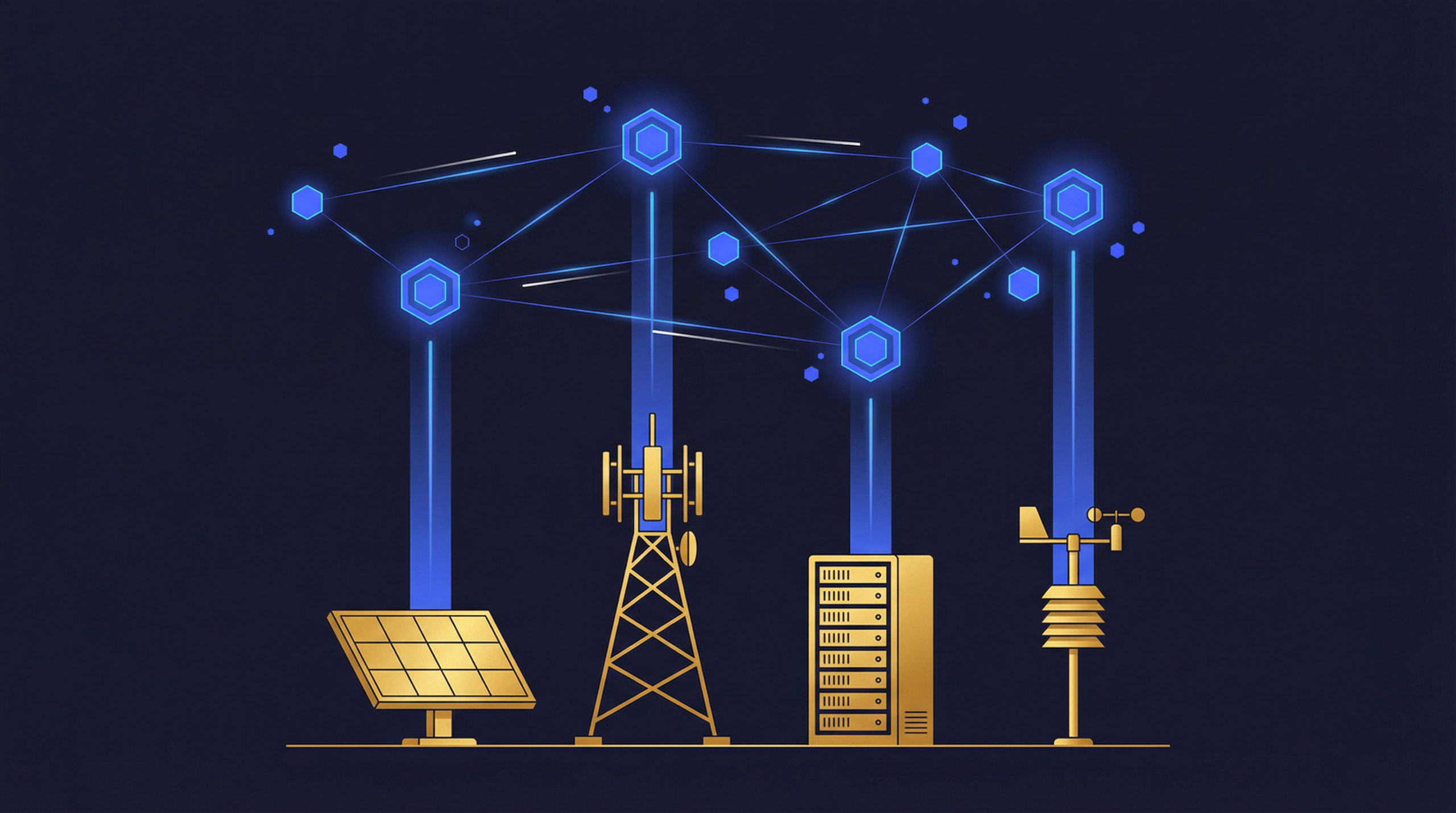
DePIN and Tokenization: Physical Infrastructure On-Chain
Building physical infrastructure traditionally requires massive upfront capital expenditure. Telecommunications companies spend billions acquiring spectrum and erecting cell towers before a single customer pays for service. Cloud computing giants build sprawling data centers filled with expensive hardware long before they can rent that capacity to enterprise clients. This capital-intensive model creates natural monopolies, limits competition, and leaves large geographic areas underserved because the return on investment does not justify the initial deployment costs. A new model for capital formation and network deployment is emerging to challenge this paradigm.
The intersection of DePIN tokenization physical infrastructure represents a fundamental shift in how hardware networks are funded, built, and operated. By using blockchain-based digital assets to incentivize individuals and independent businesses to deploy hardware, these protocols crowdsource the capital expenditure required to build global networks. Network operators receive tokens in exchange for providing verifiable utility, creating a decentralized web of physical assets that rivals centralized corporate infrastructure. This approach allows networks to scale rapidly without a central entity taking on billions in debt. Investors and network participants are now evaluating how these tokenized infrastructure networks stack up against traditional infrastructure assets, utility stocks, and real estate investment trusts.
Understanding decentralized physical infrastructure networks
Decentralized Physical Infrastructure Networks (DePIN) are blockchain protocols that use cryptocurrency tokens to incentivize people to deploy and operate physical hardware. These networks crowdsource the capital and labor required to build telecommunications, computing, storage, and energy infrastructure, creating a decentralized alternative to traditional corporate networks.
The term DePIN was coined by crypto research firm Messari in late 2022 to categorize a growing sector of projects that connect digital ledgers to physical hardware. Prior to this standardization, these projects were often referred to as EdgeFi, Proof of Physical Work, or Token Incentivized Physical Networks. Today, the DePIN category represents a combined market capitalization exceeding $30 billion across hundreds of distinct protocols. The core innovation across all these projects is the use of tokenomics to solve the “cold start” problem inherent in building any new network. By offering outsized token rewards to early participants who deploy hardware before there is organic demand, the protocol subsidizes the initial network buildout. As the network becomes robust enough to attract paying users, the revenue generated from those users is distributed back to the hardware operators, eventually replacing the initial token subsidies.
Wireless networking represents one of the most mature categories within the decentralized physical infrastructure space. Helium pioneered this model by incentivizing individuals to place Long Range Wide Area Network (LoRaWAN) routers in their homes to provide connectivity for Internet of Things devices. The protocol successfully deployed over one million hotspots globally before executing a strategic pivot to 5G cellular coverage through Helium Mobile. Competitors like XNET are taking a more targeted approach by incentivizing the deployment of carrier-grade 5G small cells in high-traffic commercial locations rather than relying on random residential placement. These networks sell connectivity back to traditional telecom operators as offload capacity, demonstrating how tokenized networks can integrate directly with legacy infrastructure.
Beyond wireless connectivity, decentralized compute and storage networks have reached massive scale by aggregating idle hardware. Render Network, which commands a market capitalization exceeding $3 billion, connects digital artists and AI developers with unused consumer GPU power for 3D rendering and machine learning tasks. Similarly, Akash Network functions as a decentralized cloud compute marketplace, while io.net aggregates idle GPU capacity specifically optimized for AI training workloads. In the data storage sector, Filecoin has amassed more than 20 exabytes of decentralized storage capacity by incentivizing data center operators and independent providers to commit hard drive space to the network. Other emerging categories include sensor networks like Hivemapper, which has mapped over 200 million kilometers of roads using contributor-owned dashcams, and energy protocols like Power Ledger that facilitate peer-to-peer energy trading across localized grids. Understanding what is asset tokenization helps clarify how these diverse physical assets generate yield on a blockchain.
How DePIN intersects with asset tokenization
DePIN and traditional real-world asset tokenization both bridge the gap between physical reality and digital ledgers, but they approach the integration from opposite directions. While traditional tokenization digitizes existing assets, DePIN protocols create entirely new physical networks that are natively tokenized from their inception.
Traditional RWA tokenization takes an existing, mature asset-such as a commercial office building, a portfolio of corporate bonds, or a piece of fine art-and creates a digital representation of ownership on a blockchain. The physical asset exists completely independent of the blockchain, and the token merely serves as a more efficient legal wrapper for transferring ownership or distributing yield. If you want to know what is RWA tokenization, it is fundamentally about financial engineering and liquidity. DePIN, conversely, uses the blockchain as the organizational layer to build the physical asset itself. The cell towers, GPUs, and weather sensors in a DePIN network would not have been deployed in their specific locations without the coordinating mechanism of the protocol and its token incentives.
The intersection of these two models occurs primarily in how investors gain economic exposure to the underlying hardware. In a DePIN network, tokenized ownership of physical infrastructure allows investors to purchase tokens that represent an economic interest in the aggregate productivity of the network. When an enterprise client pays to render a 3D video on the Render Network, or when a telecom company pays for data offload on a decentralized 5G network, that revenue flows through the protocol. In many designs, this protocol revenue is used to buy and burn the native token, or it is distributed directly to token holders who stake their assets. This creates tokenized revenue streams derived entirely from real-world economic activity rather than speculative crypto trading. For a foundational understanding of these mechanics, reviewing how tokenization works provides necessary context on smart contract execution and revenue routing.
We are now seeing physical-asset-backed tokens emerge from the convergence of DePIN and institutional finance. Traditional infrastructure funds are beginning to tokenize cell tower, fiber optic, and data center assets using the same technical standards developed by DePIN protocols. Simultaneously, mature DePIN networks are seeking institutional capital by offering tokenized equity or revenue shares that comply directly with standard securities regulations. We are witnessing hybrid models where traditional infrastructure companies deploy new capacity through DePIN incentive structures rather than funding it entirely through their own balance sheets. This convergence allows institutional investors to use DePIN protocols as the compute and storage layer for their own tokenization operations, creating a closed-loop ecosystem of tokenized assets running on tokenized infrastructure.
The technical mechanics of physical infrastructure blockchain
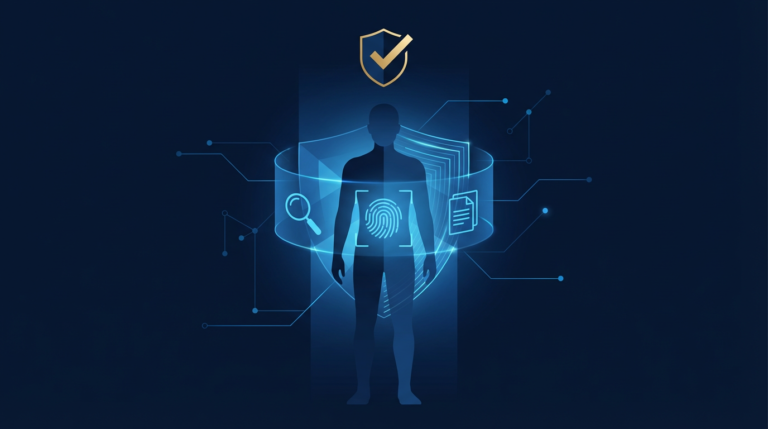
The technical foundation of DePIN relies on cryptographic verification that real-world hardware is actually performing useful work. This is achieved through Proof of Physical Work consensus mechanisms, where hardware operators must continuously prove they are providing the specific infrastructure services required by the network.
Unlike traditional blockchain networks that rely on Proof of Work (solving mathematical puzzles) or Proof of Stake (locking up capital) to secure the ledger, DePIN protocols require specialized validation. Hardware operators must submit cryptographic proofs that verify their physical contribution. For wireless networks, this takes the form of Proof of Coverage, where hardware nodes issue challenge-response “ping” tests to neighboring nodes to verify their geographic location and signal strength. Filecoin uses Proof of Spacetime and Proof of Replication to ensure storage providers are actually holding the data they claim to hold over a specific duration. Render Network utilizes Proof of Render to verify that a remote GPU accurately computed the complex mathematical lighting calculations required for a 3D scene. If a node fails these continuous automated checks, the protocol slashes their rewards or removes them from the network entirely.
Connecting these physical proofs to the blockchain requires robust oracle networks and verification systems. Oracles serve as the bridge between the physical hardware sensors and the on-chain smart contracts. The protocols use heartbeat checks, challenge-response cryptography, and user attestations to ensure that physical infrastructure is functioning correctly and has not been spoofed by malicious actors trying to extract token rewards without providing real hardware. This verification layer is critical because the entire economic model relies on the accurate distribution of tokens. You can reference a tokenization glossary to understand the specific smart contract terminology used in these verification systems.
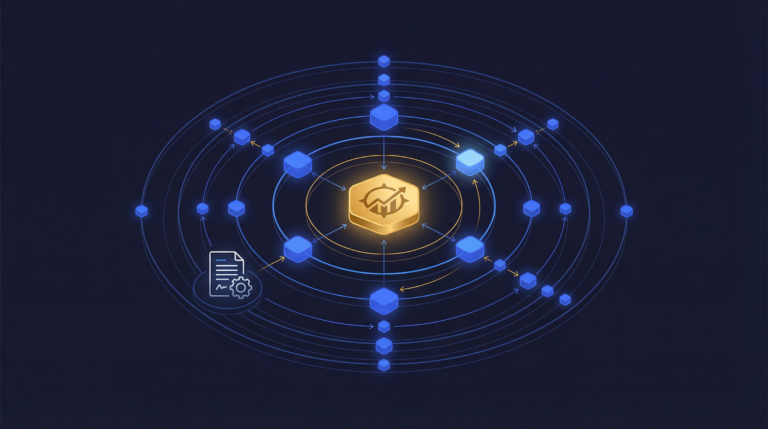
The token distribution mechanism operates on a specific flywheel model designed to bootstrap the network. In the early stages, organic demand for the network’s services is nonexistent. To attract hardware operators, the protocol issues high inflationary token rewards. These early deployers take on the physical cost and risk of buying hardware, compensated by earning a large share of the initial token supply. As the physical network grows in density and reliability, it becomes useful to enterprise clients. These clients purchase network services, generating organic revenue. The critical sustainability question for every DePIN project is whether this organic revenue will grow fast enough to sustain the hardware operators when the initial inflationary token emissions inevitably decrease over time.
Evaluating DePIN tokens as infrastructure investments
DePIN tokens present a unique asset class that blends the characteristics of utility tokens, yield-bearing instruments, and traditional infrastructure equities. Investors must evaluate the underlying hardware lifecycle, the protocol’s inflation schedule, and the organic demand for the network’s physical services.
The investment profile of a DePIN token combines utility value, staking yield, and network value. Tokens are required to purchase services from the network, creating baseline utility demand from enterprise users who need storage, compute, or bandwidth. Token holders who actively operate physical infrastructure earn direct yield through protocol rewards. Even passive investors who do not operate hardware can often participate in staking yield by delegating their tokens to active node operators, providing the economic security required by the protocol. As the network expands its physical footprint and attracts more paying customers, the aggregate value of the network increases, which theoretically drives demand for a fixed or deflationary token supply. Because the network’s value is derived from deployed hardware generating actual revenue, DePIN tokens are considered physical-asset-backed, distinguishing them from purely speculative digital assets.
However, investing in decentralized physical infrastructure carries specific risks that differ entirely from traditional digital assets. Token emission inflation is the primary headwind for investors. Many DePIN protocols have aggressive inflation schedules designed to incentivize early infrastructure deployment, which constantly dilutes passive token holders. Furthermore, hardware depreciation introduces a physical reality to the digital investment. The GPUs, hard drives, and 5G antennas powering these networks have limited lifespans and require continuous maintenance and eventual replacement. A network that cannot generate enough organic revenue to fund hardware replacement cycles will inevitably collapse when the token subsidies run out. Geographic concentration risk also plays a role, as networks may become overly dense in profitable urban centers while failing to provide the broad coverage required to compete with centralized alternatives.
Comparing DePIN token investments to traditional infrastructure investing reveals distinct structural differences. Traditional infrastructure funds and Real Estate Investment Trusts (REITs) offer highly predictable, contracted cash flows backed by physical monopolies. They utilize debt financing to optimize returns and operate within clear regulatory frameworks. DePIN networks offer higher growth potential and avoid the massive debt burdens of traditional telecom or utility companies, but they operate with significant regulatory uncertainty. DePIN tokens may be classified as securities in certain jurisdictions, which would fundamentally alter their distribution models and secondary market liquidity. Investors looking at platforms in this space often compare the pure crypto approach of DePIN with the regulated, compliant approach seen in a Centrifuge review, where traditional physical assets are tokenized within strict legal boundaries.
The future of tokenized infrastructure networks
The total addressable market for decentralized physical infrastructure is staggering, encompassing global telecommunications, cloud computing, and energy sectors. DePIN protocols are attempting to capture market share in industries that generate trillions of dollars in annual revenue.
The bullish outlook for DePIN rests on the sheer size of the markets these protocols are disrupting. The global telecommunications infrastructure market is valued at approximately $1.7 trillion. Cloud computing represents a $500 billion sector, while global energy infrastructure exceeds $3 trillion in total value. Capturing even a fractional percentage of these markets would make DePIN one of the most valuable categories in the digital asset space. The model has already proven viable at scale, with Helium and Filecoin demonstrating that decentralized networks can coordinate massive physical deployments globally. Growing institutional interest suggests that traditional telecom and cloud providers may eventually adopt DePIN protocols as a cost-effective way to expand their own networks at the edges, rather than competing directly against them. Tracking the tokenization market size provides insight into how rapidly capital is moving into these infrastructure protocols.
Conversely, significant bearish factors challenge the long-term viability of many current DePIN projects. The most pressing issue is the imbalance between token inflation and organic revenue. Many networks have successfully incentivized the deployment of hardware but have failed to attract paying enterprise customers, resulting in networks that exist solely to farm token rewards. Regulatory risk also looms large over the sector. Agencies like the Federal Communications Commission (FCC) and regional telecom regulators may challenge decentralized wireless networks that operate in licensed spectrum or fail to meet emergency service requirements. Quality of service remains a persistent challenge, as decentralized networks run by independent operators struggle to match the guaranteed uptime and service level agreements provided by centralized corporate alternatives.
The transition of physical infrastructure onto blockchain networks represents a maturation of the token economy. By aligning economic incentives through smart contracts, DePIN protocols have solved the capital coordination problem that historically prevented grassroots infrastructure development. While many individual networks will fail due to poor tokenomics or lack of market demand, the underlying mechanism of Proof of Physical Work has established a new model for deploying hardware globally. As the sector matures, the integration of traditional institutional capital and regulated tokenization frameworks will likely bridge the gap between experimental crypto networks and enterprise-grade physical infrastructure.
Frequently Asked Questions
What is a DePIN network?
DePIN stands for Decentralized Physical Infrastructure Networks. These are blockchain-based protocols that use cryptocurrency tokens to incentivize individuals and businesses to deploy and maintain physical hardware, such as wireless routers, storage drives, or solar panels, creating a distributed alternative to centralized corporate infrastructure.
How do DePIN tokens generate value?
DePIN tokens derive value from the utility of the physical network they support. When enterprise clients or consumers pay to use the network’s services (like cloud storage or 5G connectivity), that revenue is routed through the protocol, often resulting in token buybacks or direct yield distribution to hardware operators.
Are DePIN tokens considered real-world assets (RWAs)?
DePIN tokens are closely related to RWAs but differ in origin. While traditional RWA tokenization creates a digital representation of an existing physical asset (like real estate), DePIN uses token incentives to fund and build completely new physical networks from the ground up.
What is Proof of Physical Work?
Proof of Physical Work is the consensus mechanism used by DePIN protocols to verify hardware deployment. It requires node operators to submit cryptographic proofs demonstrating that their physical equipment is active, correctly located, and providing the specific infrastructure services required by the network.