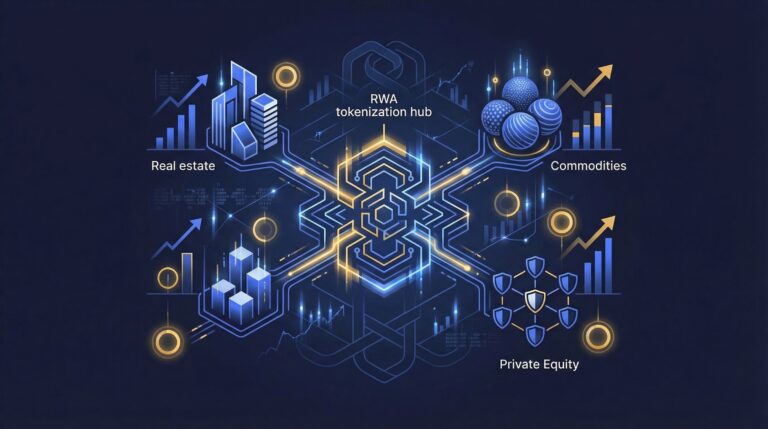
Tokenization Market Report Q2 2026: Institutional Capital
The tokenization market report Q2 2026 reveals a maturing financial sector where institutional asset managers have moved decisively past pilot programs into commercial scale deployment. Total value locked in real-world assets expanded significantly between April and June, driven primarily by tokenized US Treasury products, institutional money market funds, and private credit protocols. This analysis examines the raw data, sector-specific growth metrics, and the underlying regulatory shifts that enabled this quarter’s capital inflows. Investors, compliance professionals, and infrastructure providers require clear visibility into exactly where liquidity is concentrating and which asset classes are failing to gain traction. The data from the second quarter demonstrates a stark divergence between highly liquid tokenized financial instruments, which are seeing rapid adoption, and illiquid physical assets like real estate, which continue to struggle with secondary market friction. By analyzing platform activity, regulatory frameworks, and capital allocation patterns, market participants can better position themselves for the remainder of the year. This report synthesizes data from leading on-chain analytics platforms and institutional disclosures to provide an unvarnished look at the current state of the tokenized economy.
Executive summary and Q2 2026 context
The tokenized asset market Q2 2026 saw total value locked in real-world assets reach an estimated $12.5 billion to $14 billion, excluding fiat-backed stablecoins. Institutional adoption of tokenized money market funds and US Treasuries accounted for over 60% of this growth, while regulatory clarity in the European Union and Singapore accelerated deployment timelines for major asset managers.
The macroeconomic environment throughout the second quarter of 2026 provided a specific catalyst for the sustained growth in tokenized financial assets. With central banks maintaining relatively stable interest rates following the adjustments of late 2025, institutional investors sought capital-efficient methods to manage treasury reserves on-chain without exposing themselves to the volatility of native crypto assets. This demand for yield-bearing, low-risk instruments on distributed ledgers directly fueled the expansion of the tokenization market size across major public and permissioned blockchains. Asset managers recognized that offering a tokenized share of a traditional fund structure allowed crypto-native treasuries, decentralized autonomous organizations, and high-net-worth individuals to access traditional yields while keeping their capital within the blockchain ecosystem. The infrastructure built during the bear markets of previous years finally met a critical mass of institutional demand, resulting in sustained capital inflows rather than speculative spikes.
A defining characteristic of Q2 2026 was the clear separation between infrastructure providers and asset issuers. In earlier phases of the industry, platforms attempted to build the blockchain infrastructure, structure the financial products, and manage the assets simultaneously. The second quarter demonstrated a horizontal stratification of the industry, where traditional financial heavyweights focused purely on asset management while relying on specialized tokenization engines for smart contract deployment and compliance enforcement. We saw this model validated repeatedly as legacy banks partnered with established blockchain infrastructure firms rather than attempting to build proprietary ledgers from scratch. This division of labor reduced the time-to-market for new tokenized funds from several months to a matter of weeks, lowering the barrier to entry for mid-sized asset managers who previously viewed tokenization as prohibitively expensive. The resulting proliferation of products created a more competitive landscape, forcing issuers to compete on management fees and integrated liquidity solutions rather than mere novelty.
Furthermore, the integration of traditional finance and decentralized finance reached a practical operational level during this period. Rather than operating in isolated silos, tokenized real-world assets began functioning as collateral within major DeFi lending protocols, unlocking capital efficiency that was previously theoretical. This utility beyond simple holding was the primary driver for the increase in tokenization TVL Q2 metrics, as investors realized they could earn base yields from tokenized treasuries while borrowing against them to fund other operations. The market moved from treating tokenized assets as static receipts of off-chain ownership to viewing them as dynamic financial primitives capable of interacting with automated smart contracts. This shift in utility requires a fundamental reassessment of how we measure the success of tokenized products, moving beyond simple assets under management to focus on turnover velocity and protocol integration.
Market data and sector developments
According to RWA tokenization quarterly report data from rwa.xyz and DeFiLlama, tokenized US Treasuries surpassed $2.8 billion in AUM by the end of Q2 2026. Private credit protocols maintained steady originations, while tokenized real estate and commodities showed slower, fragmented growth due to persistent secondary market liquidity constraints and complex cross-border compliance requirements.
The dominance of tokenized government securities and money market funds cannot be overstated when analyzing the quarter’s data. Products like the BlackRock BUIDL fund demonstrated that when a top-tier asset manager issues a tokenized instrument with immediate utility and deep liquidity, capital follows rapidly. According to data aggregated by rwa.xyz, the treasury sector saw a quarter-over-quarter growth rate of approximately 18%, drawing capital primarily from stablecoin holders seeking yield and institutional investors looking for efficient cross-border collateral. The mechanics of these funds have become highly standardized, typically utilizing a bankruptcy-remote special purpose vehicle that holds the underlying securities while a smart contract manages the issuance and redemption of tokens representing shares in that SPV. This structural standardization has given rating agencies and risk managers the historical data they need to approve these assets for broader corporate treasury use, moving them out of the experimental bucket and into standard cash management strategies.
Private credit remained the largest sector by total value locked, though its growth rate was more measured compared to the explosive expansion of tokenized treasuries. The private credit tokenization space, which involves lending stablecoins to real-world businesses against off-chain collateral, stabilized around the $6.8 billion mark by late June. This sector requires significantly more operational overhead than treasury tokenization, as it involves underwriting specific borrowers, assessing physical collateral, and managing defaults in real-world legal jurisdictions. Despite these complexities, platforms operating in this space managed to maintain consistent yields that outperformed traditional fixed-income instruments. The data indicates that institutional investors are becoming more comfortable with the risk profile of on-chain private credit, provided there is a clear legal recourse mechanism in the event of borrower default. However, the exact figures for private credit TVL remain subject to verification variations, as different analytics platforms use varying methodologies to account for active loans versus idle protocol capital.
Conversely, the tokenization of physical assets like real estate and fine art continued to face structural headwinds throughout Q2 2026. While the concept of RWA tokenization explained in theoretical terms often focuses on democratizing access to commercial real estate, the practical reality shown in the quarterly data tells a different story. Real estate tokenization TVL grew by less than 5% during the quarter, hampered by the localized nature of property laws and the lack of unified secondary markets. Investors who purchase tokenized real estate often find themselves holding highly illiquid assets, unable to exit their positions without taking significant discounts to net asset value. Until a multi-jurisdictional secondary trading venue achieves sufficient volume, real estate tokenization will likely remain a niche mechanism for capital formation rather than a transformative liquidity solution. The market data clearly shows that capital is flowing toward assets that are already financialized and liquid in the traditional world, rather than attempting to force liquidity upon inherently illiquid physical assets.
Regulatory shifts and platform activity
Regulatory frameworks formalized in Q2 2026 provided the legal certainty required for institutional tokenization platforms to scale operations. The European Union’s implementation phases of the MiCA regulation and the UK’s Digital Securities Sandbox allowed platforms to launch compliant secondary trading venues, directly increasing tokenization TVL Q2 figures by enabling institutional exit liquidity.
The regulatory landscape in the second quarter was characterized by a shift from enforcement actions to framework implementation, particularly in European and Asian jurisdictions. The European Union’s Markets in Crypto-Assets regulation entered its later implementation phases, providing a clear taxonomy for tokenized financial instruments and the platforms that issue them. This regulatory clarity allowed traditional European banks to confidently allocate resources to tokenization infrastructure without the looming threat of retroactive compliance violations. Similarly, the United Kingdom’s Digital Securities Sandbox became fully operational, allowing financial institutions to test tokenized asset issuance and secondary trading under modified regulatory conditions. These sandbox environments proved highly effective at identifying the friction points between legacy settlement laws and atomic blockchain settlement, resulting in practical policy adjustments that favored market efficiency. According to a 2024 report by the Boston Consulting Group projecting market growth, this type of regulatory certainty is the primary prerequisite for reaching the estimated $16 trillion tokenized market by 2030.
In the United States, the regulatory environment remained more fragmented, though practical pathways for issuance continued to solidify. Most institutional tokenization platforms operating in the US relied heavily on established securities exemptions, specifically SEC Rule 506(c) of Regulation D, which allows for general solicitation provided all purchasers are verified accredited investors. This reliance on Regulation D explains why retail participation in the US tokenized asset market remains virtually nonexistent, as platforms must implement strict know-your-customer and anti-money laundering controls at the smart contract level. For those learning how to invest in tokenized assets, the US market remains heavily gated. However, platforms like Securitize demonstrated significant operational maturity in Q2, managing the compliance lifecycle for major asset managers seamlessly. A detailed Securitize review of their Q2 operations shows that their integrated transfer agent and broker-dealer licenses allowed them to capture a substantial portion of the institutional issuance market, proving that regulatory compliance, while expensive to build, is a massive competitive moat.
Platform activity across the sector reflected these regulatory realities, with issuance volume concentrating on platforms that held appropriate licenses in their target jurisdictions. We observed a marked decline in unregulated offshore tokenization attempts, as institutional capital strictly requires bankruptcy-remote structures and clear legal recourse. Asian markets, particularly Singapore and Hong Kong, saw aggressive platform activity driven by proactive regulatory regimes. The Monetary Authority of Singapore’s continued expansion of Project Guardian encouraged cross-border tokenized asset trading between major financial institutions, creating a blueprint for global interoperability. These jurisdictional differences are creating a fragmented global market where a tokenized asset issued in Singapore may not be legally tradable by a European entity, highlighting the need for standardized cross-border compliance protocols in the coming quarters.
Lessons learned and Q3 outlook
The primary lesson from Q2 2026 is that institutional capital requires integrated secondary market liquidity before committing to tokenized assets at scale. Looking toward Q3, market participants expect a consolidation of tokenization infrastructure providers and the launch of multi-dealer trading venues, which will likely push total tokenized market capitalization higher as friction decreases.
The data from this quarter definitively proves that simply tokenizing an asset does not magically imbue it with liquidity. The projects that succeeded in Q2 were those that built or partnered with existing liquidity venues, ensuring that investors had a clear path to exit their positions. Tokenized treasuries flourished because they represent highly liquid underlying assets and are often backed by market makers willing to facilitate redemptions. In contrast, projects that assumed the blockchain itself would generate a buyer base for illiquid assets largely failed to meet their capital formation goals. This reality is forcing a strategic pivot among tokenization platforms, shifting their focus from pure issuance technology to comprehensive market-making and liquidity provision. Understanding this dynamic is essential for anyone navigating the tokenization glossary of terms, as the distinction between primary issuance and secondary liquidity is the defining factor of platform success.
Interoperability also emerged as a critical friction point that must be resolved in the near term. During Q2, billions of dollars in tokenized assets remained siloed on specific permissioned blockchains or individual public networks, unable to move seamlessly to where demand was highest. Institutional investors expressed frustration with having to manage multiple wallets, bridge assets across vulnerable infrastructure, and navigate different compliance standards for each protocol. The market is clearly demanding a unified messaging and transfer standard for tokenized assets, similar to how the FIX protocol standardized traditional electronic trading. We anticipate that Q3 will see significant announcements regarding cross-chain interoperability protocols specifically designed for regulated financial instruments, which will allow assets to move across networks while maintaining their compliance restrictions.
Looking ahead to the third quarter of 2026, we project a continued acceleration in the tokenization of fixed-income products and institutional funds. The infrastructure is now battle-tested, the regulatory frameworks in key jurisdictions are functional, and the demand for on-chain yield remains strong. We expect to see consolidation among smaller tokenization platforms, as the cost of maintaining regulatory compliance and institutional-grade security outpaces the revenue generated by low-volume issuance. The platforms that survive will be those that secure exclusive partnerships with tier-one asset managers or build proprietary secondary trading venues. While the exact Q2 2026 figures are still being finalized in institutional quarterly reports, the trajectory is unmistakable: tokenization has transitioned from a technological experiment into a core component of modern financial market plumbing.
Frequently Asked Questions
What was the total tokenization market size in Q2 2026?
The total value locked in real-world assets reached an estimated $12.5 billion to $14 billion by the end of Q2 2026, excluding stablecoins. This growth was driven primarily by institutional adoption of tokenized US Treasuries and private credit protocols.
Which tokenized asset class grew the fastest in Q2?
Tokenized US Treasuries and money market funds saw the fastest growth, expanding by approximately 18% quarter-over-quarter. Institutional investors utilized these products to earn traditional yields while keeping capital within the blockchain ecosystem for operational efficiency.
Why is tokenized real estate growing slower than other sectors?
Tokenized real estate growth remains slow due to persistent secondary market liquidity constraints and localized property laws. Unlike financial instruments, physical real estate is inherently illiquid, and simply placing it on a blockchain does not automatically generate a pool of active buyers.
How are regulations impacting the tokenization market?
Clear regulatory frameworks like the European Union’s MiCA and the UK’s Digital Securities Sandbox are accelerating institutional adoption. These regulations provide the legal certainty required for traditional banks to launch compliant tokenization platforms and secondary trading venues.