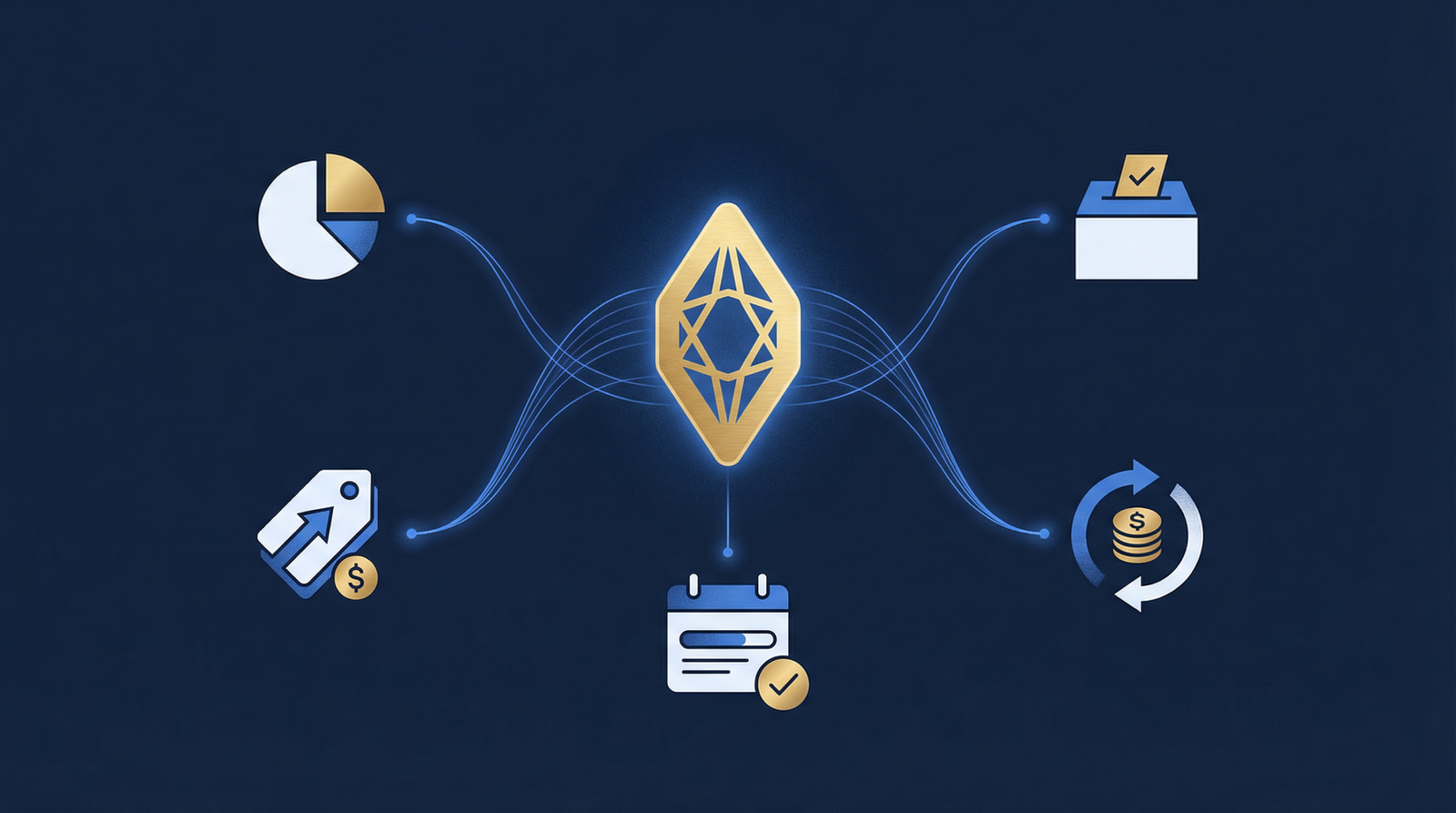
Token Economics Security Tokens: Founder Design Guide
Founders entering the digital asset space often fundamentally misunderstand the mechanics of token economics security tokens require. In the utility token ecosystem, tokenomics relies heavily on complex game theory, staking rewards, token burns, inflationary or deflationary supply mechanics, and network incentive alignment. Security token economics operates entirely differently because these digital assets represent regulated financial instruments. The design process is an exercise in traditional corporate finance applied to a blockchain architecture. If a security token incorporates complex utility-style mechanics, it will likely face immediate rejection from institutional investors and trigger intense scrutiny from securities regulators.
Designing economics for tokenized securities requires structuring the exact same elements found in a traditional equity or debt issuance. Founders must determine the supply structure by mapping tokens to the corporate cap table, establish pricing methodologies that reflect actual company valuation, and define the specific economic rights granted to investors. You must also build distribution mechanics for dividends or revenue shares and program vesting schedules that comply with federal securities law. Every decision made in this process directly impacts your ability to raise capital, manage your cap table, and maintain compliance throughout the lifecycle of the asset.
Supply structure and pricing models
Token economics for security tokens begins with mapping the token supply to the company’s equity structure and establishing a pricing methodology. Founders typically use a direct or fractional mapping to authorized shares, pricing tokens based on company valuation or traditional book-building to comply with securities regulations.
The total token supply must map logically to the company’s underlying equity structure. Founders generally choose between three common approaches when defining this relationship. The simplest method is a direct one-to-one mapping where each token represents exactly one share of stock, meaning the total token supply equals the total authorized shares allocated to the offering. While straightforward, this approach can result in unwieldy token counts for companies with massive authorized share pools. Alternatively, companies use fractional mapping where each token represents a specific fraction of a share, enabling micro-investments without generating billions of digital units. The third approach involves a fixed token supply with variable pricing, where the company mints a set number of tokens and adjusts the price per token based on the current corporate valuation. The supply structure directly affects price perception in the market. A token priced at ten cents feels psychologically different to retail investors than a token priced at one hundred dollars, even if the underlying enterprise value is identical. Securities regulators also view excessively large token supplies with suspicion, as they closely resemble the mechanics of unregulated utility tokens. To understand how this fits into your broader capitalization strategy, review our complete guide to tokenizing startup equity.
Pricing security tokens for primary issuance requires distinct methodologies that satisfy both market demand and regulatory requirements. Valuation-based pricing remains the most common model, where the token price is simply the total company valuation divided by the total token supply allocated to the round. For example, a company valued at ten million dollars issuing ten million tokens will price the asset at exactly one dollar per token. More mature companies may use book-building, allowing institutional demand to determine the final price within a specified range, mirroring the traditional initial public offering process. To incentivize early participation, issuers frequently implement fixed pricing with discount tiers, offering the earliest investors a standard ten to twenty-five percent discount on the token price. Some founders also utilize SAFE-style deferred pricing, issuing tokens that automatically convert to priced equity at the next qualified financing round. According to SEC guidance on registered offerings, issuers must clearly document their pricing methodology and demonstrate how it relates to the actual financial condition of the enterprise. Factoring these pricing models into your overall budget is a critical step when calculating the cost to tokenize a startup.
Cash flows and distribution mechanics
Security token distributions represent actual corporate cash flows, requiring precise legal and technical structuring. Companies distribute value to token holders through traditional board-declared dividends, fixed revenue shares, or programmatic token buyback programs, utilizing smart contract snapshots to automate payments while maintaining regulatory compliance.
Structuring cash distributions to token holders requires a clear choice between traditional dividend mechanics and alternative revenue-sharing models. Traditional dividends rely on the board of directors declaring a distribution at their discretion, which is then paid proportionally to all token holders recorded on a specific snapshot date. Using smart contracts for security tokens, companies can automate this process through an on-chain snapshot and claim pattern that verifies balances and distributes stablecoins directly to investor wallets. Conversely, a fixed revenue share model allocates a set percentage of top-line revenue-typically one to five percent-to token holders on a quarterly basis. This provides highly predictable cash flows for investors but creates a rigid financial obligation for the company regardless of its actual profitability. Profit-sharing models attempt to find a middle ground by distributing a percentage of net profit, directly aligning token holder returns with the company’s bottom-line performance. Some startups opt for no distribution at all, choosing to retain all earnings for aggressive growth while investors expect returns purely through asset appreciation and an eventual exit event. Each distribution model carries distinct tax implications. Revenue shares are generally taxed as ordinary income for the investor, while traditional corporate dividends may qualify for favorable capital gains tax rates depending on the jurisdiction and holding period.
Companies can also support their token’s secondary market value through structured buyback programs. Discretionary buybacks allow the company to repurchase tokens on the open market using excess cash reserves, signaling management’s confidence in the asset and providing immediate liquidity to sellers. Programmatic buybacks take this a step further by utilizing a smart contract that automatically purchases tokens using a dedicated portion of monthly revenue. For larger liquidity events, companies may execute tender offers, which are formal proposals to repurchase tokens from all current holders at a specified premium price. Founders must navigate these mechanisms carefully, as securities buyback rules apply strictly to tokenized assets. The Rule 10b-18 safe harbor provides specific conditions for public companies conducting share repurchases, dictating the timing, price, and volume of allowable buybacks. While the application of this rule to private token issuers remains a legal gray area, conservative securities counsel generally advises private companies to adhere to the rule’s volume and timing restrictions to avoid market manipulation charges. Setting up these distribution and buyback frameworks is a core component of the step-by-step equity tokenization process.
Vesting schedules and lockup periods
Vesting schedules and lockup periods for security tokens combine legally mandated holding requirements with voluntary founder restrictions. SEC Rule 144 dictates strict six-to-twelve-month lockups for restricted securities, while standard corporate governance expects founders to accept four-year vesting with a one-year cliff enforced programmatically on-chain.
Time-based restrictions on token transfers fall into two distinct categories: regulatory lockups and voluntary vesting schedules. Regulatory lockups are legally mandated and entirely non-negotiable. Under federal securities law, specifically Rule 144, investors purchasing restricted securities in a private placement must hold the assets for a defined period before reselling them. For companies subject to SEC reporting requirements, this lockup period is six months. For non-reporting private companies, the mandatory holding period extends to a full twelve months. Smart contracts enforce these restrictions at the protocol level, automatically rejecting any transfer attempt before the exact timestamp of the lockup expiration. This automated compliance replaces the manual legal opinions and transfer agent interventions required in traditional private markets.
Beyond regulatory mandates, founders and early teams must implement voluntary vesting schedules to demonstrate long-term alignment with their investors. Institutional capital expects founders to subject their own token allocations to standard venture capital vesting metrics, which typically involve a four-year vesting period with a one-year cliff. Under this structure, no tokens vest for the first twelve months, after which twenty-five percent of the allocation unlocks immediately, with the remainder vesting linearly on a monthly or quarterly basis. Investors view strict founder vesting as the ultimate commitment signal, ensuring the team cannot abandon the project after securing capital. Similarly, companies often apply voluntary lockups to early investors, enforcing a twelve-month lockup followed by quarterly vesting to prevent massive supply dumps on secondary markets. Because these rules are hardcoded into the token architecture, managing these schedules requires robust tokenized cap table management software that can track both vested balances and locked allocations in real time.
Governance and anti-dilution protections
Tokenized equity requires clear frameworks for corporate governance and investor protection against future dilution. Founders must decide whether tokens carry full voting rights, limited voting rights, or purely economic rights, while implementing weighted average anti-dilution provisions to protect early investors during subsequent financing rounds.
Determining how token holders participate in corporate governance is a critical design choice that intersects heavily with state corporate law. The most direct approach grants full voting rights, where each token carries one vote equivalent to traditional common stock. While mathematically simple, this creates massive administrative friction when attempting to collect proxy votes from thousands of retail token holders for routine board elections. Consequently, most issuers opt for limited voting rights. Under this structure, token holders only vote on major corporate actions such as the sale of the company, mergers, or proposed amendments to the token’s core economic rights. Alternatively, companies can issue tokens that represent purely economic rights with absolutely no voting power attached. While legal in many jurisdictions, stripping all governance rights can significantly reduce institutional investor interest. To balance these concerns, many founders utilize a proxy voting model where token holders delegate their voting rights to a designated representative. This mirrors the structure often used when deciding between an SPV vs direct tokenization approach, consolidating voting power while distributing economic benefits.
Protecting token holders from future dilution requires specific contractual provisions embedded in the offering documents. When a company issues new tokens at a lower price than previous rounds-a down round-anti-dilution mechanisms adjust the conversion price or token allocation of early investors to compensate for the lost value. Full ratchet anti-dilution is the most aggressive and investor-friendly approach. If new tokens are issued at a lower price, the existing holders’ conversion price automatically adjusts downward to match that exact new price, regardless of how many new tokens were issued. Because this is highly punitive to founders, the market standard is weighted average anti-dilution. This formula adjusts the early investors’ price based on both the lower price of the new tokens and the actual volume of new tokens issued relative to the existing capitalization. This provides a mathematically balanced approach that protects investors without devastating the founder’s equity position. In some exemptions, like Regulation Crowdfunding, offerings may feature no anti-dilution protections at all, requiring investors to accept full dilution risk. Understanding these terms is essential, and founders should consult a comprehensive tokenization glossary when drafting the accompanying legal documentation.
The final token economics design must be thoroughly documented in the Private Placement Memorandum or offering circular. A complete design checklist includes the supply mapping structure, the exact pricing methodology, the formal distribution policy for cash flows, the programmatic vesting schedule, defined governance rights, anti-dilution protections, and any planned buyback policies. Because these elements dictate the financial reality of a regulated security, every mechanism must be reviewed and approved by qualified securities counsel before the first token is ever minted.
Frequently Asked Questions
What is the difference between utility tokenomics and security token economics?
Security token economics relies on traditional corporate finance principles like equity mapping, dividends, and valuation-based pricing. Utility tokenomics uses game theory, staking rewards, and token burns to align network incentives. Security tokens represent regulated financial instruments and cannot use utility mechanics without facing severe regulatory scrutiny.
How should founders price a security token?
Founders should price security tokens based on the company’s actual valuation divided by the allocated token supply. Common methodologies include fixed valuation-based pricing, traditional book-building for institutional demand, or offering early investors a standard 10% to 25% discount through tiered pricing structures.
What is the mandatory lockup period for security tokens?
SEC Rule 144 mandates a six-month lockup period for restricted securities issued by reporting companies, and a twelve-month lockup for non-reporting private companies. These regulatory holding periods are legally required and are typically enforced automatically through smart contract transfer restrictions.
Do security token holders get voting rights?
Security token holders can receive voting rights, but founders often limit them to prevent administrative bottlenecks. Issuers typically grant limited voting rights that only apply to major corporate actions like a company sale, or they use proxy voting where a representative votes on behalf of all token holders.