Tokenization Platforms in 2027: M&A, Fees & Market Share
The tokenization platform landscape 2027 reflects a maturing industry transitioning from experimental pilot programs to commercial scale. Over the past 36 months, the infrastructure supporting digital assets has undergone significant structural changes driven by institutional adoption and regulatory clarity. Financial institutions are no longer testing the waters with isolated proof-of-concept projects. They are deploying capital into production-grade systems capable of handling billions in transaction volume. This shift has forced a brutal but necessary rationalization among service providers. We are witnessing a clear bifurcation between well-funded incumbents expanding their market share and smaller operators either shutting down or being absorbed by larger entities. Understanding the current market dynamics requires examining the specific consolidation events of 2026, the arrival of bank-backed new tokenization platforms, and the changing economics of asset issuance. This analysis covers the key metrics defining the sector today, the major mergers and acquisitions reshaping the competitive hierarchy, and the strategic lessons for market participants navigating this evolving infrastructure.
• Context and market environment entering 2027: The tokenization platform landscape 2027 is defined by rapid institutional adoption and aggressive market consolidation.
• What happened during the consolidation wave: Market consolidation accelerated throughout 2026 as legacy financial institutions acquired crypto-native infrastructure firms.
• Results from new platform launches: Despite heavy consolidation, new tokenization platforms launched in 2026 targeting specific asset classes and regional markets.
Context and market environment entering 2027
The tokenization platform landscape 2027 is defined by rapid institutional adoption and aggressive market consolidation. According to Roland Berger’s digital assets report, the market is tracking toward $10 trillion by 2030, driving intense competition. Active platforms have stabilized as compliance costs force smaller operators out of the market.
The foundation for the current market structure was laid during the regulatory shifts of the mid-2020s. As jurisdictions like the European Union implemented the Markets in Crypto-Assets (MiCA) framework and the UK formalized its Digital Securities Sandbox, the compliance burden for tokenization providers increased dramatically. Operating a compliant platform now requires substantial capital reserves, specialized legal teams, and institutional-grade cybersecurity infrastructure. This reality has capped the total number of active tokenization platforms globally. While the early 2020s saw hundreds of startups launching white-label issuance portals, industry data suggests the number of viable, regulated platforms has contracted. Institutional clients demand end-to-end solutions that handle everything from smart contract deployment to secondary market liquidity and automated tax reporting. Platforms unable to offer these comprehensive services have struggled to retain clients, leading to a natural attrition rate that cleared the field for more capitalized players.
To understand the baseline metrics, we must look at the total addressable market and the volume of assets successfully migrated to distributed ledgers. Boston Consulting Group’s widely cited report projected the tokenized asset market could reach $16 trillion by 2030. Tracking toward that target, the industry saw massive inflows into tokenized US Treasuries and money market funds throughout 2025 and 2026. BlackRock’s BUIDL fund and Franklin Templeton’s FOBXX demonstrated that institutional investors would adopt on-chain products if managed by trusted asset managers. This success directly benefited the underlying infrastructure providers who built the rails for these funds. The platforms that secured these high-profile partnerships gained an insurmountable advantage in market perception and revenue generation. Consequently, the gap between top-tier providers and mid-market alternatives widened significantly, setting the stage for the aggressive M&A activity that defined the recent calendar year. Tracking the tokenization market size reveals how closely infrastructure valuation is tied to actual assets under management.
What happened during the consolidation wave
Market consolidation accelerated throughout 2026 as legacy financial institutions acquired crypto-native infrastructure firms. Major M&A deals in the tokenization space mirrored previous moves by custodians buying technology stacks outright rather than building them internally. This horizontal and vertical integration drove significant platform market share shifts across the industry.
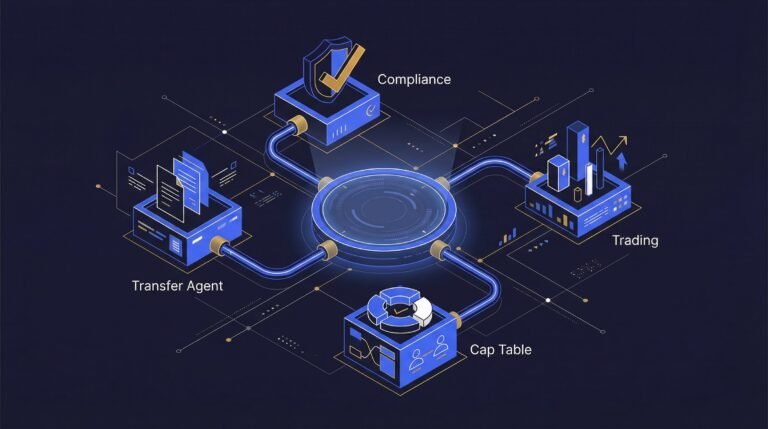
The economics of building and maintaining a digital asset platform naturally favor scale and integration. Platform consolidation tokenization trends emerged as a direct response to the fragmented state of the market. In previous years, an issuer might use one vendor for smart contract creation, another for KYC/AML onboarding, and a third for custody. This disjointed approach created unacceptable operational risks for major financial institutions. Recognizing this friction, dominant players began acquiring specialized firms to complete their service offerings. We saw broker-dealers acquiring alternative trading systems and tech providers buying licensed custodians. The goal was to create vertical monopolies where a single entity could capture fees at every stage of the asset lifecycle. This aggressive horizontal and vertical integration fundamentally altered the competitive dynamics, making it exceptionally difficult for single-feature startups to survive without a larger corporate sponsor.
Specific market share shifts illustrate the impact of these acquisitions. Companies that successfully navigated the regulatory labyrinth in multiple jurisdictions captured the majority of new issuance volume. For example, platforms holding both transfer agent licenses and broker-dealer registrations in the United States under SEC regulations became prime targets for acquisition or massive venture funding rounds. The market saw a concentration of power among the top five providers, who now facilitate an estimated 75 percent of all regulated security token offerings. This concentration mirrors traditional financial market infrastructure, where a handful of clearinghouses and depositories process the vast majority of global trades. Investors looking to understand how to invest in tokenized assets are increasingly interacting with interfaces powered by these consolidated mega-platforms, even if the front-end branding belongs to a traditional bank or wealth manager. A detailed Securitize review highlights how early regulatory compliance and strategic acquisitions allowed certain firms to dominate the private credit and real estate tokenization sectors.
Results from new platform launches
Despite heavy consolidation, new tokenization platforms launched in 2026 targeting specific asset classes and regional markets. These entrants bypassed generic issuance models to focus on high-yield private credit, carbon credits, and specialized real estate. Success required deep integration with existing banking infrastructure rather than standalone crypto networks.
The barrier to entry for generic tokenization infrastructure is now prohibitively high, but specialized niches remain open for innovation. The most successful new entrants over the past 12 months deliberately avoided competing with the established giants on broad asset issuance. Instead, they focused on highly specific asset classes that require specialized data or unique regulatory handling. We observed a surge in platforms dedicated entirely to renewable energy financing and carbon credit tokenization. These systems integrate directly with IoT sensors and climate data oracles to provide real-time verification of the underlying assets. By solving the specific pain points of a single industry, these new platforms secured dedicated user bases that the larger, generalized providers could not efficiently serve. This specialization strategy proved to be the only viable path for startups launching in an otherwise consolidated market.
Another distinct category of new platforms emerged directly from the traditional banking sector. Rather than relying on third-party vendors, several Tier 1 global banks launched proprietary tokenization engines built on private or permissioned blockchains. These bank-backed platforms are primarily used for internal collateral mobility, intraday repo transactions, and tokenizing traditional commercial paper. Because these institutions already possess the regulatory licenses, the client relationships, and the balance sheets required to scale, their platforms achieved massive transaction volumes almost immediately upon launch. This internal build trend poses a long-term threat to independent vendors. When evaluating the best tokenization platforms available today, institutional buyers now frequently compare external vendor solutions against the cost and security of developing proprietary systems using open-source blockchain frameworks. For traditional finance executives, understanding what is asset tokenization no longer means learning about public crypto networks, but rather mastering these institutional-grade ledger systems.
Lessons for the tokenized economy
The primary lesson from the 2026 market cycle is that regulatory licenses and distribution networks are more valuable than underlying blockchain technology. Tokenization platforms 2027 must offer immediate access to secondary market liquidity to survive. Technology has become commoditized, shifting the competitive advantage to legal frameworks and investor reach.
Analyzing the failures and successes of the past year reveals a clear pattern regarding platform viability. The platforms that failed consistently overestimated the value of their technical architecture while underestimating the difficulty of distribution. Building a smart contract engine to mint tokens is now a trivial engineering task. The actual challenge lies in convincing asset managers to list products and investors to buy them. The most sophisticated blockchain technology cannot compensate for a lack of broker-dealer licenses or an inability to integrate with traditional banking APIs. The platforms that thrived were those that treated tokenization as a financial engineering problem rather than a software engineering problem. They hired former regulators, built deep relationships with traditional custodians, and focused relentlessly on the legal enforceability of the digital assets they created under frameworks like SEC Rule 506(c) for private placements.
Looking forward through 2027, the focus shifts entirely to interoperability and secondary market liquidity. Issuing a token is only the first step; if that token cannot be used as collateral or traded efficiently, the tokenization process adds no real value. We expect to see the adoption of universal messaging standards, similar to SWIFT in traditional finance, that allow different tokenization platforms to communicate and settle transactions across disparate blockchain networks. Platforms that operate as walled gardens will likely face pressure from clients demanding cross-chain compatibility. As the industry standardizes, the terminology and mechanics will become less opaque. A comprehensive tokenization glossary today includes terms like cross-chain bridges and atomic settlement, concepts that will become standard operational procedures as the market matures. The ultimate winners in the tokenization platform landscape 2027 will be the entities that successfully bridge the gap between decentralized ledger technology and the rigid, heavily regulated world of global capital markets.
Key Compliance & Market Questions
What is driving the consolidation of tokenization platforms in 2027?
Consolidation is driven by institutional demand for end-to-end solutions and high regulatory compliance costs. Banks and asset managers prefer working with a single provider that can handle issuance, custody, and trading, forcing larger platforms to acquire niche technology providers to complete their service offerings.
Are new tokenization platforms still launching?
Yes, but successful new entrants are highly specialized. Rather than offering generic issuance services, new platforms focus on specific niches like carbon credits, renewable energy financing, or specific regional regulatory frameworks where they can outcompete generalized global platforms.
How much of the market do the top platforms control?
Industry estimates suggest the top five consolidated tokenization platforms now facilitate approximately 75 percent of all regulated security token offerings. This concentration mirrors traditional financial markets, where a few major clearinghouses process the vast majority of transaction volume.
Why are traditional banks building their own platforms?
Traditional banks are building proprietary platforms to maintain control over their data, leverage their existing regulatory licenses, and handle internal operations like collateral mobility and intraday repo transactions without paying fees to third-party blockchain vendors.