Tokenized Fixed Income Strategy: Bonds & Credit Guide
Fixed income is the bedrock of institutional portfolios, and it is now the fastest-growing sector in asset tokenization. By early 2026, the market for tokenized US Treasuries alone surpassed $2 billion in assets under management. Investors are shifting capital on-chain to capture yield while maintaining liquidity and composability within decentralized finance ecosystems. Developing a tokenized fixed income strategy requires understanding the distinct mechanics of blockchain-based debt instruments compared to traditional brokerage accounts. This guide examines market leaders like BlackRock and Franklin Templeton, structural risks associated with on-chain credit, and practical portfolio construction techniques. You will learn how to evaluate yields, manage duration risk, and assess the legal wrappers that protect digital bondholders.
The tokenized fixed income landscape and yield comparison
The tokenized fixed income market exceeds $2 billion in AUM, led by tokenized US Treasuries from major asset managers. BlackRock’s BUIDL and Franklin Templeton’s BENJI dominate the sovereign debt category, while platforms like Maple Finance and Centrifuge provide higher-yielding tokenized private credit and structured debt options.
BlackRock’s BUIDL leads the tokenized treasury sector with over $500 million in assets under management, offering institutional investors a stable on-chain yield. Franklin Templeton’s BENJI follows closely with more than $400 million, operating directly under the Investment Company Act of 1940 to provide regulatory familiarity. Ondo Finance’s OUSG captures approximately $250 million by feeding capital into traditional exchange-traded funds, while European issuers like Backed Finance offer tokenized versions of short-term bond ETFs for non-US investors. These products form the foundation of blockchain fixed income, providing a risk-free rate proxy on-chain that typically yields between 4.5% and 5.0% net of management fees in the current macroeconomic environment. Investors must weigh these yields against direct T-bill purchases yielding 5.0% to 5.25%, traditional money market funds at 4.8% to 5.1%, and high-yield savings accounts hovering around 4.5% to 5.0%.
Moving out the risk curve, tokenized private credit and structured debt offer substantial yield premiums over sovereign instruments. Maple Finance facilitates institutional direct lending pools where tokenized credit allocation yields range from 8% to 12%, depending on the borrower’s credit profile and the loan duration. Centrifuge operates tokenized receivables and structured credit pools, generating yields between 6% and 10% by financing real-world assets like trade invoices and real estate bridge loans. These higher returns compensate investors for assuming both the underlying borrower default risk and the illiquidity inherent in private debt markets. A comprehensive tokenized bonds investing guide details how these yield spreads fluctuate based on broader credit cycles and on-chain liquidity demands. Comparing these returns to traditional high-yield corporate bonds, which typically offer 7% to 10%, reveals that the tokenized premium is largely driven by capital efficiency rather than fundamental credit differences.
Strategic advantages of building a digital bond portfolio
Tokenized fixed income offers superior accessibility, 24/7 liquidity, and DeFi composability compared to traditional bonds. Investors can build diversified bond ladders with lower capital minimums, instantly trade positions outside standard market hours, and use tokenized debt as collateral across various decentralized financial protocols.
The primary structural advantage of tokenized fixed income lies in its radical reduction of investment minimums and friction. Traditional direct bond purchases often require $100,000 to $250,000 per CUSIP to achieve favorable pricing, effectively locking retail and smaller institutional investors out of custom portfolio construction. Tokenized platforms lower these barriers dramatically, allowing allocations ranging from $100 to $5,000 depending on the specific product and regulatory jurisdiction. This accessibility enables precise portfolio engineering, such as constructing a digital bond portfolio with staggered maturities to mitigate interest rate risk. Liquidity also improves significantly, as tokenized assets settle nearly instantly on public ledgers rather than relying on the traditional T+1 or T+2 settlement cycles that trap capital in clearinghouses. Furthermore, composability allows investors to deploy their tokenized debt as collateral in decentralized lending markets, unlocking capital efficiency that remains impossible within isolated legacy brokerage accounts.
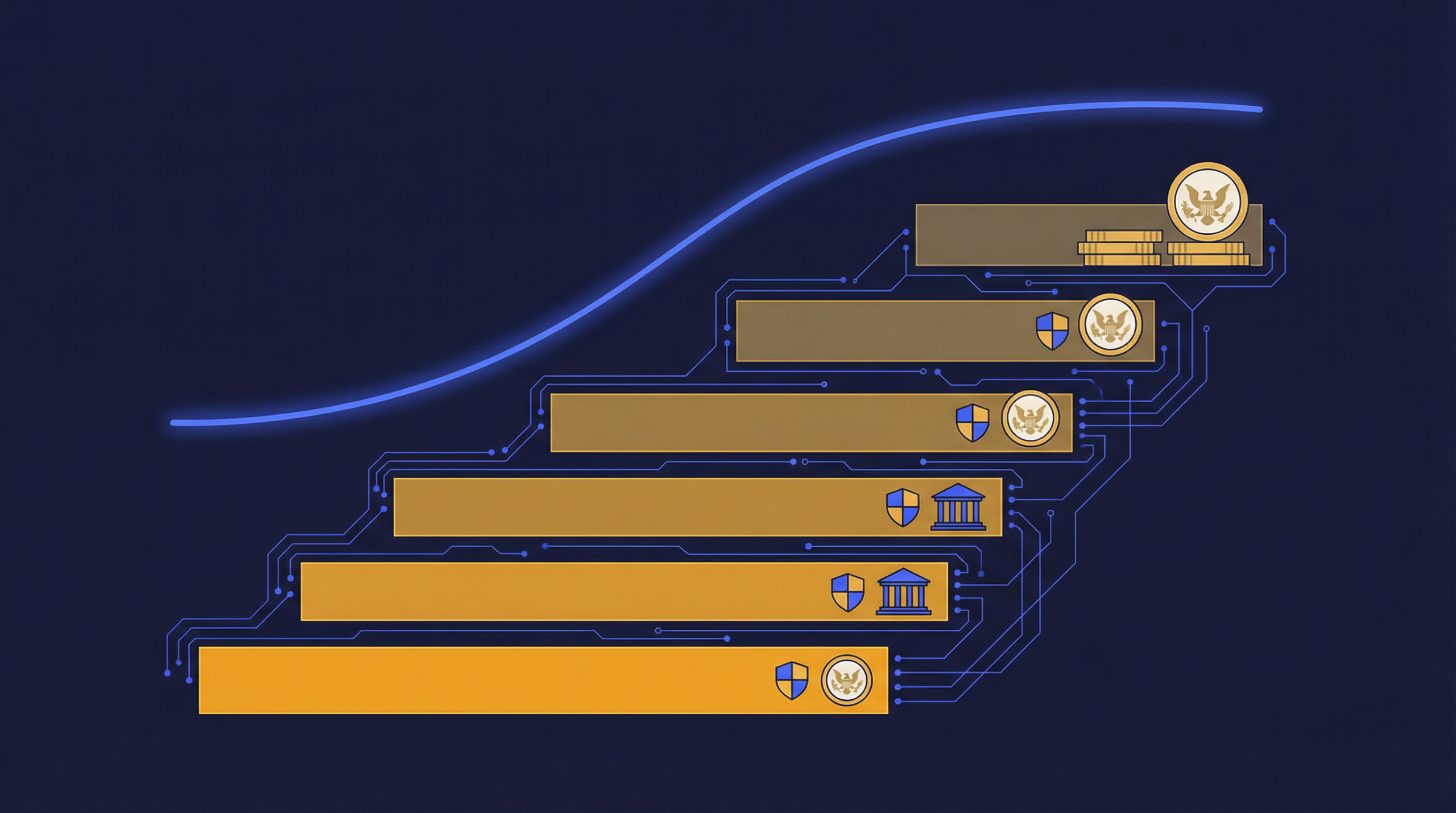
Constructing a tokenized fixed income ladder applies traditional staggered maturity strategies to blockchain-based instruments. An investor allocating $10,000 could divide their capital across five distinct duration and credit tiers to balance yield and liquidity. The foundation might consist of $2,000 in short-term tokenized treasuries like Ondo’s OUSG, capturing the baseline 0-3 month risk-free rate while maintaining near-instant liquidity. The next rung could allocate $2,000 to medium-term tokenized bonds with a 6-12 month duration, locking in yields before potential central bank rate cuts. Moving up the ladder, $2,000 could fund longer-duration tokenized corporate debt, while $2,000 targets tokenized private credit via platforms like Maple Finance for 3-12 month loans. The final $2,000 might pursue yield pickup through tokenized structured credit on Centrifuge, financing real-world asset pools. Managing this ladder requires monitoring the how to invest in tokenized assets ecosystem for new product launches that fill specific duration gaps, as the current market remains heavily skewed toward short-term instruments.
Duration management and credit analysis for tokenized assets
Managing duration risk in tokenized portfolios requires navigating a market dominated by short-term instruments. Investors evaluate credit risk by analyzing on-chain reserve proofs for treasuries, assessing corporate issuer fundamentals, and reviewing pool-level underwriting data for private credit platforms like Maple and Centrifuge.
Duration management remains a complex challenge for investors building a tokenized treasuries strategy, as the current product landscape heavily favors the short end of the yield curve. Most tokenized government debt products target the 0-3 month maturity bracket, which effectively neutralizes interest rate risk but limits potential capital appreciation during a declining rate cycle. Investors seeking to extend duration must actively seek out newly issued tokenized medium-term notes or utilize decentralized finance derivatives to synthesize longer exposures. Platforms like Pendle Finance facilitate tokenized yield trading, allowing investors to strip the yield from the principal of yield-bearing tokens and lock in fixed rates for specific durations. By purchasing fixed-yield tokens on Pendle, an investor can effectively lengthen their portfolio duration and hedge against falling interest rates without needing underlying long-term bonds to be tokenized. This advanced interest rate management requires deep familiarity with smart contract mechanics and the specific tokenization glossary terms associated with yield stripping protocols.
Thorough credit analysis is non-negotiable when moving beyond sovereign debt into tokenized corporate and private credit. For tokenized government bonds, the primary credit check involves verifying that the underlying assets are held by a regulated custodian and confirming the daily net asset value calculation methodology through independent oracle networks. When evaluating tokenized corporate bonds, investors must apply traditional fundamental analysis to the issuer’s credit rating, balance sheet health, and historical default probabilities, exactly as they would in legacy markets. Tokenized private credit demands an even more rigorous approach, focusing on the specific borrower pools, the underwriter’s historical performance, and the structural protections built into the smart contracts. Both Centrifuge and Maple Finance publish granular pool-level data detailing asset composition, historical default rates, and recovery statistics that investors must scrutinize before allocating capital. Understanding these credit dynamics is essential for accurately pricing risk and avoiding the assumption that all blockchain-based debt carries the same safety profile as tokenized treasuries BlackRock BUIDL.
Platform risk and legal structures protecting investors
Tokenized fixed income introduces platform counterparty risk alongside traditional credit risk. Legal structures determine investor protection in bankruptcy scenarios, with BlackRock’s BUIDL utilizing a bankruptcy-remote BVI SPV, Ondo’s OUSG using a Cayman feeder fund, and Franklin Templeton’s BENJI operating under the US Investment Company Act of 1940.
The integration of blockchain technology introduces distinct platform and counterparty risks that sit entirely separate from the underlying bond issuer’s creditworthiness. If the entity responsible for tokenizing the asset faces insolvency, the legal wrapper surrounding the tokenized bonds dictates whether investors can recover their underlying assets or if they become unsecured creditors. Most institutional-grade platforms utilize bankruptcy-remote special purpose vehicles to isolate the bond assets from the operating company’s balance sheet. BlackRock’s BUIDL fund operates through a British Virgin Islands special purpose vehicle, establishing a clear legal firewall that protects token holders if the issuing entity or the tokenization platform faces financial distress. Similarly, Ondo Finance structures its OUSG product as a Cayman Islands feeder fund, routing capital into underlying exchange-traded funds while maintaining legal separation from Ondo’s corporate operations. Understanding these distinct legal frameworks is critical when assessing tokenized asset risks across different jurisdictions.
Regulatory compliance and legal standing heavily influence how these tokenized instruments perform during stress events. Franklin Templeton takes a different structural approach with its BENJI fund, operating directly under the strict regulatory framework of the US Investment Company Act of 1940. This structure provides investors with the highest level of regulatory familiarity and oversight, though it often comes with stricter onboarding requirements and geographic restrictions. When evaluating a platform, investors must review the specific legal documentation to confirm their status as secured creditors with direct claims on the underlying assets. A comprehensive Securitize platform review often highlights how transfer agents manage the cap table and facilitate redemptions if the primary trading interfaces go offline. Ultimately, a robust tokenized fixed income strategy requires balancing the pursuit of on-chain yield with a rigorous assessment of the legal wrappers that secure the digital claims.
The transition of fixed income markets to blockchain infrastructure represents a fundamental upgrade to global capital plumbing rather than a speculative trend. With over $2 billion currently deployed in tokenized sovereign debt and hundreds of millions more in private credit, the infrastructure now supports institutional-scale allocations. Investors constructing a digital debt portfolio must carefully balance the liquidity advantages of on-chain treasuries against the higher yields and elevated risks of tokenized direct lending. Success requires rigorous due diligence combining traditional credit analysis with an understanding of smart contract architecture and legal special purpose vehicles. As the product landscape expands to include longer-duration instruments and more complex credit tranches, a disciplined tokenized fixed income strategy will become an essential component of modern portfolio management.
Frequently Asked Questions
What is the yield on tokenized US Treasuries?
Tokenized US Treasuries typically yield between 4.5% and 5.0% net of management fees in current market conditions. These products track the risk-free rate of short-term government debt while offering the added benefits of blockchain settlement and decentralized finance composability.
How do you manage interest rate risk in tokenized bonds?
Investors manage interest rate risk by building a bond ladder with staggered maturities or using yield-trading protocols. Because most tokenized bonds are short-duration, platforms like Pendle Finance allow investors to trade yield separately from principal to hedge against falling interest rates.
Are tokenized bonds safe if the platform goes bankrupt?
Safety depends entirely on the legal structure of the tokenization platform. Institutional products like BlackRock’s BUIDL use bankruptcy-remote special purpose vehicles to ensure that the underlying assets remain protected and accessible to token holders even if the operating company fails.
What is the difference between tokenized treasuries and tokenized private credit?
Tokenized treasuries represent government-backed debt with low risk and lower yields, while tokenized private credit involves lending to corporate borrowers for higher returns. Private credit platforms like Maple Finance offer yields of 8% to 12% but carry higher default and liquidity risks.
Sources
- [1] Tokenized Treasury Market Nears $2 Billion AUM
- [2] BlackRock USD Institutional Digital Liquidity Fund (BUIDL) Prospectus
- [3] Franklin OnChain U.S. Government Money Fund (BENJI) N-1A Filing
- [4] Ondo Finance OUSG Legal Structure and Feeder Fund Mechanics
- [5] Institutional Yield and Default Metrics in Tokenized Private Credit