Tokenized Treasuries Update Q2 2026: AUM and Yield Data
The tokenized treasuries update Q2 2026 reveals a maturing sector where institutional capital continues to migrate on-chain at a measured, predictable pace. Investors are moving beyond initial proof-of-concept allocations and treating tokenized government debt as a standard cash management tool within their broader portfolios. High interest rates have sustained demand for low-risk yield instruments across both traditional finance and decentralized ecosystems. Market participants now evaluate these digital assets based on operational efficiency, secondary market liquidity, and integration capabilities rather than novelty. The second quarter of 2026 provided clear data on how the largest asset managers are capturing market share and how decentralized finance protocols are utilizing these regulated products as base-layer collateral.
Tracking the performance of these funds requires looking past marketing claims and examining actual blockchain flows. The landscape is currently dominated by a few major financial institutions that have successfully navigated the regulatory requirements for issuing digital securities to qualified purchasers. Smaller issuers continue to launch niche products, but liquidity is consolidating around the established market leaders. Understanding the mechanics of how these products generate yield, handle redemptions, and interact with smart contracts provides a clear picture of where institutional decentralized finance is heading over the next several years. Readers looking to understand the mechanics of market entry can review our guide on how to invest in tokenized assets for specific onboarding requirements.
Total market size and yield environment in Q2 2026
The total market size for tokenized treasuries reached approximately $2.2 billion in Q2 2026, according to data from rwa.xyz. Tokenized treasury yields Q2 averaged 4.95%, closely tracking traditional money market funds while offering superior settlement speed and composability within decentralized finance ecosystems.
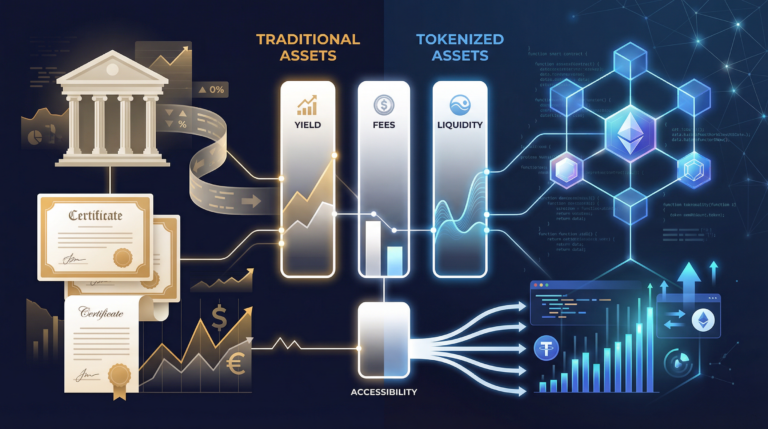
The macroeconomic environment throughout the second quarter of 2026 maintained a relatively stable interest rate profile, which kept demand for short-duration government debt consistently high. Traditional money market funds yielded approximately 5.10% during this period, according to Crane Data reports published in June 2026. Tokenized equivalents offered slightly lower nominal yields after accounting for management fees and smart contract operational costs. Investors accepted this minor yield compression because the on-chain products provided atomic settlement and immediate collateral utility that traditional broker-dealer accounts cannot offer. The ability to move multi-million dollar positions over the weekend or outside of standard banking hours has become a primary driver for adoption among crypto-native trading firms and international corporate treasuries.
Market capitalization growth in this sector has shifted from explosive retail adoption to steady institutional accumulation. The $2.2 billion total value locked represents capital that has passed through strict Know Your Customer and Anti-Money Laundering verification processes. This capital is generally sticky, meaning it remains deployed in the smart contracts for extended durations rather than actively trading across decentralized exchanges. The infrastructure supporting these assets has also matured significantly over the past two years. Custody providers, blockchain analytics firms, and tokenization platforms have built robust reporting tools that satisfy the compliance requirements of large asset managers. Investors familiarizing themselves with these infrastructure components often reference a comprehensive tokenization glossary to understand the technical distinctions between different issuance models.
Secondary market liquidity remains a focal point for institutional investors evaluating these products. While primary issuance and redemption processes are highly efficient, the ability to trade these tokens directly with other verified counterparties without returning to the issuer provides crucial flexibility. Several platforms have established permissioned liquidity pools that allow qualified investors to swap different tokenized treasury products instantly. These pools rely on market makers who arbitrage small price discrepancies between the tokenized assets and the underlying traditional bonds. The volume in these permissioned secondary markets grew steadily throughout Q2 2026, indicating that the market structure is evolving to support more complex trading strategies and automated treasury management protocols.
BlackRock BUIDL and Franklin Templeton BENJI performance
BlackRock’s BUIDL fund maintained its market dominance in Q2 2026 with an estimated $850 million in assets under management. Franklin Templeton’s BENJI followed closely with approximately $480 million. Both funds demonstrated consistent subscription flows from crypto-native treasuries and institutional investors seeking on-chain yield.
The BUIDL fund update Q2 shows that BlackRock has successfully cemented its position as the preferred cash management vehicle for large decentralized autonomous organizations and crypto venture funds. According to SEC Edgar database filings and on-chain metrics from Etherscan, the BlackRock USD Institutional Digital Liquidity Fund experienced net inflows of approximately $120 million during the quarter. The fund maintains a strict $5 million minimum investment threshold, which naturally filters the client base to institutional participants. By partnering with specific technology providers, the tokenized treasuries BlackRock BUIDL ecosystem has created a seamless pipeline for converting fiat currency into yielding on-chain assets. Investors can analyze the specific technical architecture of the platform by reading our detailed Securitize review, which covers the issuance mechanics and compliance engine powering the fund.
Franklin Templeton’s BENJI token took a different strategic approach by expanding its presence across multiple blockchain networks. While the BlackRock BUIDL fund remained heavily concentrated on the Ethereum mainnet, Franklin Templeton deployed BENJI on Stellar, Polygon, Arbitrum, and several other layer-two scaling solutions. This multichain strategy allowed BENJI to capture retail and lower-tier institutional capital that is sensitive to Ethereum’s transaction fees. The fund’s $480 million in assets under management is distributed across a much larger number of individual wallets compared to BUIDL. Franklin Templeton also integrated its proprietary Benji Investments application directly with traditional brokerage accounts, creating a hybrid user experience that appeals to investors who are hesitant to manage their own private keys.
The competitive dynamics between these two industry leaders dictate the broader market trends for tokenized government debt. BlackRock relies on its massive institutional relationships and the sheer scale of its traditional asset management business to drive adoption. Franklin Templeton leverages technological agility and broader retail access to build its user base. Both funds distribute dividends daily by airdropping additional tokens directly into investor wallets, which simplifies accounting and compounding for the end user. This daily distribution model has become the standard expectation for any new product entering the market. The success of these two funds has prompted several other traditional financial institutions to announce their own tokenized treasury initiatives, though most remain in the testing phase as of Q2 2026.
Ondo Finance and DeFi integration developments
Ondo Finance expanded its market share in Q2 2026, with its USDY and OUSG products collectively capturing over $400 million in total value locked. These government bond tokens Q2 saw increased utility as collateral across major decentralized lending protocols, driving secondary market liquidity.
Ondo Finance operates differently from traditional asset managers by structuring its products specifically for decentralized finance integration. The OUSG token functions as a wrapper for BlackRock’s traditional short-term treasury ETF, bringing that exposure on-chain for qualified purchasers. USDY operates as a tokenized note secured by short-term US treasuries and bank demand deposits, available to non-US investors. During the second quarter of 2026, Ondo focused heavily on integrating these assets into major lending markets like Aave and Compound. By allowing users to post USDY as collateral to borrow stablecoins, Ondo created a capital-efficient loop where investors can earn the underlying treasury yield while maintaining liquid capital for other trading activities. This specific utility drives demand beyond simple cash management.
Maple Finance also demonstrated strong performance in Q2 2026 through its cash management pools. Maple provides infrastructure for institutional credit, and its treasury pools allow accredited investors to access yield generated from short-duration US Treasury bills. According to 21.co’s State of Tokenization Q2 2026 report, Maple’s cash management products maintained approximately $150 million in active deposits. The platform appeals to corporate treasuries that require segregated accounts and highly customizable reporting features. Maple’s legal structure involves special purpose vehicles that hold the underlying assets, providing bankruptcy remoteness and clear legal recourse for token holders. This structural clarity is essential for corporate compliance departments evaluating tokenized bonds investing opportunities.
The integration of tokenized treasuries into decentralized finance protocols represents the most significant technical advancement of Q2 2026. Developers are building automated smart contracts that sweep idle stablecoin balances into tokenized treasuries to optimize yield. These automated yield aggregators manage the minting and redemption processes behind the scenes, providing end users with a frictionless experience. As these integrations become more reliable, the distinction between a stablecoin and a tokenized treasury will continue to blur. Users expect their on-chain cash equivalents to generate a baseline yield automatically, and protocols that fail to offer this feature are losing market share to those that integrate products like USDY or BUIDL directly into their treasury operations.
Subscription flows and institutional adoption trends
Net inflows into tokenized treasury products exceeded $300 million during the second quarter of 2026. Institutional investors drove the majority of these subscription flows, utilizing platforms that offer instant minting and redemption capabilities to manage weekend liquidity and cross-border cash positions.
The mechanics of subscription and redemption have improved drastically, reducing the friction that previously deterred traditional financial firms from participating. In earlier years, redeeming a tokenized treasury for fiat currency could take several business days and required manual intervention from the issuer. By Q2 2026, major platforms implemented automated redemption facilities utilizing stablecoin liquidity pools. Institutional clients can now burn their treasury tokens and receive USDC or other regulated stablecoins within minutes, 24 hours a day. This immediate liquidity profile fundamentally changes how trading firms manage their weekend risk. Instead of holding unyielding cash over the weekend when traditional banking rails are closed, firms deploy capital into tokenized treasuries on Friday afternoon and redeem them on Sunday evening before the Asian market open.
Regulatory clarity continues to shape the geographic distribution of these subscription flows. The majority of tokenized treasury products operate under Regulation D for US accredited investors or Regulation S for international participants. European adoption accelerated in Q2 2026 as firms gained comfort with the regulatory frameworks established by the Markets in Crypto-Assets regulation. Asian markets, particularly family offices based in Singapore and Hong Kong, accounted for a significant portion of the Regulation S subscription flows. These international investors utilize tokenized treasuries to gain exposure to US dollar yields without navigating the complex correspondent banking system. The tokens provide a direct, verifiable claim on the underlying assets without relying on multiple intermediaries.
The competitive landscape is forcing issuers to compress their management fees to attract large institutional mandates. While early products charged management fees ranging from 30 to 50 basis points, the industry average trended toward 15 to 25 basis points by the end of Q2 2026. Issuers are absorbing these lower margins to build assets under management, anticipating that scale will eventually generate substantial revenue. They are also exploring ancillary revenue streams, such as charging fees for instant redemption facilities or offering premium data reporting services. The tokenized treasuries update Q2 2026 confirms that this asset class is no longer an experimental niche. It is a highly competitive, rapidly institutionalizing sector that forms the foundational yield layer for the next generation of digital capital markets.
Frequently Asked Questions
What was the total market size of tokenized treasuries in Q2 2026?
The total market capitalization for tokenized US treasuries reached approximately $2.2 billion in Q2 2026. This figure represents steady institutional accumulation and is dominated by major funds from BlackRock and Franklin Templeton.
How did BlackRock’s BUIDL fund perform in the second quarter?
BlackRock’s BUIDL fund maintained its position as the market leader with an estimated $850 million in assets under management. The fund experienced consistent net inflows from crypto-native treasuries and institutional investors.
What yields are tokenized treasuries offering compared to traditional funds?
Tokenized treasury products averaged a 4.95% yield during Q2 2026. This is slightly lower than the 5.10% offered by traditional money market funds, with the difference accounting for management fees and smart contract operational costs.
How are decentralized finance protocols using government bond tokens?
DeFi protocols are increasingly integrating tokens like Ondo’s USDY as base-layer collateral in lending markets. This allows investors to earn the underlying treasury yield while using the asset to borrow stablecoins for other trading activities.